Llanelli Naturalists Newsletter - September 1984
Shelagh Seery
The reason for this article is to draw attention to the lack of recorded information on mammals, reptiles and amphibians in Carmarthenshire. In order to fill this gap I am asking for your help in up-dating both our county records and ultimately those held at the Biological Records Centre at Monks Wood.
A provisional atlas of Mammals in the British Isles published in 1978 by the BRI highlighted the lack of recording in Carmarthenshire. Last year saw the publication of Distribution Maps of the Amphibians and Reptiles of the British Isles. The Editor, Mr. Henry R. Arnold, points out that many species are badly under-record¬ed and the maps have been published as a final stimulus to recorders, before the present recording scheme ends in 1985 and final maps are published, probably in 1986. As this no doubt means mammals as well as herptiles (the composite name for amphibians and reptiles) it does not give us long to collate all our information and send it on to Monks Wood.
The BRC maps give information based on 10 km squares. I have endeavoured to convey this onto a stencil, with an example of a mammal (hedgehog) and reptile (slow worm), however, I will be making up records based on 2 km squares in due course, and these will need to be reproduced photographically. If possible six figure map references should be provided for even more detailed recording.
Records can only be collated from information received; it is up to all of us to play our part in noting observations before they are forgotten, recording them on something toot will not get mislaid, and forwarding these notes to the County Recorder at regular intervals, I have provided report forms, but it is not essential to use them - just the information is essential!
Mammal and herptile observation as far as I am concerned is a matter of luck rather than good management. Yesterday I dislodged a large stone from the bank by my cottage. To my surprise I had disturbed a slow-worm, that slowly collected its wits after such rude intrusion into its privacy, and after knotting and unknotting itself several times retired further into the bank. Having lived here for well nigh fifteen years without seeing any sign of a reptile I was thrilled to be able to add my observation to the records, the only one in my 10 km square. I was also glad that I had a good identification book handy so I could be sure of what I had seen. As these records are to be published nationally they must be correct. If an observation is doubtful it should be recorded as such; further observations may confirm or disprove the initial report.
Cats, presenting their trophies to their admiring owners, can be of considerable assistance to the recorder of small mammals. Only two 10 km squares in the 1977 map indicate the presence of the house mouse - surely we recorders and our cats can do better than this. No water voles at all were recorded; however, by now they may have been ousted by mink, which are steadily spreading through the county via waterways. Mink can cause a lot of damage to poultry, but are easy to catch in cage traps which can be borrowed from Welsh Office Agricultural Department, Picton Terrace, Carmarthen. These are safe to use as it is possible to release any animal caught inadvertently. Unfortunately I am told the pelt of wild mink in this country is not much good for a fur coat! It is a great shame that these beautiful animals are such a pest - this is what can so easily happen when an animal is introduced into a country - like the grey squirrel here and the rabbit in Australia. The mink can be easily distinguished from the polecat, which is native to this country, and keeps itself to itself. Mink fur is all one colour, apart from a light coloured bib. The fur of a polecat is dark on the outside and light closer to the body, and it has light markings round its muzzle, eyes and ears. A dead polecat was seen recently near rive Roads, and mink have been seen on the Gwendraeth Fawr from Kidwelly to Tumble. ((And Adrian Hughes informs us of a definite polecat seen in a recent year very near to Llangennech Ed.))
Otters are alive and well in Carmarthenshire - in fact a young one was caught in a mink cage trap near St. Clears, and was released safely and unharmed and unconcerned! This must have been a great thrill for those involved, as otters are very elusive and very seldom seen. Evidence for the presence of otters is usually their 'spraints' which they deposit to denote their territory. These spraints are laid on a prominent stone, or on a shelf under a bridge – somewhere where the next otter will come across it. It looks like a large black bird dropping, but on closer examination it is soon to contain fish scales, tiny bones and possibly fur, depending on the diet for the day. It has a characteristic smell, rather nice and spicy, unlike the mink spraint which spells fishy.
I have just touched on a very few of the many vertebrates found in the county - I am looking forward to hearing from you now, with reports for the atlas, or just reports of interesting or unusual happenings. In duo course the atlas will be published, but its success will depend on all the contributors of information, and that means YOU.
| Hedghog | x | Bat, Lesser Horsehoe | o | Squirrel, Red | |
| Mole | x | Bat, Mouse Eared | o | Squirrel, Grey | x |
| Shrew, Common | x | Bat, Whiskered | x | ||
| Shrew, Pigmy | x | Noctule | x | ||
| Shrew, Water | x | Pipistralle | x | ||
| Bat, Long Eared | x | ||||
| Martin, Pine | o | Dormouse | x | Rabbit | x |
| Polecat | x | Vole, Bank | x | Hare | x |
| Weasel | x | Vole, Water | x | ||
| Stoat | x | Vole, Short-tailed | |||
| Badger | x | Mouse, Harvest | o | Seal, Grey | x |
| Otter | Mouse, Yellow-necked | o | Dolphin | ||
| Woodmouse or Long-tailed Mouse | x | ||||
| Fox | x | Mouse, House | |||
| Rat, Brown | x | ||||
| Adder | x | Slow Worm | x | Frog, Common | x |
| Snake, Smooth | o | Lizard, Common | x | Frog, Edible | o |
| Snake, Grass | x | Lizard, Sand | x | Frog, Marsh | o |
| Newt, Smooth | x | Toad, Common | x | ||
| Newt, Palmate | x | Toad, Natterjack | o | ||
| Newt, Great Crested | x? |
The list above shows mammals and herptiles found in the British Isles. I have had no report of those marked o. Those marked x have been reported to me from the Llanelli area. I would like to have a lot more reports, over the whole area, so we can get a good idea of the distribution.
Llanelli Naturalists members can all help by sending in any mammal, reptile or amphibian record(s) either to the author of the above article or to the Secretary or Editor of the Llanelli Naturalists given records of common species such as rat, rabbit, hedgehog, frog or toad are lacking in many parts of Carmarthenshire, - so all will be gratefully received'. As suggested also, the victims of your cat's depredations can prove interesting as our cat has brought all three shrew species as well as regrettably exterminating our rockery's slow worms population. A reliable book is the Collins 'Field Guide to the Mammals of Britain and Europe' by F.H van den Brink.
Each square is a 10 km square.
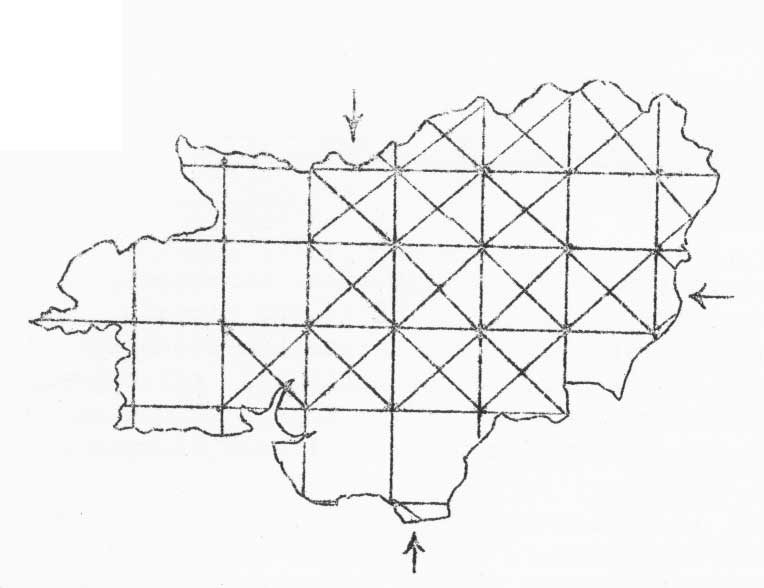
1. Hedgehog: Records taken from the ‘Provisional Atlas of Mammals of the British Isles’ 1978.
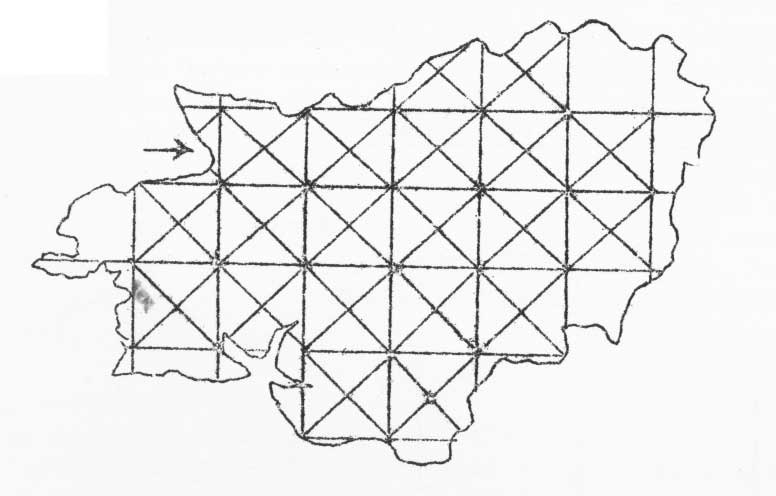
2. Hedgehog Records compiled by Carmarthenshire Mammal Recorder 1980-1984)
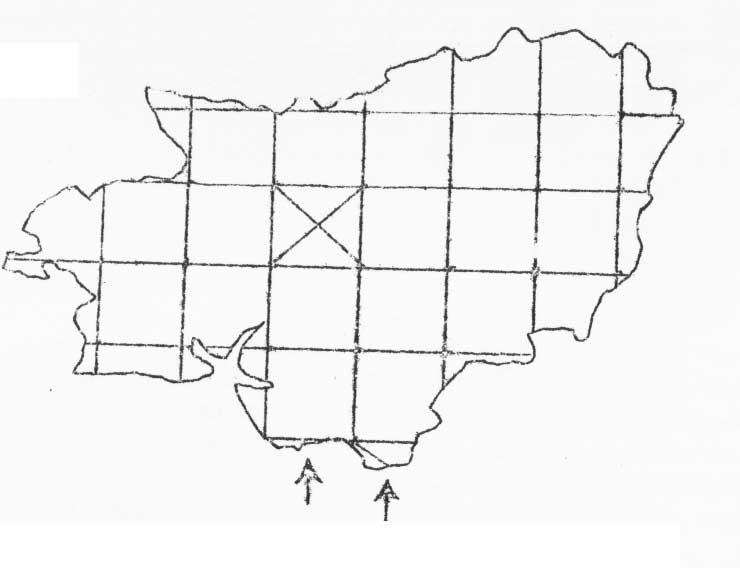
3. Slow worm: Records from the 'Provisional Atlas of the Amphibians and Reptiles of the British Isles' 1983
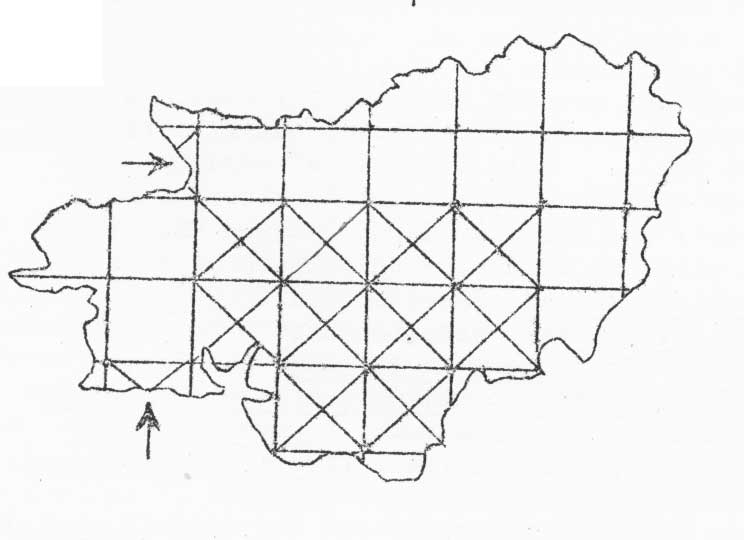
4. Slow Worm: Records compiled by Carmarthenshire Mammal Recorder 1980-1984
