 Llanelli Naturalists Newsletter - Winter 1990/1991
N.H. Mathew
Bats comprise the second largest mammal group (after rodents) in the world and this picture is reflected in their status in the British Isles where, with 15 resident species, they are in fact the largest group although of course, not existing in anything like the same numbers as mice, voles, rabbits, etc. They are generally widespread in the country but there are areas such as those that have intensive agriculture where they are very few if not entirely absent, due to the lack of their requirements - good roosting sites and feeding areas. Roost sites in this country are usually in buildings, e.g. houses and churches, or trees. Favoured feeding sites are at present the subject of the nationwide 'Bats and Habitats Survey' but it is fair to say that these are areas with the most insects and so unimproved grassland, wetland habitats including ponds and rivers, and above all deciduous trees and hedgerows are the most important.
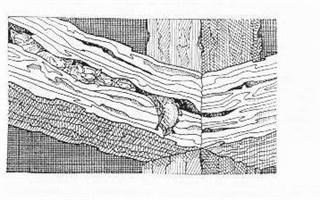
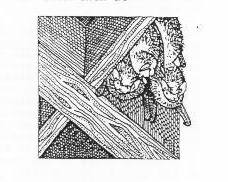
However widespread and often seen bats may be, they are rarely observed at close quarters. "Close encounters" usually occur in the breeding season at the height of summer when, sometimes, quite large groups of females assemble in houses. Here they usually keep to themselves, but young bats in particular can often get lost and wander into the human living quarters. People often find themselves with a "bat problem" when, planning roof repairs or timber treatment, they find they have a colony of bats. Because of the full protection given to bats by the 1981 Wildlife and Countryside Act, notification of the presence of bats in such circumstances must be given to the Nature Conservancy Council. In the 1980s most of the Bat Groups which not exist up and down the country came into being, one of their prime functions being to take on some of the workload of the N.C.C. occasioned by the Act. Members are able to visit houses with bat colonies and offer advice to owners. Apart from this Bat Groups undertake a wide variety of other tasks, e.g. finding and monitoring nursery colonies, surveying hibernation sites (for which a licence is needed), making and putting up bat boxes in well chosen sites, making contact with the general public at various venues such as agricultural shows etc and hence finding out more about bats in their area. A concern for bats automatically leads one into the whole field of conservation as they depend on the continued existence of good wildlife habitats.
A Bat Group was formed in Carmarthen in 1985 but after two or three years became somewhat moribund. It was relaunched again in August of this year (1990) and hopes to expand by attracting more members. There is much that a group can do in this county: there is a lot to be found out and explored as many species are under-recorded in Carmarthenshire and some such as the Lesser Horseshoe Rhinolophus hipposideros (which occurs in neighbouring counties) and the Leisler's Nyctalus leisleri are as yet unrecorded.
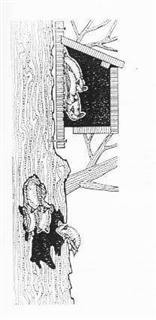 As for the bats we do have Pipistrelles Pipistrellus pipistrellus are, of course, by far the commonest and most roosts found in houses are of this or of the second commonest species, the Brown Long-eared bat Plecotus auritus. Another bat which is probably familiar to most people is the Noctule, Nyctalus noctula a large bat which is seen flying high over fields in the early evening, sometimes in the company of swifts. However, roosts of noctules are notoriously difficult to find. They live for the most part in holes in trees, such as old woodpecker holes, and are usually stumbled upon by accident when Loud squeakings and chatterings can be heard coming from inside a tree on warm summer evenings. I found one myself in this way at Derwydd (SN61-17) in 1989 where at least 12 noctules were flying In and out of a natural hole near the top of an ash tree. However, after two weeks they had gone - another characteristic of this species is the frequent change of roost site. The availability, therefore, of many roost sites is very important to them which means they are most likely to be found in areas with a relative abundance of mature broadleaved trees. I wasn't able to learn much about this Derwydd colony: was it a nursery colony or, perhaps more likely, a group of males? This year, they were evidently using another site as first the hole was used by a pair of starlings and subsequently platered up and used by nuthatches. There is great competition for tree holes!
Other species which seem to be particularly attracted to deciduous woodland are the Whiskered Myotis mystacinus and Brandt's M. brandti bats. It is quite difficult to separate them from the pipistrelle in flight and impossible to distinguish between the two except when examined in the hand. The whiskered bat sometimes uses houses for its nursery colonies but I don't know what the position is in this county. The Natterer's bat M. natteri also seems to rely on broadleaved trees and hedgerows for feeding. It is worth looking for the presence of their colonies in churches: it is possible to distinguish bats by examining their droppings! Daubenton's bat M. daubentoni is nearly always found near or over rivers and ponds where its mode of hunting like a mini-hovercraft a few inches above the water surface is diagnostic. Tree holes, bridges and buildings are all important for this species. Some bat groups undertake bridge surveys in their county: it is important that crevices in the stonework are left open even if they are only used as temporary night roosts or perches.
Not much is really known of the occurrence of the Serotine Eptesicus serotinus in the county, it is mostly found in the south and east of England. Look out for a bat the size of a noctule but with different-shaped wings (much broader) and with a slower flight beating up and down hedgerows or treelines. I might have seen one once in Carmarthenshire! Another bat that occurs in our county is the Greater Horseshoe Rhinolophus ferrum-equinum, a species that has declined by as much as 99% since the early 1900s, and which no longer lives in about half of the previously occupied range; it favours open deciduous woodland with old pasture for feeding as such areas are more productive of the preferred large insect prey such as cockchafers Melolontha melolontha. (Stubbings, 1989). It probably only hibernates here, but one can always dream of finding a nursery colony! Individuals that are found are likely to come from out of the nursery colonies in Pembrokeshire. This species undertakes many journeys during the course of a year, but for hibernation it often returns to the same site and an individual can be found in the same cave or tunnel year after year.
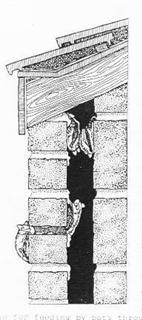 This leads me on to say something about hibernation sites. Some bats hibernate in trees and buildings. The pipistrelle for instance is thought of secrete itself deep inside stone or cavity walls - it is hardly ever found in caves or old mining adits. Such sites are important for a number of our species, e.g. Whiskered, Daubenton's, Natterer's, Long-eared, Greater and Lesser Horseshoes. Each bat has its own temperature requirement and seeks out its own position in a cave or tunnel accordingly, sites usually with a relatively high humidity. In Carmarthenshire these underground sites are mainly of two kinds: various disused lead or coal mines scattered around and natural caves found in the carboniferous limestone belt which runs across the county from Mynydd Du down towards the coast at Kidwelly. This belt, narrow as it is, is a particularly important wildlife resource, and it was felt that, particularly in view of the likely increase in applications to quarry limestone in the future, more should be known at least about the use of it by bats in the winter. with this in mind a survey was organized last winter by Tom McOwat and a group of bat enthusiasts, and cavers, went out over a number of weekends to visit the caves and record any bats found. This work I should stress was done under a licence from the N.C.C. It is hoped to continue the survey this winter but in the meantime it would be of great interest to receive any information anyone might have about bats using this area, both personal observation and anecdotal information would be welcomed, whether recent or in the more distant past. It is likely too that the associated old limekilns are important for hibernating bats. The Forestry Commission has recently carried out an initiative at Pembrey Forest, namely the adaption of some of the old ammunition bunkers for use by hibernating bats. The bat group hopes to have a visit there soon to look at the work that has been done.
A survey that anyone with an interest in bats can take part in is the 'Bats and Habitats Survey', which is an attempt to establish a baseline of information about the different habitats that are used for feeding by bats throughout the county. It is a fairly simply survey: all you nave to do is to walk a transect route through each half of a kilometre square on four evenings during the summer, recording on a map wherever you see or hear a bat (you do need a bat detector for this). The results can then be viewed the light of habitat data which are recorded on a separate map.
 If there are people with any information or queries about bats or the bat group, I would be very pleased to hear from them at
Ffairfach, Llandeilo,
Reference:
Stubbings, R.E. (1989): Conservation of the Greater Horseshoe Bat. British Wildlife, Vol 1., Nol, Oct 1989.
