 Llanelli Naturalists Newsletter - November 2005 - No 72
George Hutchinson
The purpose of this meeting was to monitor the changes in biodiversity resulting from the continuing developments in this part of the town. Members met at the top of the road along the west side of the North Dock (SS497996). Despite an uncomfortably cold south-easterly breeze with the overcast sky threatening rain, it remained dry but when shelter from the wind came it was always welcome.
Initially a transect was made from the shoreline of the dock westwards to the beach. The thin gravelly dock shore had recently been subject to the high equinoctial tides which meant that some plants had been washed away. With the tide on the turn, Buck’s-horn Plantain (Plantago coronopus) was very evident in various guises of toothed rosette leaves and with a few in seed. The small, yellow composite of the season, Autumn Hawkbit (Leontodon autumnalis), was finally blooming. Three weeks earlier, the yellow colour was supplied by the second flowering of Smooth Hawk’s-beard (Crepis capillaris) along the coast, at the Kidwelly field meeting.
A few oraches (Atriplex spp.) were growing along the dock driftline culminating in Sea Purslane (Atriplex portulacoides) with Greater Sea-spurrey (Spergularia media) and Rock Samphire (Crithmum maritimum) nearby. The tall vegetation along the northern upper slopes of the dock had been cut within the last few weeks to give a course grass slope containing Common Couch (Elytrigia repens) and Sea Couch (E. atherica).
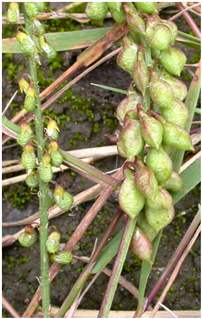
Up and across the road next, entering the rank vegetation to the north of the new housing development’s boundary fence. Field Bindweed (Convolvulus arvensis) was still in flower climbing up the browned off skeletons of Hoary Mustard (Hirschfeldia incana), with yellowing plants of Wild Mignonette (Reseda lutea) in erect fruit, Canadian Fleabane (Conyza canadensis) and Soapwort (Saponaria officinalis). Symmetry in nature was alongside shown by the ten capsule teeth of White Campion (Silene latifolia subsp. alba). Flat open ground further on had delightful patches of Hare’s-foot Clover (Trifolium arvense) with their furry heads among Kidney Vetch (Anthyllis vulneraria). This area came to an end with a raised but flattened tip with mostly rank vegetation on top, here dominated by Tall Melilot (Melilotus altissimus) in seed with Alsike Clover (Trifolium hybridum) still colourful.
Ian did a transect of the tip while the rest walked round to the sheltered west side. This calmer area below the steep-slope provided good shelter for Goldfinches. Patches of Fleabane (Pulicaris dysenterica) were well over, the seed heads dehiscing easily in this species. The flowers would have formed good yellow patches a few weeks earlier, for what is an unusual habitat for this species in Carmarthenshire, being mostly associated with marshy fields. Tiny balls of buff among the grass revealed one plant of seeding Blue Fleabane (Erigeron acer).
Looking up to the shoulder of the tip, it was noticed that there was an area open ground beyond. An ascent was made. This proved worthwhile as three melilots could be seen in flower and seed, Tall, White and the scarce one in Carms., Ribbed Melilot (Melilotus officinalis). The few plants of the last species were smaller and more delicate with smaller one-seeded, glabrous ribbed pods. Tall Melilot (Melilotus altissimus) had mostly two-seeded pods with transparent hairs on the pod-surface. At the edge of this open patch the startling blue snowflake-like flowers of Cornflower (Centaurea cyanus) lit up what was becoming an afternoon of darkening clouds. Ian joined from his crossing having found Sea Campion (Silene uniflora) growing in the railway-side wall.
After the descent from the tip, the party was led on a circular walk northwards then eastwards back to the cars. The grassland was traversed to the edge of the beach where Sea Radish (Raphanistrus raphanistrum subsp. maritimus) was in good fruit with its mostly two mericarps having one-seeded fruit and the two globes linked by only a narrow constriction. Among the straw a curious one-metre circle of fresh, green-leaved Common Bird’s-foot-trefoil (Lotus corniculatus) was still in flower. The light-colour and its robustness referred it to the introduced var. sativus. From here the group followed the concrete roadway towards an old factory, now used as a depot for the Millennium Coastal Park. Large planted trees of Holm Oak (Quercus ilex) were showing their attractive bright green acorns. These concealed flowers of an even more startling blue, this time of Chicory (Cichorium intybus). At a T-junction, tall stands of Japanese Knotweed (Fallopia japonica) choked the road verge on one side. Much of this was noticed to be in seed. This seemed odd as almost all Japanese Knotweed in the British Isles is male sterile. Material was sent to Dr John Bailey, a specialist in Fallopia at Leicester University, who kindly replied promptly to say the black seed was unripe and would have been caused by fertilisation by pollen from another species of Fallopia, for example Russian-vine (F. baldschuanica) or Giant Knotweed (F. sachalinensis). This could have been caused by a bee travelling some distance. The Russian-vine is grown occasionally in gardens in the area, and was in full, white flower across South Wales at the time of the meeting whereas F. japonica was just going over.
Another mystery ensued as on the opposite road verge was an example of an introduced Smooth-leaved Elm. Leaves were round and small with a distinct asymmetric base to the blade and rather coriaceous. The underside had small tufts of white hair in the axils, the angle between the midrib and lateral veins, and the petioles were quite pubescent. The taxonomy of British elms is complex and after much work it was concluded to be the one that has a leaf shape like a small U. procera, namely Ulmus coritana. The species is associated with eastern England. A fine planted tree of Hornbeam (Carpinus betulus) was alongside.
The road beyond had a small area of waste ground adjoining and here was the probable source of the Cornflower, where, in such an unlikely spot, a wild-flower seed mix had been scattered. The last species were added to the day’s list, including very tall racemes of Weld (Reseda luteola) with their entire leaves dwarfing seeding Wild Mignonette (R. lutea) alongside.
