Llanelli Naturalists Newsletter - November 2005 - No 72
Andrew Stevens
Leaders: Andrew Stevens and Kerry Jones
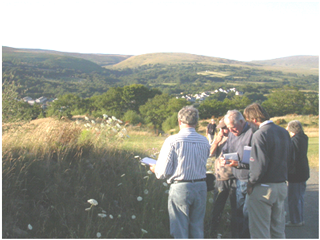 An evening meeting was chosen as the course is much busier at the weekend and the danger from stray golf balls would have restricted access to parts of the course. This, combined with distance from home, meant that only a small group started out from the clubhouse. The course manager Kerry Jones explained that he aims to enhance use for wildlife while maintaining a course that is challenging and satisfying to play on.
The course is located on part of the north-facing flank of the Amman Valley that had been opencasted for coal on at least two occasions (in the 1950s and early 1990s) and Richard Pryce offered us a valuable insight into the operation of the site as he recalled the time when, as a geologist with British Coal Opencast, he was involved in its design, working and early restoration phases. Prior to consent being granted for the working of the site, he carried out a vegetation survey which demonstrated that the area included a very good example of the matrix of marshy grassland, acid rhos pasture, semi-improved neutral grassland and deciduous woodland, all enclosed within small hedge-banked fields, characteristically found within the Carmarthenshire coalfield valleys. It was acknowledged by CCW that at least part was of SSSI quality, although not designated as such.
Coal mining and transformation to a golf course involved much earth movement with long-term storage of topsoil during which vital components of a living soil were lost. It brought to the surface base-rich, biologically inert sub-soil making it unlikely that original vegetation could be re-established easily in the short term. Soil structure was lost so the land is poorly drained in winter and dries out readily in summer. This was illustrated as we walked below the clubhouse to an area where growth had been so poor that the grass had remained uncut for many years. Vegetation cover was a sparse mixture of drought tolerant grasses with occasional patches of Common Fleabane Pulicaria dysenterica where winter flushing occurs. Kerry has plans to encourage further flowering plants allowing it to develop into a species rich meadow and taking a small hay crop occasionally.
Further down hill we came across a small pond constructed as a hazard to frustrate golfers. There was some discussion as to its value for wildlife as it tended to collect nutrient rich run off from a green above and required regular removal of excessive plant growth. There was a large population of Fringed Waterlily Nymphoides peltata which Richard explained is not native to western Britain and is very invasive and invariably a threat to native vegetation where it occurs. It is not a true waterlily, but related to Bogbean Menyanthes trifoliata.
 We then walked along the lower (northern) boundary of the course where an acid wooded bank had remained undisturbed. Here we found Bilberry Vaccinium myrtilus, Betony Stachys officinalis and Common Cow-wheat Melampyrum pratensis. A diversion was made to view a disturbed embanked area used for temporary storage of soil and organic material. There were many robust flowering specimens of Wild Carrot Daucus carota with Field Scabious Knautia arvensis, Greater Knapweed Centaurea scabiosa and Fodder Burnet Sanguisorba minor ssp. muricata lending colour to the banks. Kerry revealed that a wild flower mixture was sown several years previously and these species are survivors from this.
Further on in an area of “rough” where growth was sparse we hoped to find Dyer’s Greenweed Genista tinctoria which had been noted the previous year. This species was recorded in several fields before opencast operations began but even then it was not common. It has declined alarmingly in recent years in the county due to both habitat loss and neglect. This eluded us; instead, we saw several plants of Yellow Bartsia Parentucellia viscosa which is also uncommon only occurring elsewhere in the county in coastal dunes. This species was first recorded at Garnant, during site workings, in the same location but only persisted for a couple of years.
Next we examined an area of “rough” where some of the original grassland remained and where a rich mixture of plants represented a transition from drier acid to damper, more base-rich soil ie: Heath Rush Juncus squarrosus, Green-ribbed Sedge Carex binervis, Heath Woodrush Luzula multiflorum, Tormentil Potentilla erecta, Self Heal Prunella vulgaris, Common Knapweed Centaurea nigra, Whorled Caraway, Greater Burnet Sanguisorba officinalis, Sneezewort Achillea ptarmica and Ragged Robin Lychnis flos-cuculi. It remains as a narrow strip squeezed between a short-mown fairway and encroaching scrub but the vegetation is becoming increasingly rank. Kerry told us how he has slightly increased the area of rough at the expense fairway, increased the height of cut and plans to take a hay cut and control scrub in autumn.
Following the Nant Main uphill, among Wild Angelica Angelica sylvestris, we found two plants of Pennyroyal Mentha pulegium. It is likely that these were not native, but a north American variety with upright growth habit, brought in with grass seed used in restoration of the site, in common with Alsike Clover Trifolium hybridum. Further on we found several patches of Pennyroyal near the path, in damp soil mainly composed of weathered shale. This situation seems to be tolerated by the Pennyroyal but has resulted in only sparse growth of other plant species.
At various points, isolated patches of vegetation suggested that leaching had reduced the base richness at the soil surface sufficiently to allow acid-loving plants to become established. Indicators of this were Sheep’s Sorrel Rumex acetosella, Heather Calluna vulgaris, Heath Rush, Heath Bedstraw Galium saxatile and Bilberry.
It was clear that there is potential for conflict between management of the site to provide attractive surroundings and good playing conditions for golfers, and to preserve the special conditions that an immature landscape and open site potentially provides for wildlife such as the Brown Hare and Skylark and for plants that can stand little competition or reptiles and invertebrates that need bare areas that warm up quickly. The walk provided a good chance to understand the two perspectives and to appreciate the irony that coal mining and recreational use have succeeded in preserving fragments of a much richer grassland where, in the last 50 years, modern agriculture has left so little.
