Llanelli Naturalists Newsletter - September 2007 - No 73
Ian Morgan
Leader: Ian Morgan (assisted by Richard Pryce, George Hutchinson and Tony Lewis)
Members met by a disused quarry*, adjacent to a large brick chimney about half way up Cwm Capel. The weather was quite sunny at first, but quickly became overcast and rainy by the end of the meeting. The group decided to follow the road down the valley towards Burry Port rather than the equally-interesting walk inland to the chapel – this can be left for another day. Whilst the leader knows the area reasonably well, he was greatly helped by the three expert botanists listed above, the extra pairs of eyes, plus their knowledge, added to the list of plants seen. Quite a few spring migrants such as Chiffchaff and Blackcaps (as well as resident birds) were in song and added interest to the afternoon but plant recording was the main aim of the field meeting.
 At the quarry, plants such as Alexanders Smyrnium olusatrum and Wood Forget-me-not Myosotis sylvatica added colour to the area. After a short distance the party came across a `garden escape`, Pink Sorrel Oxalis articulata, naturalised on a roadside bank, identified by George Hutchinson and Tony Lewis (Tony sadly passed away in October – see his appreciation in the Editorial of this issue). Tony’s `sharp eye` for good plants, field skills and also his particular, readily-shared knowledge of urban plants is greatly missed by members of the Naturalists. Indeed, because of the urban-rural interface of Cwm Capel, the meeting focussed on the many escapee plants from adjacent gardens. Less `domesticated` plants seen included two types of fumitory: White Ramping-fumitory Fumaria capreolata subsp. babingtonii (a taxon endemic to Britain) and the usual common woodland-edge species.
Further down the road the party stumbled across three plants of Mexican Fleabane Erigeron karvinskianus coming into flower on a retaining wall. This is a rapidly increasing, attractive dainty, alien species with flowers reminiscent of the common daisy. Not far away, was some Common Ramping-fumitory F. muralis. Along this road, several more garden plants spilled over to establish and almost naturalise themselves on the `wild` side of garden boundaries. In this category was White Stonecrop Sedum album but some Rock Crane`s-bill Geranium macrorhizum had not quite made it – yet! A longer-established alien was Greater Celandine Chelidonium majus, with its characteristic orange sap.
Many plants of yet another escaped garden plant growing on a roadside bank was Garden Candytuft Iberis sempervirens whilst Russian-vine Fallopia baldschuanica was doing its usual rampant climbing act nearby.
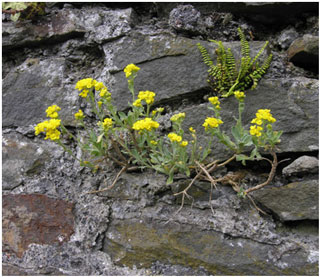
Ascending the road westwards to `the Graig` we found a solitary plant of Golden Alison Alyssum saxatile that had established itself on a stone wall, a few plants of Garden Grape-hycacinth Muscari armeniacum, the variegated form of Greater Periwinkle Vinca major and one Spanish Bluebell Hycacinthoides hispanica with particulary broad leaves. The hybrid bluebell H. x massartiana was also seen (as was the native H. non-scriptus). A variegated plant of Sweet Vernal–grass Anthoxanthum odoratum caused some brief confusion, but was soon correctly identified.
Rest assured though, some native plants were recorded before we retraced our steps back to the cars: a small remnant ‘natural’ area near the top of the Graig with an assemblage of heathy grassland plants was interesting and included Slender St John`s-wort Hypericum pulchrum, Heath Milkwort Polygala serpylifolia, Sheep`s-bit Jasione montana and Spring Sedge Carex carophyllea which stick especially in the writer`s mind.
*The quarry was nicknamed locally `Cwar Mac` or Mc Kiernon`s Quarry and the chimney is the stack of Cwm Capel (or Kenross) Colliery, which was leased to George Bowser in the early 1800s. Bowser lived at Cenrhos, a large, old property that the Naturalists passed on their way up to the Graig. Cenrhos (`the end of the rhos or heath – not a corruption of `cefn`) and which was not the temporary home of the early Carmarthenshire botanist James Motley (as the leader suggested during the meeting)); Motley was actually ensconsed at Rock Cottage, Pembrey during a period of financial hardship for him. [Some of the above information was extracted from the excellent series of four booklets about Pembrey and Burry Port published by the late John Nicholson in 1993-4].
