Llanelli Naturalists Newsletter - September 2006 - No 7
Jamie Bevan
Introduction
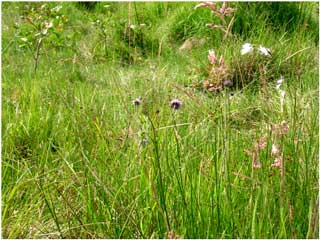 The genus Eriophorum (cotton-grasses) is included in the sedge family Cyperaceae and comprises approximately 20 species worldwide. Four species occur in Britain, namely Eriophorum angustifolium (Common Cotton-grass), E. vaginatum (Hare’s-tail Cotton-grass), E. gracile (Slender Cotton-grass) and E. latifolium (Broad-leaved Cotton-grass).
The first two species are locally abundant in many parts of Britain, being ubiquitous components of upland blanket mires and lowland raised bogs; E. angustifolium also extends into other habitats such as valley and flood-plain mires, flushes, wet heaths and swamps. In contrast E. gracile and E. latifolium are much scarcer plants; E. gracile in particular is restricted to just a handful of sites in southern England and north and south Wales, where it usually occurs on liquid peat in quite swampy situations (Byfield, 1991).
E. latifolium occurs patchily throughout most of Europe where it generally occupies wet, base-enriched habitats (Tutin et al., 1980). In Britain it has a widespread but localised distribution (Clapham et al, 1987; Stace, 1997), a reflection of its preference for base-rich substrates. Most of its Welsh records are from the calcareous fens of Anglesey (v.c. 52) and Llyn (v.c. 49), and from base-rich flushes on the Devonian Old Red Sandstone of Brecknock (v.c. 42) (Ellis, 1983). Despite a shortage of published information on the historical distribution of E. latifolium, it is generally accepted that the species has undergone a substantial decline in many parts of Britain through drainage and agricultural improvement (Byfield, 1991).
This article aims to review the distribution and habitat requirements of E. latifolium in Carmarthenshire (v.c. 44), in the light of several new records. It also provides guidance on its identification and offers a few comments on its conservation.
Status of Eriophorum latifolium in Carmarthenshire
Until relatively recently E. latifolium was considered to be extinct in Carmarthenshire. It is included by T.W. Barker, in the Natural History of Carmarthenshire (1905) as having been "Found by Dr H. L. Jones” but the record is unlocalized. In his List of the Flowering Plants and Ferns of Carmarthenshire, R.F. May (1969) refers to a record (also dating from 1905) at Pont Aber near Capel Gwynfe, made by H.H. Knight, at the time a master at Llandovery College, who carried out a considerable amount of botanical recording in Carmarthenshire in the early 1900s. In the absence of any more recent records, May relegated E. latifolium to an appendix listing “Species presumed lost or extinct”.
E. latifolium was eventually rediscovered in Carmarthenshire in 1989 when Ian Morgan came-across of a sizeable population in base-rich flush vegetation at Maes-y-ffynnon, approximately 3 km north-east of Capel Gwynfe. This site is about 1 km from Pont Aber and may or may not correspond to Knight’s original record.
More recent botanical recording has produced several further new records of E. latifolium. The Countryside Council for Wales (CCW) has recently completed a detailed “Phase II” survey of semi-natural lowland grasslands in Carmarthenshire, as part of a Wales-wide grassland survey programme (see Bevan (1999) for an overview of the main grassland types encountered in Carmarthenshire). Although this survey work concentrates on the identification of plant communities, numerous new records for various uncommon species, including E. latifolium, were generated during the course of the work.
In 1993 Phase II surveyors discovered three new populations of E. latifolium, each in small stands of base-rich flush vegetation overlying Old Red Sandstone strata. The first site, Gellyfawr, is located approximately 1 km north-east of Carmel; Cwrtbrynbeirdd is 1 km south-east of Trap; while Pen-y-graig-goch is 2 km north-east of Capel Gwynfe. This last site is very close to the Maes-y-ffynnon population and is less than 1 km from Pont Aber. Two further populations were then discovered by Jonathon Graham, during botanical survey work for CCW’s Tir Cymen scheme. Again these sites are located on Old Red Sandstone strata: Tyle-pengam lies approximately 2 km south-west of Llanddeusant, and Gelli-gynon some 2 km west of Llanddeusant. A seventh E. latifolium population of approximately 30 plants was discovered by Graham Motley at Cae Cilmaenllwyd SSSI (grid reference SN670204) on 8 May 2002 again in base-rich flush Carex dioica-Pinguicula vulgaris mire overlying Old Red Sandstone strata and an eighth population, extending over several tens of m2 was discovered and identified by Richard Pryce on 5 June 2004 during a meeting of the Wildlife Trust for South and West Wales led by Denys Smith near the source of the River Llwchwr and only about 700m from the Cwrtbrynbeirdd population.
In each case population size is small, ranging from 5-50 plants. It should be stressed that each site is in private ownership and landowner permission should be obtained prior to any visit. All populations are located within the Brecon Beacons National Park.
Habitat of Eriophorum latifolium in Carmarthenshire
 At each of the above sites E. latifolium grows in base-rich flush vegetation which in National Vegetation Classification (NVC) terms is most closely related to M10 Carex dioica-Pinguicula vulgaris mire (Rodwell, 1991). This community is primarily associated with base-rich soligenous mires in the upland fringes of north-western Britain, but it also occurs more locally in lowland situations, usually as small fragmentary stands. It is dependent on more or less continuous irrigation by lime-rich waters emerging from calcareous bedrock or superficials, and in Britain is confined to calcareous substrates in areas of high rainfall. In Carmarthenshire the community is largely restricted to just a few small stands on the Old Red Sandstone in the Brecon Beacons National Park (Bevan et al., in press).
Carex-Pinguicula mire is a distinctive vegetation type containing a suite of base-demanding species. In Carmarthenshire it typically comprises an open species-rich sward, dominated by a mixture of Molinia caerulea and various small sedges including Carex panicea, C. hostiana, C. pulicaris and C. nigra. Other common associates include Anagallis tenella, Juncus articulatus, Eriophorum angustifolium, Pinguicula vulgaris and Succisa pratensis. Also distinctive is the carpet of “brown mosses”, with Campylium stellatum, Ctenidium molluscum and Drepanocladus revolvens among the commonest species. Several other uncommon plants have been recorded in this vegetation in Carmarthenshire, including Epipactis palustris, Listera ovata, Galium uliginosum and Carum verticillatum. Quadrat data listing the floristic associates of E. latifolium at two of its Carmarthenshire sites are presented in Table 2; for ease of reference, NVC nomenclature has been followed for all taxonomic groups.
E. latifolium appears to be intolerant of competition from other plant species and is dependent on a degree of poaching by grazing animals to maintain a suitably open sward (Byfield, 1991). At each of its Carmarthenshire sites, the vegetation is grazed by either cattle, sheep or ponies.
Identification of Eriophorum latifolium
Of the three other Eriophorum species which occur in Britain, E. latifolium is only likely to be confused with E. angustifolium. Both E. vaginatum and E. gracile have slender bristle-like leaves, which distinguish them immediately from the broad-leaved E. latifolium.
Within its narrow range of habitats, E. latifolium is frequently found growing alongside the closely related E. angustifolium, which is much less exacting in its ecological requirements. Confusion between the two species is possible, but if flowering or fruiting material is present then identification is relatively straightforward. In view of the scarcity of E. latifolium, all determinations should be made in the field and plants should certainly not be uprooted. The following guidance on identification has been extracted from standard Floras (Clapham et al., 1987; Stace, 1997) and a useful article on the identification of British cotton-grasses (Byfield, 1991), published some years ago in British Wildlife.
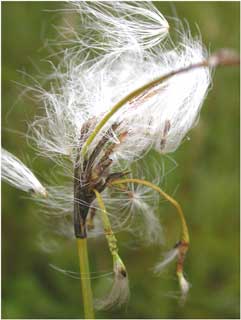
E. latifolium is distinguished from E. angustifolium by its triangular flowering stem, the short forward-pointing bristles on the peduncle, and its short (4-5 mm), blackish glumes which have a narrow hyaline margin (figure 2). In E. angustifolium the flowering stem is more or less terete throughout, the peduncles are smooth, while the glumes are longer (c. 7 mm) and paler, with a broad hyaline margin. Also, the leaves tend to be broader (3-8 mm) in E. latifolium (leaves 3-6 mm wide in E. angustifolium), although this is not a definitive character. More reliable is the flat unchannelled leaf of E. latifolium, which tapers to a short trigonous point. In E. angustifolium the leaf is deeply channelled and tapers to a long trigonous point, which often turns a deep red in older leaves. Finally, in E. latifolium the uppermost leaf on the flowering stem lacks a ligule, in contrast to the short ligule of E. angustifolium.
Overall, the peduncle character is probably the most useful; this can be checked with a good hand lens, or by running the lips or the tip of the tongue along the peduncle. Another useful “jizz” character is the loosely tufted growth habit of E. latifolium, giving rise to solitary plants, which contrasts with the rhizomatous habit of E. angustifolium.
Conservation of Eriophorum latifolium in Carmarthenshire
Despite the recent increase in records, E. latifolium nevertheless remains an uncommon and localised species in Carmarthenshire. Greater understanding of its habitat preferences might now lead to the discovery of further populations, but its specific requirement for wet, base-rich soils means that the species will inevitably be restricted to localities where such substrates occur. In Carmarthenshire, E. latifolium is apparently restricted to stands of Carex dioica -Pinguicula vulgaris mire, which is itself a rare and localised community (Bevan et al., in press). It is recommended that any future searches for E. latifolium should focus on such vegetation, which is largely confined to the Old Red Sandstone in the Brecon Beacons National Park.
Naturally it is desirable to conserve the remaining populations of E. latifolium. Unfortunately, however, there are often logistical problems associated with protecting small populations of uncommon plants in fragments of semi-natural habitat, particularly if these occur within intensive agricultural settings. Statutory protection measures can only be applied to the most outstanding species sites, and conservationists often must rely on the goodwill of the landowner to ensure favourable management.
Fortunately, all of the known Carmarthenshire E. latifolium populations lie within larger areas of mixed semi-natural habitat which are currently under sympathetic management. Furthermore three sites have now been selected as Sites of Special Scientific Interest (SSSI), following CCW’s Phase II lowland grassland survey. This should secure the long-term protection of these sites, although it is important that the requirements of E. latifolium are taken into account when planning their management.
A fourth E. latifolium site is currently managed under a Tir Cymen agreement. This agri-environment scheme was initially piloted in the Dinefwr part of Carmarthenshire, but has since been replaced by Tir Gofal, which now operates throughout Wales. Such schemes have a major role to play in the future conservation of wildlife habitats in the wider countryside, which should in turn benefit a range of specialist species, including E. latifolium.
The future prospects of E. latifolium in Carmarthenshire therefore appear favourable at present, as long as the sympathetic management of its remaining sites is maintained. The current switch towards agri-environment farming methods in Wales, as practised under the Tir Gofal scheme, offers new opportunities for habitat and species conservation, and hopefully will help to arrest the decline of much of Wales’ characteristic flora.
References
Bevan, J.M.S. (1999). Semi-natural grassland and its conservation in Carmarthenshire. The Bulletin of the Llanelli Naturalists, 4 (February 1999), 27-32.
Bevan, J.M.S., Motley, G.S. & Stevens, D.P. (In press). A vegetation survey and conservation assessment of lowland grasslands in Dinefwr. CCW report, Bangor.
Byfield, A. (1991). British Cotton-grasses. British Wildlife, 3 (1), 37-40.
Clapham, A.R., Tutin, T.G. & Moore, D.M. (1987). Flora of the British Isles (Third Edition). Cambridge University Press, Cambridge.
Ellis, R.G. (1983). Flowering Plants of Wales. National Museum of Wales, Cardiff.
May, R.F. (1969). A List of the Flowering Plants and Ferns of Carmarthenshire. West Wales Naturalists’ Trust, Haverfordwest.
Rodwell, J.S. (Ed.) (1991). British Plant Communities. Volume 2: Mires and Heaths. Cambridge University Press, Cambridge.
Stace, C. (1997). New Flora of the British Isles (Second Edition). Cambridge University Press, Cambridge.
Tutin, T.G., Heywood, V.H., Burges, N.A., Moore, D.M., Valentine, D.H., Walters, S.M. & Webb, D.A. (Eds.) (1980). Flora Europaea. Volume 5: Alismataceae to Orchidaceae (Monocotyledones). Cambridge University Press, Cambridge.
Acknowledgements
I am grateful to Tim Blackstock, Ian Morgan, Graham Motley and Dr David Stevens for helpful comments on an earlier draft of this article. Additional thanks are due to Graham Motley for valuable discussions in the field.
J M S Bevan, Countryside Council for Wales, Beechwood Office, Talley Road, Llandeilo, Carms, SA19 7HR
