Llanelli Naturalists Newsletter - November 2005 - No 72
Tony Lewis
This year’s trip to Jersey was very rewarding, botanically speaking, especially for aliens, a particular favourite of mine and a constant source of fascination. Constant because of the increasing number of Mediterranean and Southern Hemisphere species being reported. Late season is the best time to see these strange plants (Viv and I were there in September this year) with their intriguing names, Kangaroo-apple, New Zealand Spinach and Cock's-eggs for example, although the last of these I have only seen in Guernsey. In Jersey, arable means potatos in the main, and when sown with White Mustard (Sinapis alba) after the main crop has been lifted, the fields present a fine show of yellow flowers reminiscent of Oil-seed Rape (Brassica napus subsp. oleifera). More often though, the fields lie fallow and it is then that it gets interesting. Cockspur (Echinochloa crus-galli) from the Tropics is frequent as well as the Southern European, Hairy Finger-grass (Digitaria sanguinalis), while Common Amaranth (Amaranthus retroflexus) can be so abundant as to be mistaken for a crop. Gallant-soldier (Galinsoga parviflora) is often a component of the arable weed flora where it is both abundant and vigorous, quite untypical to Carmarthenshire (and Glamorgan) eyes.
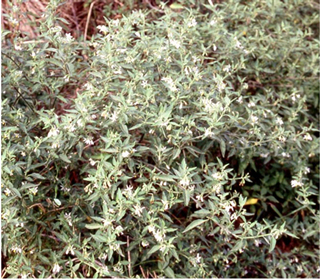
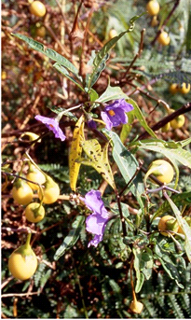
The Nightshade family is well represented and Green Nightshade (Solanum physalifolium) occurs in potato fields and on waste ground. It is easily distinguished from the common Black Nightshade (S. nigrum) by the paler green foliage and the calyces which enlarge in fruit, half enclosing the berry. This species is a newcomer to Wales where it is usually found with its close South American relative the Potato (S. tuberosum). Tall Nightshade (S. chenopodioides) grows up to 1.6m tall with white flowers and purplish-black fruits. Once scarce in Jersey, it appears to have increased appreciably in a very short time. A native of Australia, Kangaroo-apple (S. laciniatum) is even bigger, reaching 2m or more. The purple flowers and large yellow-orange fruits of this handsome shrub are very distinctive and the foliage is unusual in that the leaves are both entire and lanceolate, and deeply lobed and ovate, on the same plant.
New Zealand Spinach (Tetragonia tetragonioides) is actually closely related to the Hottentot-figs (Carpobrotus spp.) but hails from South-east Asia, South America and Australia. It looks very like a fleshy-leaved Goosefoot (Chenopodiaceae) and had us baffled when we found it on the beach near our hotel. However, we enlisted the aid of Joan Banks, the Botanical Recorder for Jersey, who of course identified it for us. The species is not common on the island but, shortly after our visit, Joan wrote to say that she had found a few small plants on another beach much further west - a good example of how one record can lead to another! Joan was very helpful and generous in giving her time, making our visit so much more enjoyable. We are most grateful to her. Excellent drawings of most of the above plants can be found in the new BSBI Handbook, Illustrations of Alien Plants of the British Isles, (Clement et al, 2005).
Postscript - Shortly after our return from Jersey, Viv and I were nosing around the Morfa end of the new road works where a footpath diversion cuts through an embankment. In the disturbed ground Viv spotted an unfamiliar plant which I tentatively suggested was Velvetleaf (Abutilon theophrasti). When this was confirmed at home later (op. cit. p.94), Viv asked, somewhat tetchily I thought, 'How did you know that, clever-clogs?' Some things you just can't explain. So far as I know, it has not been recorded from Jersey.
 |
 |
 |
 |
Reference:
Clement, E.J., Smith, D.P.J. and Thirlwell, I.R. (2005). Illustrations of Alien Plants of the British Isles. Botanical Society of the British Isles, London.
