Llanelli Naturalists Newsletter - Summer 1988
Richard Pryce
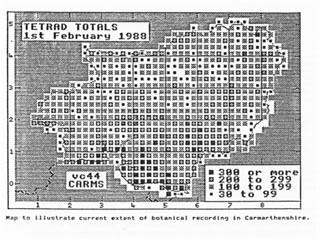
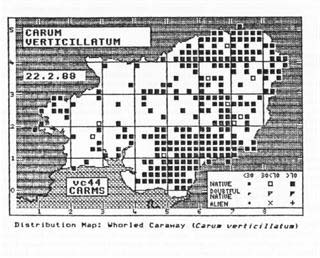
Recording did not start in earnest until May due to the late spring. At the beginning of Wildflower Week (16th May), a small party set out to record in the Cross Hands, Whitland tetrad for the B.S.B.I Monitoring Scheme. Nothing spectacular was seen but an unimproved valley mire, dominated by Purple Moor-grass and containing various sedge species and Whorled Caraway was seen which repayed a second visit in late June. Most noteworthy, however, was the visit to North Road Cemetery, Whitland after the main party had dispersed. Here more than seventy plants of Green-winged Orchid were counted by Mathew Pryce (MJP) and made a spectacular show amongst about five hundred Early Purple Orchids. These probably constitute the largest populations of the two species in the vice-county.
 Also during Wildflower Week, a phone call from Matt Ridley, Chief Ranger at Gelli Aur Country Park, alerted me to his discovery of Bird's-nest Orchid under a parkland Lime tree alongside the main entrance drive. In fact, eight flowering plants were subsequently counted on 20th May, one of which bore a previous year's spent flowering spike. (Rachel Pryce L MJP). An old record for 'Golden Grove' from the early 1950s presumably refers to the same locality.
The second Saturday of Wildflower Week saw another unspectacular meeting held in order to record the Llanpumsaint tetrad for the B.S.B.I. Monitoring Scheme. An ornamental series of ponds with adjacent species-rich pastures at Felin Llanpumsaint were probably the highlight of the day: Whorled Caraway was very frequent over a large area and Marsh Cinquefoil and Bog-bean occurred as emergent vegetation. The Afon Gwili near to the ruined farmstead of Glangwili was visited later and was found to contain the Water Crowfoot, Ranunculus penicillatus whilst across the river, a disturbed, species-rich pasture had Whorled Caraway, Yellow-flag, Bog Violet and Common Lousewort amongst the species recorded (Trevor Crosby (TSC) & RDP).
A week later Ian Morgan (IKM) reported his discovery of a traditionally-managed, base-rich, hay meadow near Abergorlech which supported frequent Moonwort, Fairy Flax, Restharrow and Cowslip (all new 10km square records) and when the site was revisited on 8th July with Derek Wells (N.C.C. Chief Grassland Scientist), four flowering spikes of Frog Orchid were chanced-upon by John Hopkins, literally at his feet, whilst discussing the geology of several small sandstone outcrops. This was the first inland record of the species in the vc since 1908. Nearby was an extensive blanket mire with a good stand of Royal Fern, sadly under threat of afforestation.
 A good population of very well grazed Adder's-tongue Fern was recorded on part of the new Dyfed Wildlife Trust reserve at Crug Melyn, Brechfa, at first sight apparently unpromising, comprising principally of tussocky Purple Moor-grass with invasive willow and birch. Trust management should in future improve the chances of the survival of the Adder'-tongue and diversify the 'area of Purple Moor-grass.
A very fine wetland site, near Bethlehem, known to Mrs.Vaughan in the early 1970s, was rediscovered when the owners consulted N.C.C. over management. The quality of the area can be appreciated by the fact that Marsh Helleborine has been recorded sporadically. Other notables included White Beak-sedge, Petty Whin and Dyer's Greenweed. The site is typical of what much of lowland Carmarthenshire must have been like before the great accelleration in agricultural improvement in recent decades and it is very refreshing to have a landowner who is so sympathetic and enlightened as to conserve this important area despite his consequent loss of income.
Another first class site, on this occasion near Glanamman, discovered by Adrian Fowles (APF), wasvisited by Derek Wells and entourage in July. Consisting of a mosaic of semi-natural grassland habitats, some very rich, undoubtedly the most spectacular species seen was Fragrant Orchid (eight plants in flower) but nearby were c25 spikes of Greater Butterfly Orchid together with Dyer's Greenweed amid an extensive drift of Dactylorchids. A large population of Restharrow was noted in an adjacent enclosure and Tawny Sedge and Meadow Thistle seemed to be almost ubiquitous! A nearby valley woodland had three plants of Great Horsetail.
 Turning to the north of the vc, a series rhos-heathlands near Rhydcymerau, another of APF's finds, was found to be largely dominated by tussocky Purple Moor-grass, extremely difficult and tiring to traverse, but with frequent plants of Narrow Buckler Fern. One small species-rich enclave, under severe threat from encroaching willow and bramble, supported a good population of Wood Bitter-vetch with two spikes of Greater Butterfly Orchid, Dyer's Greenweed and Wood Horsetail close by.
Yet another site studied by APF was the extensive moorland and mire with rocky crags of Cors Bryn Mawr, Nant Fawr and Carn Fawr, north of Ffarmers, which had populations of Cranberry, Crowberry, the hybrid sedge Carex demissa x hostiana and, on the crags, Beech Fern and Fir Clubmoss.
Whorled Caraway has at last been found in SN32, in fact at two sites, one o4 which, near Blaenycoed, was a particularly rich valley mire with, for instance, Bog St.John's-wort, Ivy-leaved Bellflower and Marsh Lousewort (George Hutchinson (GH) & RDP). Several new Whorled Caraway stations we-e also discovered in SN42, most notable being the c100 acres of acid heathland and rhos pastures at Ffynnon Newydd, Llanpumsaint, an area that would repay a detailed resurvey (John Killick, GH L RDP).
Alan Newton led a weekend to record the vc's bramble flora and familiarise local recorders with this daunting group. As a result of effective planning and the efficiency and enthusiasm of the participants, the extent of the ground covered during the three day meeting was astonishing. The 'Carmarthenshire Grand Tour' only ended after 52 localities had been visited in seventeen 10km squares, resulting in 280 new bramble records having been added to the vc files, 255 of which were "good" microspecies or Dewberry, Raspberry or Loganberry, the remainder being undescribed taxa, hybrids or forms. Twelve new vc records were made,
viz Rubus amplificatus, R. cardiophyllus, R. flexuosus, R.insectifolius, R. micans, R. moylei, R.plicatus, R.procerus cv.Himalayan Giant, R. rosensis, R.scaber, R. villicauliform and Loganberry (first Welsh record). There were, in addition, five second vice-county records and the total number of bramble records for the county was more than doubled. A full account of the meeting is published elsewhere (Newton L Pryce, 1988).
Jim Bevan's annual visit to study hawkweeds, included the cliffs above Llyn y Fan Fach and the old limestone quarries of the Black Mountain. He is making considerable progress in sorting out the local hawkweed flora and several specimens were collected for study in the lab. Tentative determinations included Hieracium rectulum and specimens taken in 1986 from a roadside in Llanedi were H. Iepidulum (Stenstr.) Omang., a new vc record and second Welsh record.
The dandelions were not neglected either. Chris Haworth very promptly determined specimens (some comprising very poor or inadequate material) which Annie-Mary Pell (AMP) and I had collected. Of the sixteen identifiable specimens submitted, no less than seven were new vc records!
These were Taraxacum rhamphodes, T. pseudohamatum, T. crocaiflorum, T. ancistrolobum, T. polyodon, T. sellandii and T. undulatum. Chris' patient letter and instructions on how to collect better material in future were very encouraging.
So at last a start has been made on tackling the critical groups but there is still a long way to go.
Despite heavy commitments elsewhere, James and Mary Iliff have again been very active, particularly in the northeast of the county and in Monitoring Scheme square SN72. But probably their most notable contribution this year is a plant collected in 1983 at Cilycwm of the hybrid tormentil Potentilla &recta x P.reptans P.x Italics, a hybrid, although previously produced artificially, new to science in the wild! Their specimen was exhibited at the B.S.B.I. Exhibition Meeting in November by Dr.Brenda Harold, who had determined its identity cytologically at Imperial College with Dr.Jack Ellis.
Heather Sealy-Lewis has the distinction of being the first recorder to raise the total number of species in her home grid square (Llansteffan) to over 500 with the addition of such species as Small-flowered Cranesbill, Field Penny-cress and Chewing's Fescue Festuca nigrescens (F. rubra subsp. commutata), a new vc record.
All of the graveyards and burial grounds situated within the B.S.B.I. Monitoring Scheme squares were scrutinized by AMP, some have received two or even three visits during the year, a total of sixty sites and 104 visits! Some of the species she recorded are Prickly Sedge, Greater Burnet, Wood Horsetail, Hedge-bedstraw, Fairy Flax, Bristly Oxtongue, Elecampane and Royal Fern. A truly singular effort -congratulations!
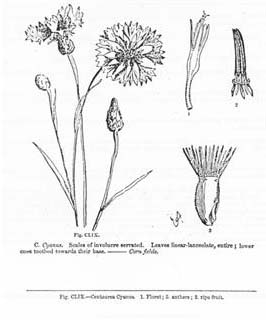
Miscellaneous records during the season included a new site for Cornish Moneywort near Llidiadnenog (TSC), White Melilot from Penygroes (AMP) and Cornflower which appeared at two separate localities about two miles apart, near Porthyrhyd, on the newly excavated cuttings for the Cross Hands By-pass (MJP & RDP).
References
Dony, J.G., Perring,F.H. & Rob, C.M. (1980). English Names of Wild Flowers. Cambridge.
Ellis, R.G. (1983). flowering Plants of Wales. Cardiff.
Newton, A. & Pryce, R.D. (1988). B.S.B.I. Rubus Meeting, Carmarthen, 1987. B.S.B.I. Welsh Bull. 46: (in press).
Pryce, R.D. (1987). Botanical Report, Spring 1987. Llanelli Nats. Newsl. Summer 1987.
(1988a). Efailwen, Carmarthenshire / Pembrokeshire, 20th June 1987. B.S.B.I. News 48.
(1988b). Rubus Meeting, Carmarthen, 31st July to 3rd August 1987. ibid.
(1988c). Carmarthen, 14th to 17th August 1987. ibid.
