Llanelli Naturalists Newsletter - July 2008
George Hutchinson
Leader: Edith Jones
At the end of the long driveway down to the farm Edith, Neil and the two sheepdogs greeted the many people who had turned up on this glorious summer’s day. One purpose of the visit was to examine the effect on the landscape of the Transco gas pipeline construction works. One party guided by Andrew Stephens took the wet route and Edith led the other to examine the drier grassland. The former party would return eventually through the drier pastures back to the farm.
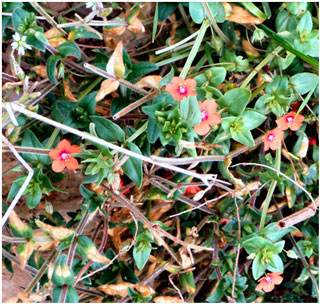
Descending through the grazed field the fully open Scarlet Pimpernel Anagallis arvensis reflected the sunny weather. So too did a male Common Hawker dragonfly Aeshna juncea.
 Turning into the first wet field we were confronted by a tall line of ‘Edith’s Triffids’, resplendent in full flower (Greater Tussock-sedge, Carex paniculata). The wet area in front had many small tussocks of Purple Moor-grass Molinia caerulea among which was found Heath Grass Danthonia decumbens.
It was time to squeeze past the northern end of the ‘Triffids’ into a wild wet wood, where concentration on balance was paramount. As well as much Remote Sedge Carex remota there were brief glimpses of Wood Horsetail Equisetum sylvaticum, Hard Fern Blechnum spicant, Creeping Soft-grass Holcus mollis with its ‘hairy knees’ (nodes) and the remains of spring flowers like Wood Sorrel Oxalis acetosella.
Daylight emerged with the sight of gentle boggy flushes down the hillside, an area which would turn out to be the most species-rich of the day. The red glandular hairs and yellow-green leaves of Round-leaved Sundew Drosera rotundifolia were eye-catching on small mounds of bog moss Sphagnum spp. A variable-sized but well-fruiting sedge grew amongst them. This was later kindly determined by Arthur Chater as just the Common Yellow-sedge Carex viridula ssp. oedocarpa (formerly known as C. demissa). Other species noted included Lesser Skullcap Scutellaria minor in flower, Whorled Caraway Carum verticillatum, Bog Pondweed Potamogaton polygonifolius and Round-leaved Crowfoot Ranunculus omiophyllus surfacing on the tiny patches of open water.
Some of the other wet-habitat species noted were Carnation Sedge Carex panicea, Star Sedge C. echinata, Marsh St John’s Wort H. elodes, Bulbous Rush Juncus bulbosus, the bright yellow-orange of emerging Bog Asphodel Narthecium ophioglossum, Bog Pimpernel Anagallis tenella, Marsh Violet Viola palustris, Marsh Pennywort Hydrocotyle vulgaris and tiny plants of Creeping Willow Salix repens, all set off by the shocking-pink of Bell Heather Erica cinerea (on dry tussocks) and the white perianth-bristles of Common Cottongrass Eriophorum angustifolium. This was certainly an area that had been made more resplendent by the recent heavy rains.
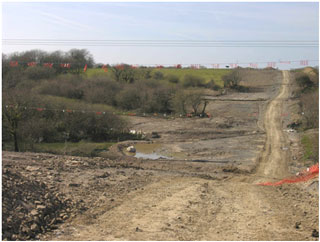 In total contrast, after walking through a grazed field shortly afterwards, our boundary was set by the bare soil of the pipeline construction site. Apart from a few storage bunds of top-soil on the far side containing the classic yellow-flowered ruderals (dandelion Taraxacum agg, Charlock Sinapis arvensis, Hoary Mustard Hirschfeldia incana and Tall Melilot Melilotus altissimus), the area was devoid of vegetation. Climbing up steeply at right angles to the course of the Gwendraeth Fawr river the party stopped in places to gain breath and look back to view the continuous band of bare earth crossing over the distant hillside as wide if not wider than the M4 in places with all turf, hedges and woodland removed. Near its top members turned left along the contour, past pipeline sediment traps, to reach a rich sloping meadow near the farm which had been bisected and partly destroyed by the works. Here a pure population of the eyebright, Euphrasia arctica ssp. borealis, was in flower all across the field. Red Bartsia Odontites vernus and Quaking-grass Briza media were common, with a few Bristle Club-rush Isolepis setacea in damper parts. The treats to end a very enjoyable afternoon were the more finely divided leaves of Burnet-saxifrage Pimpinella saxifraga, identified by Andrew, followed by tea kindly supplied by the Jones’s who were thanked for hosting us on their farm, wonderfully conserved with Nature in mind.
For an account of the Llanelli Naturalists’ previous visit to the farm on 19th June 2005, see Llanelli Nats. Newsl. No. 72, pp. 19-20 (Nov 2006).
