Llanelli Naturalists Newsletter - No. 74 - July 2008
Andrew Stevens & Richard Pryce
Acting Leader: Richard Pryce
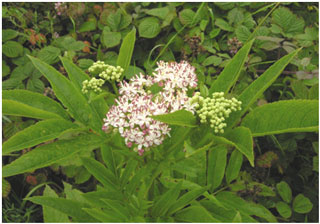 A good number of members arrived for this meeting but some were discouraged by the recently started penetrating rain and decided to return home. However, the majority, led, in the absence of the advertised leader, by Richard Pryce, made their way along the roadside verge to the extensive stand of Danewort Sambucus ebulus which has been known at this site since the 1950s, but which in recent years has become increasingly overgrown with brambles. Across the road, the acting leader described the geology of the wet valley colonised by acid mire vegetation dominated by ungrazed Purple Moor-grass Molinia caerulea and tall-herb vegetation. This valley occupies the outcrop of the Middle Shales of the Millstone Grit which is sandwiched between the hard, resistant Basal Grits to the north and the Farewell Rock to the south. The Farewell Rock is so named as when the old miners came up against it underground, they knew that they had reached the base of the coal-baring strata. The productive Coal Measures occupy the Gwendraeth Fawr valley to the south. The narrow Carboniferous Limestone outcrop occupies the ground below the crest of the ridge to the north but has been severely affected by past quarrying and as a result has lost much of its wildlife interest. The wide Gwendraeth Fach valley in which Llangyndeyrn is nestled, marks the outcrop of the Old Red Sandstone which has been thrust upon itself, effectively doubling its thickness, by the major fault known as the Cennen Disturbance which can be traced all the way from Milford Haven, through the Cennen valley to Church Stretton in Shropshire, and beyond to the Abberley Hills.
The party made its way along the footpath to the exposed outcrop of the Basal Grits where characteristic acidophilic plants grow in the rock crevices and form thin vegetation mats over the hard sloping rock-slabs. Bilberry Vaccinium myrtillus, Heather Calluna vulgaris and Bell Heather Erica cinerea are frequent growing in locally dominant mats of Sheep’s Fescue Festuca ovina and Wavy Hair-grass Deschampsia flexuosa. A few plants of a hawkweed Hieracium sp. were also found in the rock crevices and a specimen was collected for later determination by the BSBI referee.
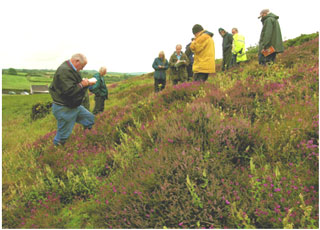 By this time the rain had eased somewhat and the path was followed eastwards through the Middle Shales valley where the ground is mostly colonised by patches of bramble Rubus fruticosus agg, Bracken Pteridium aquilinum and tall-herb species. This rank vegetation is due to the lack of grazing management over the past couple of decades although some relict acid mire species remain including Purple Moor-grass Molinia caerulea, various rushes Juncus spp., Velvet Bent Agrostis canina, Whorled Caraway Carum verticillatum, Self-heal Prunella vulgaris, etc. Soon the path rose out of the valley to the trig. point marking the summit of Mynydd Llangyndeyrn where short acid grassland dominated by Common Bent Agrostis capillaris occurs in discreet patches between the Bracken stands.
By this time the weather was starting to deteriorate again and it was decided to turn north down to Tygwyn Farm and follow the track back to the main road. Several weedy species were noted in disturbed ground and dung heaps around the farmyard including Marsh Cudweed Gnaphalium uliginosum, Pineappleweed Matricaria discoidea, Water Pepper Persicaria hydropiper and Hoary Mustard Hirschfeldia incana.
Further along the track a marked change in the vegetation of the banks was noted between the bracken dominated vegetation of the acid ground and the verdant green sward supported by the calcareous soils derived from the Carboniferous Limestone. Plants noted here included Glaucous Sedge Carex flacca, Rough Hawkbit Leontodon hispidus, Common Spotted-orchid Dactylorhiza fuchsii, Imperforate St.John’s-wort Hypericum maculatum and Quaking Grass Briza media.
As the rain became heavier, the pace of those present increased and it was left to the acting leader to make a note of the vegetation growing on the banks of the small stream where it crossed under the road. This vegetation is also very rank with dominant bramble and young trees and bushes of Grey Willow Salix cinerea, Alder Alnus glutinosus and Downy Birch Betula pubescens with tall-herb species including Great Willowherb Epilobium hirsutum, Hemp Agrimony Eupatorium cannabinum, Meadow-sweet Filipendula ulmaria and Common Nettle Urtica dioica and Hedge Bindweed Calystegia sepium ssp. sepium weaving all together into a solid mass! A few spikes of Common Spotted-orchid also braved this tangle.
It is a great pity that common grazing seems largely to have been abandoned on Mynydd Llangyndeyrn. The successional changes which have occurred in the last two or three decades have severely depleted the vegetation diversity of the site, particularly the wet, acid mire in the valley. This site, however, remains one of the best in the county to demonstrate dry, acid heath often confined to the cracks and crevices in the dip slope of the Basal Grits where competition from rank species is less of a problem.
