Llanelli Naturalists Newsletter - September 2007 - No 73
George Hutchinson and Philip Jones
Leader: George Hutchinson (assisted by Tony Lewis and Richard Pryce)
This meeting to study mainly alien and naturalised plants came about as a result of a brief ‘recce’ made by Richard Pryce, Ian Morgan and GH on 26th Sept 2004 down the lane to the former Thyssens in Bynea and coming across some unusual plants. The problem was getting beyond the edges of the lane in places as impenetrable thickets of the common Arrow Bamboo Pseudosasa japonica occurred. Some had yellow culms and leaves in places which was thought might be some sort of cultivar or form. Also, huge birches occurred on the east side of the lane with wonderful peeling bark.
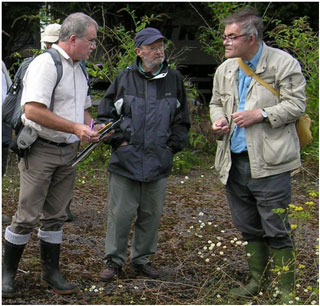 What had happened since was explained to the members before starting, but this included noticing that over the two years both the bamboo and birches had vanished. Photos and a letter had been sent to Dr Chris Stapleton, the BSBI bamboo referee based at Kew. He had commented that the yellow plants were just an unhappy part of the clump, suffering from too much sun, drought, etc., and that many of the yellow and black clones given names by some people merely revert to green. To maintain the colour one would have to keep cutting out the green culms; eventually not much would be left.
The birch, originally considered to be Betula utilis agg. by GH was determined as B. jacquemontii by Dr Peter Sell at Cambridge. It is one of the group of Himalayan birches but replaces B. utilis in the western areas. Photocopies to show the size of the leaves and bark were shown.
The fieldwork started by visiting the first of four rectangular plots. The erect, arching Diels’ Cotoneaster C. dielsianus, with its four stones to the fruit and off-white underside to the leaves, was one of many plants of this species and many Cotoneasters seen over the afternoon. Blue Fleabane Erigeron acer, with its tiny, delicate, mauve ligules (ray florets), abounded. Plants were more easily detected when in seed, with their dense yellowish-white pappus. Biting Stonecrop Sedum acre had small re-growth of its green leaves. An impressive, large, now yellow-leaved grass was growing near the overgrown petrol station. The hollow culms with their dark maroon nodes reminded one of tiny bamboo, but the trick lay at the base of the blade with its hairy-rimmed auricle and minimal ligule - Tall Fescue Festuca arundinacea. The new growths alongside showed this better, the hairs tending to have dropped off the old leaves.
Pampas-grass Cortaderia selloana, a relic of past ornamental plantings, hid among the roadside cypress trees and nearby the radiating, razor-sharp leaves of Tufted Hair-grass Deschampsia cespitosa was establishing in the cracks. Much Wild Marjoram Origanum vulgare had spread over the site enjoying the dry conditions, but Common Fleabane Pulicaria dysenterica, typical of more damp areas, was in full flower. A curious Rowan cultivar with pale-yellow, erect fruit resembled Sorbus ‘Joseph Rock’. However, its lowest branch had clear red fruit, probably caused by the root stock of Rowan Sorbus aucuparia, on which the cultivar was originally grafted, starting to show through with age and lack of gardening. Silver Birch Betula pendula here showed excellent characteristic double-serration to the dark-green, shiny leaves.
By now Imperforate St John’s-wort Hypericum maculatum and the more delicate Perforate St John’s-wort H. perforatum had been found, but it was a one metre tall, shrubby Hypericum which was to take the honours. The rancid leaves identified it as Stinking Tutsan H. hircinum. It was a common plant here, but nearly all in seed. Only on reaching the third plot were some plants found in flower. Just before exiting the first plot a tall Autumn Hawkweed Hieracium sabaudum, with its white-hairy phyllaries, was found in flower, decorating the south-west corner.
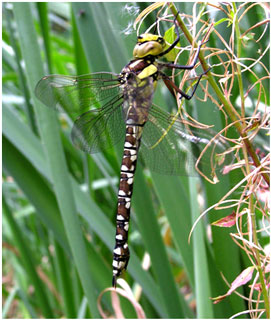
Now a break was taken to examine a tiny pond across the road well hidden by White Poplar Populus alba and an old, majestic Weeping Willow Salix x sepulcralis. Least Duckweed Lemna minuta coated the pond bright green; a species only first recorded in 1977 and now starting to replace Common Duckweed L. minor in many areas. Bulrush Typha latifolia dominated along the edge, but it was here on this cool day that a Southern Hawker dragonfly Aeshna cyanea rested on a small stem. It was ideal to photograph, both overhead and side views, and the opportunity was not missed. Identification was by the coloured bands across the last two segments of the abdomen, instead of the paired spots of other hawkers (see photo).
 Over the afternoon larger butterflies were well represented with Red Admiral on Buddleja and glimpses of Painted Lady, with a few Clouded Yellow for which it has been a good year. There were also fleeting glimpses of low-flying Common Blue.
Plot 2 had a lovely free-standing Eared Willow Salix aurita. The rugose leaves and ears (stipules) resplendent along the twigs in the afternoon sun. A tiny, flat rosette of lobed leaves revealed Buck’s-horn Plantain Plantago coronopus among large patches of the succulent-leaved, glaucous White Stonecrop Sedum album. A few of the diagnostic almost flat-topped (sub-corymbose), many-flowered panicles of the latter remained. Stopping, standing and staring revealed many miniatures, the next being the greyish-white hairy leaves of Common Cudweed Filago vulgaris, but only a few plants this year compared to previously.
Along the eastern boundary of the plot Willow-leaved Cotoneaster C. salicifolius, with just tiny fruit at this stage, arched over the bright-red-fruited Wall Cotoneaster C. horizontalis. Symmetry in nature could be admired with Twiggy Mullein Verbascum virgatum, each solitary, spherical fruit arranged around the stem on very short pedicels.
The so-far hidden third plot to the south-east was entered with some anticipation through a dark, narrow, low archway under the trees. It was not in vein as the large area opened out to initially reveal Hollyberry Cotoneaster C. bullatus with its ripe shining-red fruit and bullate leaves, but by now drought-affected yellow leaves; the first Cotoneaster to fruit. The one free-standing Hypericum hircinum was in flower near here, the petals >15mm giving further evidence from the leaf aroma that it was this species and not the similar Tall Tutsan H. x inodorum.
Then it was decided to record up one side of the rectangular land and return down the other side. Many new curiosities were recorded: white-flowered Red Bartsia Odontina verna ssp. serotinus, the tiny delicate remains of Silver Hair-grass Aira caryophyllea, LInaria x sepium L. vulgaris x repens the classic hybrid toadflax, Soapwort Saponaria officinalis, Vervain Verbena officinalis still with a few tiny, light-mauve flowers on dark stems, and the tall, brownish-white Carline Thistle Carlina vulgaris, its straw-coloured heads recalling the radiating sun.
Like the previous plots, patches of eyebright Euphrasia sp. were common still with some terminal flowers left. All this proved to be the hybrid E. confusa x nemorosa, now more common than the parents in the county. All three taxa tend not to have glandular hairs, but some plants were found near the east end of the plot with seemingly tiny glandular hairs, growing among thick grey lichen carpeting the floor. But alas, this was a trick of nature, mold vigorously affected all the plants examined in this area.
An infected branch of Wall Cotoneaster C. horizontalis was colourful with the orange-yellow and grey of the common lichens Xanthoria parietina, Physcia tenella and Ramalena farinacea (det. A. Orange), the whole plant backed by a robust, sharp-purple-flowered Bell Heather cultivar Erica cinerea cv. Before leaving Tony Lewis showed us more of the Filago vulgaris, on the edge of disturbed soil created by ‘bikers’; also, much taller Hollyberry Cotoneaster C. bullatus than before growing in more shade and rank vegetation, but showing the same features as earlier.
Across the lane there was time to visit a large plot of more recently bulldozed earth, being prepared for new factory foundations. Although many plants had flowered from the earth, the clear contrast here with the former sites was the absence of shrubs. Marsh Cudweed Gnaphalium uliginosum, the commonest cudweed by far in the county, was at the base of the rough entrance [note the earlier encountered Filago is also a Cudweed]. The member of the Malvaceae was later determined as just Common Mallow Malva sylvestris.
The eye-catching, erect spikes of seeding Weld Reseda luteola were the tallest plants. Hoary Mustard Hirschfeldia incana had arrived, but so far the long, curved heads of seeds formed an open ‘thicket’ only at the end of the site. A tiny Slender Rush Juncus tenuis was the best well-hidden unexpected plant; another case of stop, stand and stare.
Exiting gave a different perspective to the entrance, with the Arrow Bamboo Pseudosasa japonica finally showed up, but only lying as part of a pathetic culm of cut grass. Walking back up the lane plants spotted through the tall shrubs and not seen earlier were Perennial Sow-thistle Sonchus arvensis, with its large yellow capitula, and Glaucous Sedge Carex flacca, drooping heads in a line, spotted waving in the breeze.
A final climax to the meeting came when a dark-coloured Common Lizard and family were found camouflaged on the remains of dark purple brick rubble; the S-shaped curvature of the adult probably giving it away. Then a bright red flash of a male Common Darter dragonfly Sympetrum striolatum) landing on a pale stone nearby gave a colourful end to a very productive recording meeting.
Few fungi were seen during the walk. Pale Brittlestem Psathyrella candolleana was present beneath a large White Poplar tree. This species is a very common saprophyte on decayed wood and grass debris, so can be found in woods, grassland and parks. In the same area a second fungus was collected. This keyed out (after microscopic examination) as Pluteus cinereofuscus, an uncommon species. Pluteus species grow on decayed wood, mainly of deciduous trees, but some species are confined to the wood of conifers. Some species are common on sawdust or woodchip so may be found more frequently on flowerbeds mulched with woodchip. The spores of Pluteus give a pink spore print whereas Psathyrella gives a purple-black spore print.
