Llanelli Naturalists Newsletter - September 2007 - No 73
Simeon Jones, Philip Jones & Richard Pryce
Leaders Simeon Jones and Marcus Weaver
Around a dozen members met at the club house for this evening visit to be guided around by the course manager Marcus Weaver to see the enlightened approach to conservation on this top class golf course. The weather couldn’t have been more conducive to a leisurely stroll around the golf course, being bright and warm for so late in the season.
The group made its way over to the Machynys Ponds hoping then to go on the some of the other water bodies on the course. The escaped and invasive Fringed Water-lily Nymphoides peltata Lili’r-dŵr Eddїog was soon discovered having got into the small pond to the east of the main Machynys Pond - it can be seen in summer covering the main pond like a carpet. The dramatic, large-leaved, Water Dock Rumex hydrolapathum Tafolen y Dŵr was seen here. This scace plant is mainly confined to coastal areas in Carmarthenshire. Mare’s-tail Hippuris vulgaris Rhawn y Gaseg was also appreciated by the group being quite a rarity with a liking for coastal lagoons.
 On the main Machynys Pond, originally dug for clay but considerably enlarged during the construction of the golf course, Gipsywort Lycopus europaeus Llysiau’r Sipsiwn was found which was used by gipsies to darken the skin. Brookweed Samolus valerandi Claerlys was also present being quite common in the wet fringes of coastal water-bodies and dune-slacks.
Impressive areas of rough were admired which are home to skylark in the summer. A common small grassland fungus, Conocybe tenera, was found. This has a conical cap (Conecap) and reddish-brown spores covering the gills. Also in the rough grass was another fungus with a conical cap but the gills were tinged pink. An important feature for identification was the bag-like structure (volva) at the base of the stipe making it one of the Volvariella (Rosegills). This keyed out as V. pusilla, an uncommon species and the first seen by Philip Jones. A large milkcap, Lactarius controversus was present under willow near one of the ponds. This is rather uncommon and only found close to willow or poplars as it has a symbiotic (mycorrhiza) relationship with these trees. Some members sampled the “milk” produced when the cap is broken: a drop placed on the tongue has an acrid taste, drying the mouth, but not as unpleasant as milk from some species. Shaggy Inkcap Coprinus comatus was also seen.
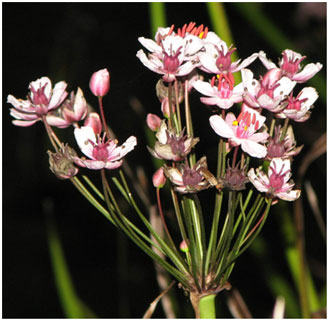
The light was fast fading by the time the party returned to the club-house but there was one other sight still to see. In a small pond between the club-house and the sea wall, a substantial stand of Flowering Rush Butomus umbellatus Brwynen Flodeuog with its pretty three-petalled flowers, discovered by Ian Morgan the previous week, was inspected. This is the first Carmarthenshire record of this species, which is also known at Crymlyn Bog east of Swansea, and would appear to be the most westerly extant record in South Wales.
The group had hoped to see more of the many other ponds on the course but were prevented by nightfall and so after thanking Marcus for an enjoyable evening the meeting came to an end.
