Llanelli Naturalists Newsletter - September 1998 - No 3
G S Motley & J J Graham
Introduction
This is the first in a series of articles dealing with the better-recorded bryophyte groups in Carmarthenshire. The authors are currently recording for a comprehensive bryophyte flora of the county (see Graham & Motley, 1996).
The moss genus Sphagnum (bog moss) has traditionally been treated separately from other bryophytes groups as it has no close relatives (Daniels & Eddy, 1990). Taxonomic treatment within the group has varied greatly throughout this century. The 1926 Census Catalogue (Duncan, 1926) lists a total of 18 species and 30 varieties under Dixon and Jamesons arrangement, and 47 species and 96 varieties under the Warnstorfian system (the latter actually omitting colour varieties, forms and sub-forms!). Today, about 30 species and five varieties are recognised in Britain (Hill, 1978). Until recently, Sphagnum distribution in the county was poorly known. H H Knight actively recorded bryophytes in the area in the early part of this century, but largely ignored Sphagna; consequently, Wade (1948) did not include any species in his compilation of The Bryophytes of Carmarthenshire, although Sherrin (1946) listed 10 species as occurring in v.c.44. Over the past few years there has been an increase in bryophyte recording in the county, and many Sphagnum records have been generated, mainly by the authors and by Countryside Council for Wales (CCW) staff involved in survey work. At the time of writing, 17 species and five varieties are known from Carmarthenshire.
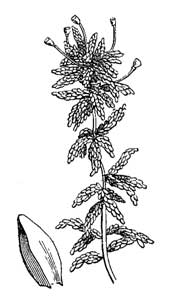 Briefly, a Sphagnum plant consists of a stem on which arise clusters ('fascicles') of branches (usually differentiated into spreading and pendant branches). At the top of the stem, immature branches are bunched to form the 'capitulum'. The most important features for identification purposes are the stem and branch leaves (in particular their overall shape, the juxtaposition and structure of the large dead hyaline cells and green photosynthetic cells, and the number, position and size of pores); the structure of the stem cortex is also diagnostic of some species/groups. Although many diagnostic characters are microscopic, with practice, the majority of plants can be identified to species in the field; however, some specimens can be difficult, mainly because of plasticity in growth form (e.g. plants growing in well-illuminated situations can differ considerably from those growing under shade), and similarity between species.
Sphagnum has a variety of uses. In the form of peat it is used in horticulture as a growing medium and soil improver. Peat is also used as fuel; at a number of boggy sites in Carmarthenshire (e.g. Pyllau-cochion (SN4926) and Carmel (SN5915)) there is evidence of past peat cutting. The moss itself has been used to line hanging baskets, for dressing wounds, as a packaging material and for mopping up oil spills. Hopefully, as substitutes become cheaper and more widely available, there should be less demand for Sphagnum moss and peat from the horticultural trade.
Bog mosses are unusual among bryophytes in that they can be dominant in some habitats. Most species are adapted to growing in acid, nutrient-poor conditions and are often among the main species of bogs, which can cover extensive areas of land. As well as being play an important part in controlling run-off of rainwater from upland areas. They are also one of the habitats for which Britain holds a significant part of the European resource. Many bogs and other peatlands have been damaged through drainage, afforestation and pollution. Sphagna are widespread throughout much of Carmarthenshire, and are most abundant in upland areas and where there are concentrations of Molinia-Juncus pastures, wet heaths and flushes in the lowlands (e.g. the coalfield of the south-east). Although bryophyte recording has been less intensive in the far west of the county, this is also the most agriculturally improved area, and the species maps should give a reasonably complete indication of distribution patterns.
Ecology
Some Sphagnum species are characteristic of different plant communities as described in the National Vegetation Classification (NVC) (Rodwell, 1991a & b). This account attempts to highlight some of the NVC communities in Carmarthenshire in which Sphagnum species are prominent. A list of the communities mentioned in the text is given in the Appendix.
Sphagnum is principally associated with mire habitats, although it can be prominent in some swamp, woodland and upland grassland communities. On better quality bogs there are sometimes pools with floating mats of Sphagnum. Two such types are recognised in the NVC: Sphagnum auriculatum bog pool community (M1) which consists of a mixture of S. cuspidatum and S. auriculatum, and Sphagnum cuspidatum/recurvum bog pool community (M2) in which S. auriculatum is rare and S. recurvum frequent.
Examples of these communities can be seen at Cors Goch, Llanllwch SSSI near Carmarthen (SN3618) and the bogs associated with a prominent quartzite ridge (e.g. near Carmel (SN5915)). The Eriophorum angustifolium bog pool community (M3) is occasionally encountered in upland areas; here, S. recurvum and S. cuspidatum can be common. There are no extensive tracts of blanket bog in the uplands, and the small areas which remain have usually been degraded by drainage, burning or over-grazing.
Because many such bogs have been modified, the vegetation often does not fit comfortably within the framework of the NVC. However, some are similar to Erica tetralix-Sphagnum papillosum raised and blanket mire (M18) and Calluna vulgaris-Eriophorum vaginatum blanket bog (M19) with species such as S. papillosum, S. auriculatum, S. subnitens and S. capillifolium being common. The bogs associated with the quartzite ridge often have characteristics of both Scirpus cespitosus-Erica tetralix wet heath (M15) and Scirpus cespitosus-Eriophorum vaginatum blanket mire (M17); Sphagnum subnitens and S. cuspidatum are generally prominent, and S. tenellum is often present.
Together with the moss Polytrichum commune, Sphagna are particularly conspicuous in acid flush vegetation referable to Carex echinata-Sphagnum recurvum/auriculatum mire (M6). This community generally consists of Juncus and/or Molinia and abundant small sedges over a carpet of mosses.
Amongst the common Sphagnum species are S. auriculatum, S. recurvum, S. subnitens and S. papillosum, together with locally prominent S. palustre and S. fimbriatum. Where ground water is slightly base-enriched, the local rarities S. teres and S. contortum may occur.
Wet heath corresponding to M15 is widespread in the eastern part of the county, with concentrations in the coalfield area and below the flanks of Mynydd Du; scattered degraded stands resembling this community also occur in the uplands. Typically, S. subnitens is the most common species, but S. auriculatum, S. recurvum and S. papillosum may also be prominent and there can be scattered patches of S. cuspidatum and S. capillifolium in hollows. This is the main community from which S. tenellum has been recorded. Sphagna can also be prominent in certain types of Molinia grassland, particularly heathy forms such as the Juncus acutiflorus-Erica tetralix sub-community of Molinia caerulea-Cirsium dissectum mire (M24c) and the Erica tetralix sub-community of Molinia caerulea-Potentilla erecta mire (M25a); both S. auriculatum and S. subnitens are common here. Runnels referable to Hypericum elodes-Potamogeton polygonifolius soakway (M29) are occasionally encountered in the upland fringe and in Molinia- and Juncus-dominated vegetation in the lowlands; S. auriculatum is usually abundant in this community.
Sphagnum can also be conspicuous in some woodland communities. In stands of Quercus petraea-betula pubescens-Dicranum majus woodland (W17) in the north-east of the county, particularly those with a fairly open canopy over rocky slopes, Sphagnum quinqefarium, S. fimbriatum and S. capillifolium are often common in the ground layer. Sphagna may also carpet the floor of carr woodland (e.g. Salix cinerea-Betula pubescens-Phragmites australis woodland (W2) and Betula pubescens-Molinia caerulea woodland (W4)); between the Talley lakes (SN6333) for example, S. fimbriatum, S. palustre and S. squarrosum are prominent under a canopy of alder and birch.
It is likely, that before the drainage and improvement of land for agriculture, species now rare in the county (e.g. S. magellanicum), were once more widespread. Examination of peat cores from bogs such as Cors Goch SSSI and those associated with the quartzite ridge may also reveal whether raised mire species such as S. pulchrum and S. imbricatum were once part of the Carmarthenshire bryophyte flora. For the interested reader, more detailed notes on the identification (as well as morphology, taxonomy and ecology) of Sphagna can be found in Daniels & Eddy (1990) and Hill (in Smith,1978). Sphagnum: a field guide (Hill, 1992) is an inexpensive and useful introduction to identification within the group. Hodgetts (1995) gives a general account of the role of Sphagnum mosses in NVC communities in Britain.
Species accounts
In the following species accounts, taxonomy and nomenclature follow that of Hill (1978); where names differ from Daniels & Eddy (1990), the synonym from this source is given in parentheses. An indication of altitudinal range and the occurrence of sporophytes is also given. Detailed records are given only for species recorded on five or fewer occasions.
Sphagnum papillosum Lindb.
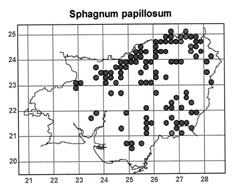 Widely distributed and locally abundant, with concentrations north of the Tywi, along the quartzite ridge and on the Coal Measures. It is not as abundant on Mynydd Du as might be expected - presumably as a consequence of bog degradation. It occurs in a variety of open mire, bog and wet heath habitats. In the uplands it only persists in quantity on relatively unmodified mire and bog. Typical NVC communities include M6, M15, M18, M19 and M25a. It is one of the main peat-builders of acid bogs where it often forms quite firm hummocks. It is often associated with S. subnitens and S. capillifolium, with which it may grow intermixed. Hummocks of S. papillosum often support a variety of liverworts, including Calypogeia spp., Cephalozia spp., Cephaloziella spp., Gymnocolea inflata, Kurzia pauciflora and Odontoschisma sphagni and, more rarely, Mylia anomola.
Alt. 30m (Cors Goch, Llanllwch, SN3618) to 500m (Blaenllynfell, Mynydd Du, SN7618).
Capsules not noted.
Sphagnum palustre L.
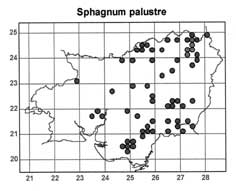 Another widespread species, occurring in a variety of mesotrophic and mildly acidic habitats. The distribution is similar to that of S. papillosum, but it appears to be less common in the north of the county and in the uplands. It is often prominent in the Juncus effusus sub-community (M6c) and Juncus acutiflorus sub-community (M6d) of M6 flush, where it is often accompanied by Polytrichum commune. In the uplands it occurs on slightly flushed grassy slopes and by streams. On bogs it may grow intermixed with S. recurvum, whilst in wet woods common associates may include S. fimbriatum, S. recurvum and S. squarrosum. Slightly squarrose forms of S. palustre (often growing in shade) are not infrequent and may be mistaken for S. squarrosum.
Alt. 30m (Cors Goch, Llanllwch, SN3618) to 400m (Mynydd Mallaen, SN7242). Capsules rare.
Sphagnum magellanicum Brid.
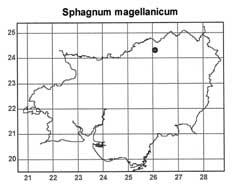 Rare, recorded once near Esgairdawe, where it occurs in rather atypical habitat - flushed and rather heathy Molinia grassland (M25a). Associates included Narthecium ossifragum, Carex panicea, Erica tetralix, Sphagnum recurvum and S. auriculatum. The typical wine-red form is unmistakeable, but green plants are easily overlooked as S palustre or S. papillosum. The species should be searched for in good quality, relatively unmodified bogs, basin and valley mires.
SN6142, upper Nant Thames valley, JMSB, Sep. 1994.
Sphagnum squarrosum Crome
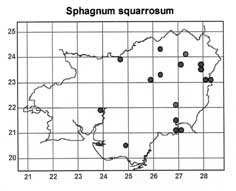 A few scattered localities, mainly in the lowlands in the eastern part of the county. It is a distinctive plant that is only likely to be confused with squarrose forms of S. palustre and robust forms of the next species.
Where it does occur it is often abundant. It is usually found in mesotrophic marshy or swamp habitats, often under the shade of scrub. At Talley Lakes (SN6333) it is abundant under alder and birch, where associates include S. palustre, S. fimbriatum and Polytrichum commune. It has also been recorded at the edges of soligenous mires in the uplands (e.g. the Llyn y Fan Fach area (SN8023) and Waun Ddu (SN8230)). Here, common associates include Juncus spp., Sphagnum recurvum and S. auriculatum.
This species is sometimes associated with tall sedge and Phragmites fen in the Swansea area and it may possibly occur in similar habitat around Llanelli.
Alt. 30m (Cors Goch, Llanllwch, SN3618) to 370m (Mynydd Du, SN8230).
Capsules rare.
Sphagnum teres (Schimp) Ångstr.
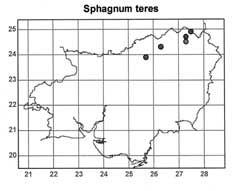 A rare species, recorded from five localities in the north-east of the county. There is also an unlocalized 1976 record from Caeo forest in the same general area. It occurs on flushed ground where there is some slight base-enrichment of the water. Two of the records are from M6d flush where associates included Juncus acutiflorus, Carex panicea, Lotus uliginosus and Sphagnum recurvum. Sphagnum teres intergrades with S. squarrosum, but highly squarrose forms have not yet been noted in the county.
Unlocalized record Caeo Forest, MOH & EWJ, c.1976; SN7345, Mynydd Mallaen, RGW, 1980; SN7246, Nant Melyn, RGW, Sep. 1980; SN5738, Rhosydd Rhydcymerau, JMSB & DEG, Aug. 1991; SN6242, Rhyd-lydan, GSM, June 1993, SN7448, Allt Rhyd-y-Groes NNR, MN, Nov. 1997.
Alt. 200m (Brechfa Forest, SN5638) to 300m (Mynydd Mallaen, SN7244).
Capsules not noted.
Sphagnum fimbriatum Wils.
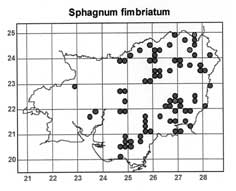 Common in the lowlands and uplands, with records from all but the westernmost part of the county. It occurs on the floor of carr woodland and on flushed slopes in hanging oak woodland (W17). In conifer plantations it is frequently found at the edges of ditches and on flushed banks. It occasionally forms lawns in M6 flush, particularly in the uplands. Common associates include S. palustre, S. subnitens, S. recurvum and Polytrichum commune. In oak woodland in the north-east of the county, it is occasionally found with S. quinqefarium.
Alt. 10m (Pwll, SN4701) to 550m (nr. Llyn y Fan Fach, SN8020).
Capsules common.
Sphagnum russowii Warnst.
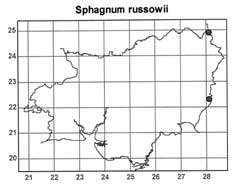 A rare species, although possibly overlooked. It has been recorded in the uplands in flushed Juncus vegetation by the track leading up to Llyn y Fan Fach, and at the edge of a base-rich seepage with Calliergon sarmentosum near Llyn Brianne. In the rest of Britain it is usually associated with flushed rocky and grassy banks on moors and in upland woods, including conifer plantation (Hill et al., 1992). It should be looked for in the north-east of the Carmarthenshire where there is much suitable habitat.
However, there are very few records from the southern half of Wales and it is likely to be genuinely rare in the county.
SN7418, Mynydd Du, unconfirmed record RNS pers. comm.; SN8022, nr. Llyn y Fan Fach, GSM, Oct. 1996; SN8049, nr. Llyn Brianne, JJG & GSM, Mar. 1997.
Alt. 300m (Llyn Brianne, SN8049) to 400m (nr. Llyn y Fan Fach, SN8022).
Capsules not noted.
Sphagnum quinquefarium (Braithw.) Warnst.
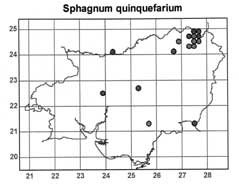 This species is mainly recorded from oak woodlands (W17) in the Teifi, Gwili, Cothi and upper Tywi valleys. Here, it is often abundant on heathy, rocky slopes. Elsewhere in Britain it is recorded from more open upland habitats, but it has not yet been found in this situation in Carmarthenshire. Associates include Sphagnum recurvum, S. fimbriatum and S. capillifolium. The record from the Twrch valley in the extreme south-east needs confirmation. In some earlier surveys there has been a tendency to name all green Sphagnum in woodland as S. quinquefarium; without voucher specimens, most of these records have been omitted.
Alt. c.100m (Teifi & Gwili valleys), 150m (Cothi valley, SN5226) to 400m (Mynydd Mallaen, SN7442).
Capsules not noted.
Sphagnum capillifolium (Ehrh.) Hedw.
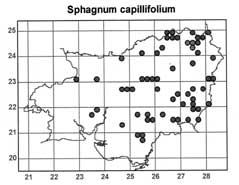 Widely but thinly distributed throughout all but the westernmost parts of the county. It is frequent in a variety of mire, wet heath and bog habitats in both the lowlands and uplands, although it is often most abundant on deep peat. Typical NVC communities include M15, M17, M18 and M19, and less frequently M6 and M25a. In the north-east of the county, it is sometimes noted on banks in open deciduous woodland (W17). Red plants (formerly known as S. rubellum) appear to be more common than green plants, particularly in open habitats on deep peat, but the two often occur together.
Alt. 30m (Cors Goch, Llanllwch, SN3618) to 650m (nr. Llyn y Fan Fach, SN8020).
Capsules occasional, late summer.
Sphagnum subnitens Russ. and Warnst.
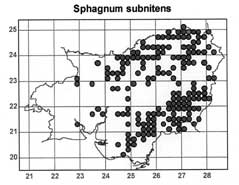 The most commonly encountered Sphagnum species. Frequent in both the lowlands and uplands either side of the Tywi valley, with a scattering of records further west. It occurs in a wide variety of habitats including bog, flush, marshy grassland and open woodland; it is particularly common in M6 flush and in heathy communities such as M15, M24c and M25a; S. papillosum and S. recurvum are frequent associates. It is occasionally prominent at the edges of M10 and M37 flushes, growing on raised ground that is not in direct contact with the base-rich ground water. It can form quite firm hummocks which may support a varied liverwort flora including Calypogeia spp., Cephalozia spp., Cephaloziella spp. and Gymnocolea inflata.
Alt. 10m (Whitehill Down, SN2913) to 650m (nr. Llyn y Fan Fach, SN8022). Capsules common.
Sphagnum molle Sull.
The 1981 Census Catalogue lists S. molle as occurring in v.c.44, but there are no details, and it does not appear in the 1992 Atlas - it may be an error or an unlocalized record. An oceanic species, widely although sparsely scattered throughout Britain, and apparently much overlooked (Hill et al., 1992).
Habitats from which it has been recorded include damp peaty streamsides, blanket bog and wet heath.
Sphagnum compactum DC.
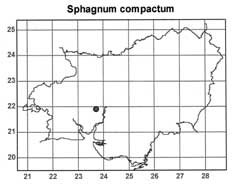 Despite the widespread occurrence of suitable habitat in the county, this species has been recorded only twice. On Cors Goch SSSI it occurs sparingly in M15 wet heath. There is also an unlocalized record from SN41 (Hill et al., 1992). It may be somewhat overlooked but it is also rare in adjacent counties, with only two localities in Glamorgan (Wade et al., 1994) and one recent record from Ceredigion (Hale, 1996). In the rest of Britain it is chiefly a species of wet heaths and damp heathy grassland where the peat is shallow and very acidic (Hill et al., 1992). It is a coloniser, regenerating rapidly on burnt wet heaths.
SN3618, Cors Goch, Llanllwch , BBS, April 1978; SN41, unlocalized and undated record (Hill et al., 1992).
Alt. 30m (Cors Goch, Llanllwch, SN3618). Capsules not noted.
Sphagnum auriculatum var. auriculatum Schimp.
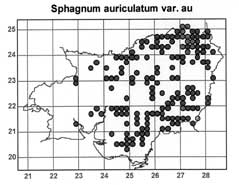 One of the most commonly encountered species, with a similar distribution to S. subnitens. The map shows it to be absent only from coastal areas, the Tywi valley and the far west of the county. It occurs in a variety of habitats, most notably bog, flush and marshy grassland where it often forms lawns. Typical NVC communities include M1, M6, M24 (particularly the M24c sub-community), M25 and M29. S. auriculatum var. auriculatum is a very variable plant. Green, tumid forms are often found growing submerged in bog pools, runnels and ditches. The coppery form with strongly curved branches ('cows horns') is particularly noticeable on flushed banks and dripping rocks in the uplands. Other forms may resemble var. inundatum and can be difficult to identify (many specimens have been checked, and not all plants can be positively ascribed to a variety using the characters given in Hill (1978)).
Alt. 10m (Whitehill Down, SN2913) to 650m (nr. Llyn y Fan Fach, SN8020).
Capsules rare.
Sphagnum auriculatum var. inundatum (Russ.) M.O. Hill (S. subsecundum ssp. inundatum (Russ.) A. Eddy)
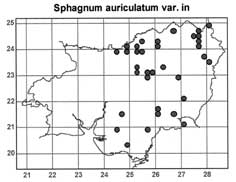 Many specimens of S. auriculatum have been examined by the authors and var. inundatum appears to be genuinely less common than var. auriculatum. The distribution map shows a sparse scatter of records, mainly in the eastern half of the county. It has been recorded from wet heath (M15), acid flush (M6), at the edges of base-rich flushes (M10) and on stream banks. Although most records are from the lowlands, this is probably just a reflection of the intensity of recording there.
Alt. 10m (Whitehill Down, SN2913) to 300m (Nant Clawdd valley, SN6646).
Capsules not noted.
Sphagnum contortum Schultz
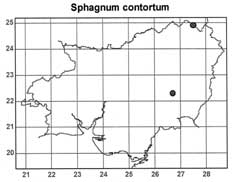 This species has only twice been recorded in the county. At Llwynyrynn it is occasional in a baseenriched flush (M10), where associates include Campylium stellatum, Bryum pseudotriquetrum, Calliergon cuspidatum and Aneura pinguis. At its other locality near Allt Rhyd-y-groes it occurs as scattered plants at the edges of a mildly base-enriched runnel in Molinia grassland, where associated bryophytes include Calliergon cuspidatum and Drepanocladus revolvens.
SN6723, Llwynyrynn, DEG, Aug. 1992; SN7548, nr. Allt Rhyd-y-groes, GSM et al., Mar. 1996.
Alt. 170-200m.
Capsules not noted.
Sphagnum cuspidatum Hoffm.
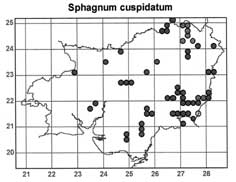 A wide scatter of records with concentrations on Mynydd Du, the Cambrian Mountains and along the quartzite ridge. However, it is less common on Mynydd Du than would be expected, again presumably a consequence of overgrazing and/or burning. It is one of the more easily recognised species, particularly when growing in water, where it is often described as resembling the fur of 'drowned cats'. Typically it occurs in waterlogged acidic habitats and can be dominant in pools (M1 and M2) on ombrotrophic bogs, in peaty ditches, and can be found colonising damp bare peat. It also frequently occurs in damp depressions on M15 wet heath. Associated species in better developed bog-pools may include Rhynchospora alba, Drosera rotundifolia, D. intermedia and Vaccinium oxycoccos.
Alt. 30m (Cors Goch, Llanllwch, SN3618) to 650m (nr. Llyn y Fan Fach, SN8020).
Capsules occasional.
Sphagnum tenellum (Brid.) Brid.
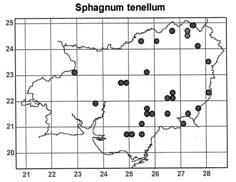 Widely, but sparsely distributed in both upland and lowland areas, the main concentration of records centred on the mires associated with the quartzite ridge, north-east and south-west of Carmel. As with S. compactum, it is surprising that it is not encountered more frequently as there is much suitable habitat in the county. It is mainly recorded from wet heath (M15) and modified ombrotrophic mires. Associated species typically include Molinia, Calluna vulgaris, Erica tetralix, Scirpus cespitosus, Carex panicea, Hypnum jutlandicum and Sphagnum subnitens.
Alt. 30m (Cors Goch, Llanllwch, SN3618) to 550m (nr. Llyn y Fan Fach, SN8022).
Capsules occasional.
Sphagnum recurvum var. amblyphyllum (Russ.) Warnst. (S. flexuosum Doz. & Molk.)
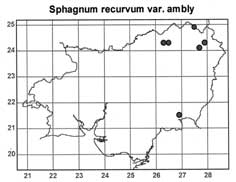 Rare, but doubtlessly overlooked. Recorded from only five localities, mainly in the north-eastern part of the county. It has mostly been noted in M6 flush, where typical associates include Molinia, Juncus acutiflorus, Agrostis canina, Carex spp., Aulacomnium palustre, Polytrichum commune and other Sphagnum spp. SN6242, nr. Esgairdawe, JMSB & GSM, June 1993; SN7842, nr. Rhandirmwyn, JMSB, Jul. 1994; SN7641, nr. Cilycwm, JMSB, Aug. 1994; SN6914, nr. Garnant, GSM, Aug. 1994; SN6443, nr. Harford, JMSB & GSM, Sep. 1994, SN7448, Allt Rhyd-y-Groes NNR, MN, Nov. 1997.
Alt. 100m (nr. Cilycwm, SN7641) to 200m (nr. Esgairdawe, SN6242).
Capsules not noted.
Sphagnum recurvum P. Beauv. var. tenue Klinggr. (S. angustifolium (Russ.) C. Jens.)
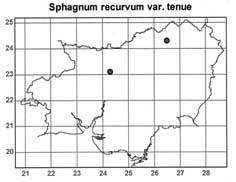 Rare, but probably under-recorded. It has only twice been found in Carmarthenshire, where on both occasions it occurred in flushed grassland. At one site associates included Molinia caerulea, Carex panicea, Succisa pratensis, Aulacomnium palustre, Polytrichum commune, Sphagnum papillosum, Sphagnum subnitens and Gymnocolea inflata. SN6443, nr. Harford, GSM, Sep. 1994; SN4330, Dyffryn Croes, SA, Jul. 1995.
Alt. 130-160m.
Capsules not noted.
Sphagnum recurvum P. Beauv. var. mucronatum (Russ.) Warnst.
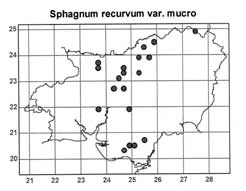 One of the commonest species, widely distributed and absent only from the far west of the county and along the Tywi valley. Often abundant in acid mire and wet heath (e.g. M15 and M25) and soligenous flush (M6) in both the uplands and lowlands, where it may form extensive lawns. It is also frequent in Eriophorum angustifolium bog pools (M3) in blanket mire on Mynydd Mallaen and Mynydd Du (Burn, 1982; Day & Burn, 1983). It is not uncommon on flushed banks in damp woodlands. Typical associates include Polytrichum commune, Sphagnum subnitens, S. fimbriatum, S. palustre, S. auriculatum, Molinia, Carex spp. and Juncus spp.
Alt. 30m (Cors Goch, Llanllwch, SN3618) to 550m
(nr. Llyn y Fan Fach, SN8022). Capsules rare.
Of the species not yet recorded from Carmarthenshire, the following are perhaps the most likely to occur.
Sphagnum girgensohnii Russ.
This species should be looked for on wooded slopes in the north-east of the county and on shaded banks in the uplands. In the main part of its British range it is often accompanied by S. russowii.
Sphagnum warnstorfii Russ.
This species has been recorded from the Elan Valley in Radnor (SN96) (Woods, 1993) and from Ceredigion (SN45 and SN77) (Hale, 1996). It may occur in mildly base-enriched flushes in the Cambrian Mountains in the north-east of the county. A specimen of S. warnstorfii was found in an unlabelled collection of bryophytes thought to be from the Ystradffin area (SN7846) near Rhandirmwyn.
Sphagnum platyphyllum (Braithw.) Warnst.
Recorded from just outside our area (SN95) (Hill et al., 1992), and more recently in Pembrokeshire and Brecknock (M. Yeo, pers. comm., 1997). As with S. warnstorfii, this species should be sought in baseenriched flushes in the north-east of the county and perhaps also on Mynydd Du.
Sphagnum subsecundum Nees
As with S. platyphyllum and S. warnstorfii, this species should be looked for in flushed rushy areas where the ground water is slightly base-enriched; S. contortum, S. teres and Drepanocladus exannulatus are common associates (Hill et al., 1992).
Recorders, collectors and abbreviations
SA - Sarah Andrews
JJG - J. J. Graham
EWJ - E.W. Jones
BBS - British Bryological Society
MOH - M. O. Hill
MY - Marcus Yeo
JMSB - J. M.S. Bevan
GSM - G. S. Motley
RGW - R. G. Woods
MN - Martha Newton
Acknowledgements
We would like express our gratitude to the many people who have contributed bryophyte records to the scheme. Special thanks are due to Sarah Andrews, Jamie Bevan, Dawn Gray, Richard Howarth, Morfydd Lloyd and Ray Woods for the many Sphagnum records submitted, and the Countryside Council for Wales for access to survey data. We would also like to thank Tim Blackstock, Jamie Bevan, David Stevens, Ian Morgan and Marcus Yeo for their constructive criticism of earlier drafts of this paper. We are indebted to Dr Alan Morton for the use of his DMAP computer mapping software which Richard Pryce used to produce the final versions of the distribution maps.
References
Burn, A. (1982). WFU Upland Vegetation Survey. No.2: Cothi-Tywi and Mynydd Mallaen. NCC Report, Bangor.
Corley, M.F.V. & Hill, M.O. (1981). Distribution of Bryophytes in the British Isles. A Census Catalogue of their Occurrence in Vice-Counties. British Bryological Society, Cardiff.
Daniels, R.E. & Eddy, A. (1990). Handbook of European Sphagna. ITE. HMSO, London.
Day, P. and Burn, A.M. (1983). WFU Upland Vegetation Survey. No 12: Mynydd Du (Black Mountain), Brecknock/Dinefwr. NCC report, Bangor.
Duncan, J.B. (1926). A Census Catalogue of British Mosses. BBS, Berwick-upon-Tweed.
Graham, J.J. & Motley, G.S. (1996). Recording for a bryophyte flora of Carmarthenshire. The Bulletin of the Llanelli Naturalists 2, 14-16. Llanelli.
Hale, A.D. (1996). A Provisional Register of Rare Bryophytes in Ceredigion (v.c.46). CCW Report, Aberystwyth.
Hill, M.O. (1978). Sphagnopsida in: The Moss Flora of Britain & Ireland, edited by A.J.E. Smith, 30-78. CUP, Cambridge.
Hill, M.O. (1992). Sphagnum: a field guide. Revised and updated by N.G. Hodgetts and A.G. Payne. JNCC, Peterborough.
Hill, M.O., Preston, C.D. & Smith, A.J.E. (1992). The Atlas of the Bryophytes of Britain and Ireland (Vol.2). Harley Books, Colchester.
Hodgetts, N.G. (1995). Bog moss in Britain - the identification and role of Sphagnum. British Wildlife 7, 9-17.
Rodwell, J.S. (ed.) (1991a). British Plant Communities. Volume 1. Woodland and Scrub. CUP, Cambridge.
Rodwell, J.S. (ed.) (1991b). British Plant Communities. Volume 2. Mires and Heaths. CUP, Cambridge.
Sherrin, A.L.S. (1946). Census Catalogue of British Sphagna. Revised by A. Thompsom. BBS, Berwick-upon-Tweed.
Smith, A.J.E. (1978). The Moss Flora of Britain & Ireland. CUP, Cambridge.
Wade, A.E. (1948). The bryophytes of Carmarthenshire (parts I & II). Trans. Brit. Bryological Soc. 1., BBS.
Wade, A.E., Kay, Q.O.N. and Ellis, R.G. (1994). Flora of Glamorgan. NMW, Cardiff.
Woods, R.G. (1993). Flora of Radnorshire. NMW, Cardiff.
Appendix
NVC communities and sub-communities mentioned in text:
M1 Sphagnum auriculatum bog pool community
M2 Sphagnum cuspidatum/recurvum bog pool community
M3 Eriophorum angustifolium bog pool community
M6 Carex echinata-Sphagnum recurvum/auriculatum mire
M6c Juncus effusus sub-community of M6 mire
M6d Juncus acutiflorus sub-community of M6 mire
M10 Carex dioica-Pinguicula vulgaris mire
M15 Scirpus cespitosus-Erica tetralix wet heath
M17 Scirpus cespitosus-Eriophorum vaginatum blanket mire
M18 Erica tetralix-Sphagnum papillosum raised and blanket mire
M19 Calluna vulgaris-Eriophorum vaginatum blanket bog
M24 Molinia caerulea-Cirsium dissectum fen-meadow
M24c Juncus acutiflorus-Erica tetralix sub-community of M24 fen-meadow
M25 Molinia caerulea-Potentilla erecta mire
M25a Erica tetralix sub-community of M25 mire
M29 Hypericum elodes-Potamogeton polygonifolius soakway
M37 Cratoneuron commutatum-Festuca rubra spring
W2 Salix cinerea-Betula pubescens-Phragmites australis woodland
W4 Betula pubescens-Molinia caerulea woodland
W17 Quercus petraea-Betula pubescens-Dicranum majus woodland