Llanelli Naturalists Newsletter - May 1995 - No 1
David M. John
Estuaries are important wetlands for waterfowl but are inhospitable environments for attached seaweeds because of the predominance of mudflats and sandflats, often absence of rocky shores, large tidal range and dilution of seawater by freshwater from land drainage. The coastal area of Llanelli lies within the Loughor Estuary and so its seaweed flora contains only a fraction of the 580 species known from England and Wales. A stroll along the strandline of the beach at Llanelli gives some idea of the local seaweeds for these lie washed up along with saltmarsh plants and other debris. It is only possible to conjecture on the origin of these drift plants, but no doubt many of the seaweeds originate from the nearby breakwaters and bastions although these structures have existed for less than two years. The majority of the hard surfaces suitable for seaweed colonisation in the Loughor Estuary are man-made, usually taking the form of harbour breakwater systems and rock or clinker foreshores built to protect against coastal erosion.
The following account is a beef introduction to the commoner seaweeds of the Llanelli Coast and their distribution in the vicinity of Llanelli itself and Burry Port/Pembrey. The observations are based on visits made in April and August 1994 and April 1995. Only the larger (greater than 1 cm in size) and more distinctive seaweeds are considered in any detail. Some of these seaweeds are illustrated and each is briefly described when first mentioned. To confirm the identification of these red and green seaweeds it is necessary to take into account microscopic characters.
Llanelli Foreshore
In recent years the foreshore has been transformed by the completion of two stone breakwaters (`fish-tail groynes') and smaller bastions. Imported coarse sand has been used to build up the beach between them and has resulting in the burial of a series of wooden groynes. These new man-made structures have provided surfaces that are ideal for the attachment of seaweeds and are good examples of unintentional habitat recreation.
Distinctive bands of brown seaweeds are already beginning to develop on the breakwaters and bastions on the beach at Llanelli. There is to be found at the uppermost level of the intertidal a felty covering of the fine, hair-like green alga Enteromorpha prolifera. Immediately below are thin. sheets of laver (Porphyra umbilicalis), a red seaweed despite its purplish-brown colour, accompanied by the spiral sea wrack (Fucus spiralis). The flattened branches of this brown seaweed are spirally twisted hence its common name. In the fertile condition the tips of its branches are swollen and around each extends a narrow marginal ridge. Still lower on the shore are two other sea wracks, the bladder wrack (Fucus vesiculosus) and the saw wrack (Fucus serratus). The branches of the bladder wrack have bladder-like swellings to the side of the central midrib (sometimes in pairs) and at the branch fork. On occasional the branches of the spiral wrack are swollen but these are irregular and never bladder-like. The name 'saw wrack' derives from the toothed appearance of the margin's of each branch. Less frequent is another brown alga, the knotted or egg wrack (Ascophyllum nodosum), whose flattened olive-brown branches consist of a series of elongate bladders.
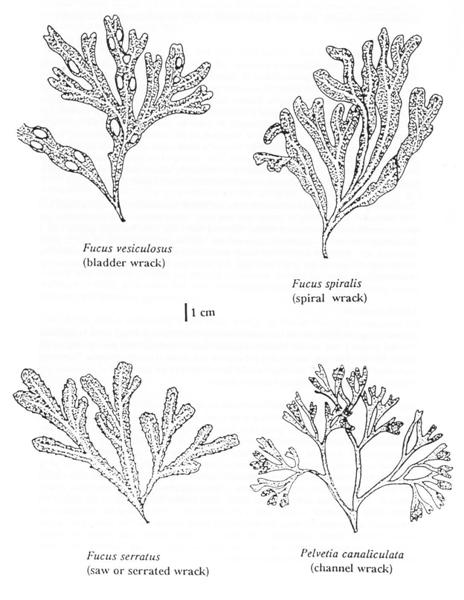
The bladder wrack is frequent on stones overlying the muddy area of foreshore lying below the more steeply sloping sandy beach. Often accompanying the bladder wrack is the laver seaweed and the narrow, green, strap-like branches of Enteromorpha intestinalis (no common name). Also present on these stones is another green seaweed, the thin sheets of the sea lettuce (Ulva lactuca). Occasionally growing on the sea wracks are tufts of the limp, hair-like brown seaweed Acinetospora crinita.
All the above mentioned seaweeds are also cast up on the beach. Seaweeds bleach as they decay and dry out so making it difficult to identify plants collected along the strandline.
Burry Port and Pembrey Foreshore Burry Port Harbour
The harbour is one of the most important seaweed habitats along the coast. The steeply sloping walls of its wave-sheltered inner basin are covered with a carpet of mostly brown seaweeds. These are not haphazardly arranged but occupy vertical bands or zones that to some extent reflects their tolerance to drying out during low water. It follows that seaweeds growing higher up the shore are adapted to survive longer periods of exposure to the air than those at lower levels.
Wave splash and spray extend marine influences above the limit of the tides. This area of shore is recognised by the presence of what appears from a distance to be a band of yellow-orange and blackish lichens. On closer inspection the rocks are seen to covered by yellow-orange crusts of Caloplaca (e.g., C. manna, C. thallincola, C. microthallina) and black patches of Verrucaria maura that are easily mistaken for tar spots. These lichens sometimes overlap with a lower band of two brown seaweeds, the spiral wrack (Fucus spiralis) and the channelled wrack (Pelvetia canaliculata). The branches of the channelled wrack are inrolled at the edges to form a conspicuous channel (hence its name) and it becomes almost black and very brittle if left dry for several days. On occasion it forms a distinct band immediately above a band of the spiral wrack. In April 1995 patches of the dark green, somewhat wedge to fan-shaped, flattened fronds (to 1 cm long) of the green alga Prasiola stipitata were common in the splash zone and just below. Sometimes green mats of Enteromorpha prolifera are present at this level on the shore and extend downwards to about the mid-tide level. On the more sheltered sides of large boulders Enteromorpha grows with Rhizoclonium tortuosum, another green and hair-like seaweed. To distinguish between these two seaweeds requires microscopic examination. A 10x hand lens is just sufficient to see that the filaments of Enteromorpha prolifera are branched and those of Rhizoclonium are simple or bear short peg-like branches. In damp shaded cracks and crevices there are purplish-black clumps or mats of Catenella caespitosa. Despite its colour this is a red seaweed and consists of swollen, sausage-like branches, about 1-3 mm in width. Often barnacles are present in quantity at this shore level and the vertical limit of these sessile animals and the sea wracks approximates to the uppermost limit of the tides.
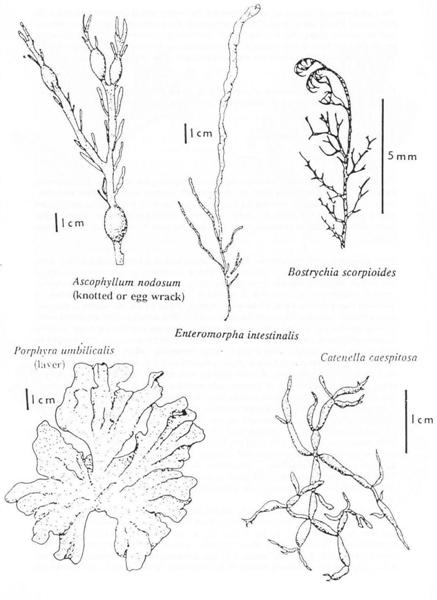
The walls of the harbour basin at about mid-tide level are covered by a mixed band of the bladder wrack, saw wrack and knotted wrack. These sea wracks also grow on stones, rocks and other hard objects lying on the muddy floor of the harbour. The knotted wrack is less common outside the harbour and is absent from the wave-exposed westerly side of the main breakwater. It thrives in relatively sheltered habitats and is known to be intolerant of violent wave action. Epiphytes are occasionally present on the sea wracks. Growing on the knotted wrack are dense, dark reddish-purple, spherical tufts of the finely branched red alga Polysiphonia lanosa and on the bladder wrack the brush-like tufts formed of the minute radiating filaments of the brown alga Elachista fucicola.
There are a few small pools on the more wave-exposed tip of the main breakwater. In two tidepools visited in April and August there were found the green seaweed Chaetomorpha linum and the red seaweed known as carragheen or 'Irish moss' (Chondrus crispus). Chaetomorpha is formed of coarse (to 0.5 mm wide), unbranched, hair-like strands whereas Irish moss is bushy, purplish-red, and consists of flattened and regularly divided branches. Microscopic examination of Chaetomorpha revealed on its surface the minute, filamentous red seaweed known as Audouinella. Two other algae were present in these pools in April 1995, the flattened and ribbon-like fronds of the brown alga Petalonia fascia and the brownish-red, terete (circular in cross section), hollow, branches of the red alga Dumontia contorta (=D. incrassata). Bands of the mussel Mytilus edulis occur on the wave-exposed outer parts of the breakwater along with the sea lettuce Ulva lactuca.
Saltings
The saltmarsh lying to the west of Burry Port Harbour became a local nature reserve in 1993. Its higher plants are well-known, but the less conspicuous seaweed vegetation has received little or no attention. Seaweed diversity is low and, like other saltmarsh plants, the seaweeds show a vertical zonation relating to the frequency of inundation by the tides, salinity variations, and changes in the nature of the substratum.
About one kilometre west of the harbour lies another breakwater forming part of what was formerly Pembrey Harbour. Some of the more frequently encountered saltmarsh plants in its immediate vicinity include Halimione portulacoides, Spartina anglica, Salicornia spp. Sueda maritima, Armeria maritima, and Aster tripolium. Very close to where the marsh meets the breakwater there are clumps of channelled wrack and spiral wrack growing attached to small stones tying amongst the rooted saltmarsh plants. Two small purplish-black seaweeds (Catenella caespitosa, Bostrychia scorpioides) are also found at this upper tidal level. These are both red seaweeds despite their colour and principally grow on the stems and undersurface of leaves of saltmarsh plants, especially Halimione portulacoides. Bostrychia scorpioides is distinctive in having strongly incurved tips to its minute, branched filaments.
Blackish mats of blue-green bacteria (often known as 'blue-green algae') are frequently encountered on bare areas of mud and sometimes cover the lower stems of rooted plants These bacteria and microscopic algae known as diatoms (brown, silica-walled unicells) are only evident when present in vast numbers. Diatoms are responsible for the golden brown discolouration of open areas of mud. Immediately below the rooted plants, and tending to fringe channels in the saltmarsh, are dark green, felty growths of Vaucheria (a yellow-green seaweed). Well-developed Vaucheria plants are spongy and its fine, regularly divided filaments tend to trap silt particles. Microscopic examination is essential to confirm Vaucheria and reproductive bodies have to be present to identify the species. Other algae present on hard surfaces in the salt marsh include the bladder wrack and two species of Enteromorpha, E. intestinalis and the much branched E. compressa.
Only one alga cast up on the shore was not detected growing attached in the area. This was the filamentous red alga Ceramium nodulosum (=C. rubrum which was collected in April 1995 on the eastern side of the main breakwater of Burry Port Harbour.
In Conclusion
Further more exhaustive exploration along the Llanelli Coast will undoubtedly lead to the discovery of less conspicuous seaweeds and those of more seasonal occurrence. The excellent Field Studies Council's AIDGAP series of fully illustrated keys (Hiscock, 1979, 1981) is recommended to anyone wishing to identify the commoner brown and red seaweeds. The most recent books dealing with green seaweeds (Burrows, 1991) and yellow-green seaweeds (Christensen, 1987) are published in the 'Seaweeds of the British Isles' series. Still to be published in this series are volumes that complete the red and brown seaweeds.
Acknowledgments
Thanks go to Dr William Purvis (Natural History Museum, London) for identifying the lichens, and Dr Judith John for identifying the rooted saltmarsh plants, constructively commenting upon the text, and encouraging me to write this article.
References
Burrows, E.M. (1991). Seaweeds of the British lsles Volume 2 Chlorophyta. The Natural History Museum, London.
Christensen, T. (1987). Seaweeds of the British lsles Volume 4 Tribophyceae (Xanthophyceae). The Natural History Museum, London.
Hiscock, S. (1979). A held key to the British brown seaweeds. Field Studies Council Publication No. S4.
Hiscock, S. (1986). A field key to the British red seaweeds. Field Studies Council Publication No. 13.