Llanelli Naturalists Newsletter - September 1984
Ian Morgan
The Limestone Outcrop
This article will concentrate on that part of the limestone which extends from the town of Cydweli to Mynydd Llangyndeyrn; the NE continuation of the limestone will be dealt with in a later article. The outcrop of the Carboniferous Limestone extends in fact all the way around the northern rim of the South Wales Coalfield, effectively delineating its boundary and in essence dividing rural Wales from that part dominated by industry, where the coals and ironstones on which was established so much of the early industries are to be found.
The limestone is tilted or 'dips' in our area in a roughly South-east direction and this dip is also a feature of the adjacent rock types. Mynydd-y-Garreg (MyG) and Mynydd Llangyndeyrn (ML) are prominent features because of the hardness of their rocks - the limestone itself and the overlying grits and quartzite’s (the quartzite outcrop will be discussed in the next article of this series).
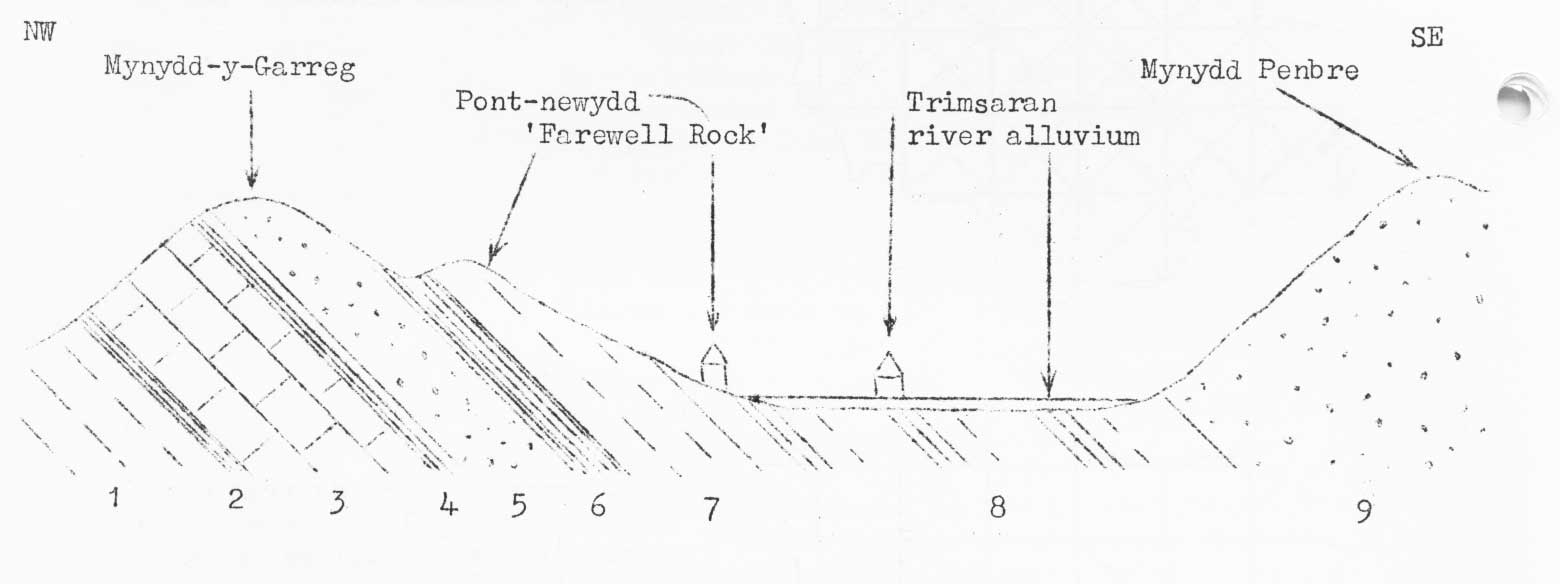
- Old. Red Sandstone
- Lower Limestone Shales
- Carboniferous Limestone
- Upper Limestone Shales
- Quartzites, grits
- Shales
- Flaggy sandstones and sandstone
- Shales and coals
- Pennant Sandstone
Not to scale and dip of strata exaggerated.
N.B. The harder rocks form prominent ridges whilst the softer shales have been eroded away to form depressions or valleys.
The Carboniferous Limestone vegetation contrasts greatly with the parallel and overlying outcrop of grit/quartzite that produces such poor, rocky acid soil, ,but farmers have cultivated pastorally the fertile limestone soil. Only a little of scrubby ash woodland survives on MyG but below ML better quality woodland still exists, a good example is that around the disused quarry near the ruins of Capel Dyddgen (SN4612) Here the young regenerating ashwoods are a pleasure in May, with carpets of Ramsons (Allium ursinum), Early Purple Orchids (Orchis mascula), Sweet Woodruff (Galium odoratum), Three-veined Sandwort (Moehrhyngia trinerva), with the Hart's Tongue Fern (Phyllitis scolopendrium) and Soft Shield Fern (Polystichum setiferum) abundant. Grasses on the limestone include Brachypodium sylvaticum, Milium uniflora and Zerna ramosa. A rarity that was found near this quarry is the shrubby with sweet-smelling purple flowers in very early spring, Spindle (Euonymus europaeus), colourful in autumn, grows in some areas.
In more open parts, both primroses (Primula vulgaris) and Cowslips (Primula veris) grow sometimes hybridizing to form intermediates 'False Oxlips'), with brick-red flowers as well as the more normal yellow or lemon. Common Spotted Orchids (Dactylorhiza fuchsii) colour the grassland and sunny banks, whilst both in sun and shade grows the unobtrusive Twayblade (Liparis ovate). The rare Herb Paris (Paris quadrifolia) was found by R.F. May, in limestone woods at Bleangaen (near Crwbin, SN476132); it has not been re-found.
Under shade, darker-coloured, early flowering violets are likely to be the Early Dog Violet (Viola reichenbachiana), though the commoner Dog Violet (Viola riviniana) occurs on the hedgebanks often with the former and probably hybridizing with it. For the beginner it may be difficult to separate these two species, so some ‘points of difference’ are tabulated in an appendix at the end of this article. The sunny, open areas of Capel Dyddgon quarry has interesting plants such as Salad Burnet (Poterium sanguisorba), Quaking Grass (Briza media) and a type of Meadow Rue (Thalictrium minus), Dame’s Violet (Hesperis matronalis) thrives on a hedgebank nearby.
By the almost-destroyed Limestone outcrop , at the Van Quarry SN4511, lanes on the Carmarthen side hold an abundance of Columbine (Aquilegia vulgaris) and Alexanders (Smyrnium olusatrum). Moving South-west to near the farm of Glan-hiraeth SN433086 are some old lime kilns where grows Greater Knapweed (Centaurea scabiosa), while some rocky outcrops MyG hold a few plants of Traveller’s Joy (Clematis vitalba), another lime lover. On shallow soils grows the Autumn Felwort (Gentianella amarelle) first noted here in 1930 by A.E. Wade but still thriving.
On Mynydd Llangyndeyrn stands a ruined cottage amongst an ash copse and around it, abundantly grows a naturalized population of the yellow (sometimes Orange), flowered Welsh Poppy (Meconopsis cambrica), and farther North-east, to near 'Clos-yr-yn' ('the enclosure of the ash trees') SN493136, is a warm South-east -facing bank with much Thyme (Thymus drucei) and Brittle Bladder Fern (Cystopteris fragilis) growing in limestone fissures.
The old mill at Felindre SN459124 (literally 'mill-settlement') was powered by a strong current of water emanating from below the limestone. (The mill is near outcrop of the softer Lower Limestone Shales which contain micro-fossils called ostracods, just visible to the naked eye). On the stream can be seen the Beautiful Demoiselle (Calopteryx virgo), a large bottle-green damselfly, and nearby in the hedgerows and on walls grow a good variety of less common plants - the Dusky Cranesbill (Geranium phaeum), Shining Cranesbill (Geranium lucidum), White Dead Nettle (Lanium album)¬, Bistort (Polygonum bistorta), Greater Celandine (Chelidonum majus) , White Stonecrop (Sedum album) and Red Valerian (Centranthus ruber).
The 'climax vegetation' (i.e. if man had not interfered) of the limestone would have been Ash-hazel woodland, with other woody species in lesser quantities. If the outcrop had been south-facing instead and greater in vertical extent with exposed areas of rocks then we could have expected rarities e.g. rare white-beams or the rare flora found on Gower's warm, south-facing cliffs.
The birds of the area are not exceptional but Stock Doves and Kestrels nest in old quarries and the woodlands have their quota of typical local forest birds, including Tawny Owls roosting on ivy-covered rocks and nesting Buzzards making use of the woods for nesting, whilst hunting over the productive farmland to the North Mammals include badgers and the very rare Greater Horseshoe Bat at one cave.
The limestone has been quarried for a long-time - for liming unproductive acidic, fields, for 'flux' in blast furnaces, for building material, and more recently for road grit; the scale of modern quarrying operations is giving concern with the limestone’s distinctive, flora being threatened.Copper, tin and lead occur sporadically in veins, an adit near Graig Farm (SN438093) is a legacy of mineral extraction during the last century.
Moving away from 'the main limestone outcrop, an 'outlier' of limestone occurs on the farm of Ystrad Ferthyr (SN4212) and this wooded hillside also contains a typical calcareous flora. The farm is not without interest for it was here that William Salesbury, the chief translator of the first Welsh Testament (1567) spent some time when he was working on his translation. From MyG, one can look across to Llwyn-y-Barcut ('Kite Copse') and Allt Cunedda ('Cunedda's wooded hillside') both beyond Cydweli; Allt Cunedda is popularly believed to be the only site named after the Celtic King Cunedda, but some noted authorities dispute this - see Appendix 2.
Grayling butterflies - with perfectly camouflaged hind wings hiding the fore-wings at rests are common out on open, sunny ground; e.g. Capel Dyddgen quarry and near Clos-yr-yn, where can also be seen colonies of the local Marbled White and the diminutive Small Blue.
Three 'classical zones' (i.e. diversions), named after their main fossils (in the 'type area' in the Avon Gorge), are found in the limestone of our area, they are: Cleistopora (K), Seminula (S2) and Dibunophyllum (D); the first two fossils are brachiopods (vaguely similar, but totally unrelated to modern bivalves like the cockle), the latter (D) is a coral. The K zone is represented by the Lower Limestone Shales - as at Felindre - pale greenish-grey shales. The S zone is exposed in a row of large quarries with corals, productids and seminulids, very common fossils. The D zone starts with the brownish, friable 'Honeycombs Sandstone', then 'oolitic' limestone (again fossiliferous), finally passing up into highly fossiliferous beds. In this zone exists a fossil coral reef - filled with corals such as Lithostrotion and Syringopora and 3+ species of brachiopods - near the Four Roads quarry.
The fossil fauna often varies laterally (as does the rocks lithology ‘constitution’) from MyG to ML. Like life in modern environments, fossil species were adapted to a particular range of environmental conditions i.e. their 'ecological niche'. The D zone of MyG has species of a higher energy, wave-washed environment (some corals, crinoids and brachiopods) whilst ML has those more typical of quieter lagoonal conditions - a few crinoids, bivalves and gastropods. The Carboniferous Limestone was laid down some 370-325 million years ago in a mostly warm, shallow sea.
Appendix 1: Differences between Viola reichenbachiana (Early Dog Violet) and Viola riviniana (Common Dog Violet)
- The spur of Viola reichenbachiana is at least 1/3 less than the width of Viola riviniana.
- The spur is straighter and less bulbous at its end compared to Viola riviniana.
- The spur of Viola reichenbachiana is darker, that of Viola riviniana are usually of a pale blue-grey.
- The petals of Viola reichenbachiana are considerably narrower.
- Different leaf shape.
- The 'sepal appendages' are greatly shorter in Viola Reichenbachiana than in Viola riviniana.
- Viola reichenbachiana is often in full flower, under tree cover on the North facing Carboniferous Limestone outcrop when Viola riviniana is only starting to flower on South facing sunny slopes in the Llanelli area.
- Viola reichenbachiana is found on the limestone (and a few other calcareous localities e.g. Cwm Clydach, base of Mynydd Pembre); it is absent from acidic soils (on which Viola riviniana is common).
Appendix 2: Allt Cunedda
Cunedda (fl. c. 400?) Is said to have come down from the 'Welsh, kingdom of Manaw Gododdin (near Stirling) to dispute control of land occupied by Irish settlers in North Wales. These Irish settlers have left a legacy of place-names remaining to the present and their descendants were believed to be responsible also for the famous bilingual (Latin and Irish notched 'Ogom' script) ‘Votoporix Stone' now housed in Carmarthen Museum. The settlers are thought to have been the Déisí and Uí Liathain originating from Munster and Leinster at the start of the 4th century A.D.
Regarding the place name 'Allt Cunedda', the great Welsh place-name expert, the late Professor Melville Richards attributes it to a corruption (of the earlier 'Alit Cynatha') by early ordnance mappers. Incidentally, and finally, the correct meaning of Kidwelly/Cydweli is given by the authoritative Prof. Richards as the 'territory of Cadwal' ("Cadwal-i"); 'i' as a suffix denoting 'the land of’.