Llanelli Naturalists Newsletter - Winter 1992/1993
Phillip Jones
A guided walk looking for fungi held on Saturday, 17 October at Pembrey Country Park was very well attended. Nearly 30 people, including a group of Scouts, forayed in the morning and a further 30 or so people attended the afternoon walk. About 50 different species of fungi were found including a new record for the area of an "earth star" species. Earth stars are a form of puffball, generally uncommon but several varieties can be found in the Country Park and the adjacent Forest area. Three species had previously been found in the Country Park but one of the keen-eyed Scouts (Rhys Jones) found a fourth variety, Geastrum nanum. An advantage of having young people on such a walk is that they are inquisitive, and often find unusual specimens.
The group returned to the visitors centre at 1pm, a few with packed lunches staying for the afternoon. It was again nice to have families with children searching for more specimens in a different area of the Country Park and in part of the forest outside the perimeter fence. A patch of an unusual "jelly" fungus was found. This species, Tremiscus helvelloides, grows on the ground and is an unusual pink colour. It has only recently been recorded from Britain and seems to have spread from Central Europe but has now been found at a number of sites in this country. This species is said to be edible like its close relative the "Jews ear" fungus but these fungi do not have much flavour.
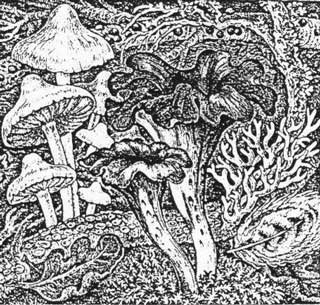 The tiny puffball Bovista limosa was again found this year in the Country Park. This is one of the rare fungi included in the provisional Red Data Book for fungi. Sand dune areas containing mobile "yellow" dunes as well as the older fixed "grey" dunes have interesting fungi and such areas around the Welsh coast are important, not just in a British but also in an European context.
On Sunday 18th October, a fungus foray was held at the Dinefwr Castle Woods Nature Reserve, Llandeilo. About forty members from several Dyfed Wildlife Trust sections met for the walk, though the narrow path through the Reserve was not very suitable for showing any specimens found. A picnic lunch was taken near Liandyfeisant Church before walking to the Castle and completing a circular walk. One of the interesting fungi found was Aqaricus placomyces, one of the mushroom family similar to the common field mushroom but not an edible species as it is one of the yellow-staining group which can cause gastrointestinal upsets if eaten. The common Jews-ear fungus, Auricula auricula-judae was found not only on elder, the usual host, but also on elm and sycamore. Old fruit bodies of the beefsteak fungus, Fistulina hepatica were found on several oaks.
The final foray was held on 31st October at Middleton Hall (SN527188) which was again well attended. Late in the season there were few of the larger agarics but plenty of smaller fungi and brackets growing on wood. There were some lovely porcelain fungi Oudemansiella mucida on beech branches, and several kinds of cup fungi were collected including the uncommon Pachyella babingtonia.
