Llanelli Naturalists Newsletter - May 2002 - No 68
Kath Cottingham & Richard Pryce
Leaders P A Jones, R D Pryce & G Hutchinson
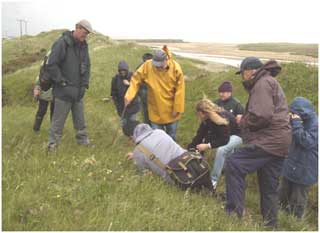 On an unseasonally dull and windy late-May afternoon, nine members and friends assembled at Pembrey Harbour having first been met by Phillip Jones in the car park by Burry Port Yacht Club, the advertised meeting-place. Severe mowing of the whole Burry Port Harbour area had forced the change of venue. It had been planned to show members the scarce plants which occur on the dock walls and on the meadow areas but all had been destroyed by the relentless and unnecessary vegetation-removal, mowing and herbiciding regime. This had totally ruined, not only the uniqueness of the site, but also the afternoon for many of those present. The leaders considered it unfair to expect members to pay the newly introduced car parking charges when there was very little of interest to see.
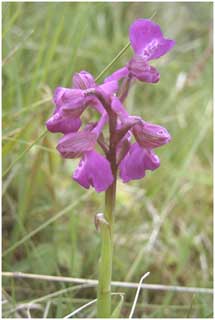
Whilst waiting in the cars at Pembrey Harbour a closely flying flock of about twenty Ringed Plovers (Charadrius dubius) wheeled over head. RDP gave a short introduction to the flora of Pembrey Harbour and the Ashburnham Dunes which form part of the Pembrey Saltings Local Nature Reserve, the Pembrey Coast SSSI and the Carmarthen Bay Saltmarsh and Dunes cSAC. The walk commenced just as the rain started but two plants of Hedgerow Cranesbill (Geranium pyrenaicum) were seen in flower on the northern harbour wall although most of the spring annuals had been desiccated by the previous dry weather and were unrecognisable. The rain seemed to be holding off as the small party walked towards the golf links. Few populations of Cowslip (Primula veris) were in evidence although few were still in flower but most noticeable, and pointed out by the leaders, was the abundance of Yellow Oat-grass (Trisetum flavescens), a characteristic species of these calcareous dune grasslands. Occasional Green-winged Orchids (Orchis morio) were soon encountered and became more frequent westwards. The party was soon joined by Barry and Sandra Stewart and Andrew Stevens. Immediately, Barry was able to demonstrate his knowledge of the invertebrates pointed out by the others: single caterpillars of the Oak Eggar (Lasiocampa quercus quercus) and The Lackey (Malacosoma neustria) moths. He then discovered a Small Blue butterfly (Cupido minimus) sheltering from the strong wind low in the vegetation in the vicinity of an abundant stand of Kidney Vetch (Anthyllis vulneraria), its larval food plant. He also drew attention to leaf mines caused by the larva of the moth Aprorema anthyllidella on Kidney Vetch, to a micro moth Elachista argentella and a stiletto fly Acrosathe annulata, a silvery-coloured male of a species restricted to coastal dune habitats.
 A small spinney of Sycamore (Acer pseudoplatanus) and Hawthorn (Crataegus monogyna) near the few remaining planted Corsican Pines (Pinus nigra ssp. laricio) had an ground flora incuding Ivy (Hedera helix), Lords and Ladies (Arum maculatum), Herb Robert (Geranium robertianum) and Polypody fern (Polypodium sp.) material of which was collected by GH for checking at the National Museum. A short stretch of path through the dunes with eroding and mobile-sand banks supported a rich community of characteristic plants. These included a good specimen of Sand Catchfly (Silene conica), several clumps of Heath Dog-violet (Viola canina) in seed, Dune Pansy (V. tricolor ssp. curtisii), Biting Stonecrop (Sedum acre), the nationally scarce Dune Fescue (Vulpia fasciculata), Sea Hard-grass (Catapodium marinum), Sea Holly (Eryngium maritimum) and Sea Bindweed (Calystegia soldanella). A little further on, considerable discussion took place between RDP, GH and BS over a single glabrous-leaved plant of Cat’s-ear (Hypochoeris radicata) and whether the plant was, in fact, Smooth Cat’s-ear (H. glabra), a species not seen in Carmarthenshire since 1982. The consensus was that it was only an aberrant H.radicata. There was then further discussion regarding the leaf-hairs on a non-flowering hawksbeard (Leontodon sp.) as to whether they were forked or not. They were forked and the plant was tentatively determined by its relatively large size as Rough Hawksbeard (L. hispidus).
As the rain finally came-down in earnest, the party hurriedly returned along the dune front cycle-path but GH made a detour out of the wind through inland dune hollows where he saw a Brown Hare (Lepus capensis), Hairy Tare (Vicia hirsuta) and more Heath Dog-violet.
