Llanelli Naturalists Newsletter - May 2002 - No 68
Ian Morgan
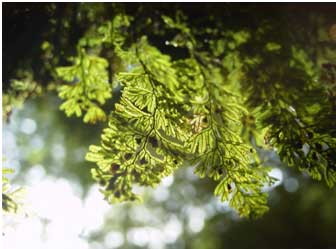
The Tunbridge Filmy-fern Hymenophyllum tunbridgense is a very small fern, growing typically in humid gorges on damp rock faces and mostly confined to the warmer and wetter ‘Atlantic’ fringes of Britain. It also occurs in the Weald of Kent – hence its English name. Until December 2001, there were only five records in Carmarthenshire - at Nant Melyn and Allt Rhyd-y-Groes near Rhandirmwyn; Cwm Twrch; near Gwernogle and Glyn-hir, Llandybie. At the latter site it was first noted by H.H.Knight in 1907 and then not seen again until R.H.Davies and R.N.Stringer literally stumbled upon it as they descended into the gorge in 1983. This population was monitored by the writer and by R.D.Pryce and a party of BSBI experts in Summer 2001.
The first of the new spate of records, resulting in almost a doubling of the Carmarthenshire sites, was the discovery of a large patch of Hymenophyllum tunbridgense on the left bank of the Aber Lledle river, (going downstream, before the waterfall) near Glyn-hir, Pont-Henri SN474103 (IKM, 3 December 2001) in the Gwendraeth Fawr valley. Subsequently, Sam Bosanquet (SDSB) provided new records for two more sites – in Cwm Berem, Pontyberem SN501123 and 501124 (at two sub-sites), and Allt Troserch, Llangennech SN548042. The Pont-Henri and Pontyberem localities were in deeply incised wooded gorges, cut through the Farewell Rock of the upper Millstone Grit (so-called because the early miners knew they would not find any workable coal below it), while at Allt Troserch, a large population (probably the largest in Carmarthenshire) occurs on Pennant Sandstone bluffs adjacent to the Afon Morlais. Most recently, eagle-eyed Sam spotted a large patch growing in a sheltered crevice on the left (eastern) bank of the Afon Cwm Mawr, south-west of Cencoed-uchaf, Llanelli SN478031 on 6 April 2002. These recent records of H. tunbridgense from gorge sites in south-eastern Carmarthenshire perhaps now cast a doubt on the identity of the old record of Wilson’s filmy-fern H. wilsoni from Cwm Lliedi, ‘below Ystradfair’, Felinfoel (c.SN518037) made by L.W.Dillwyn in c.1850. It is unclear whether at this date H. tunbridgense had been split from H. wilsonii, which at that time included all British filmy-ferns. Even if it had been recognised as a separate species by then, it is likely that it had not filtered through into the literature which would have been at Dillwyn’s disposal. So it is possible that his record does actually refer to what we now recognise as H. tunbridgense, but as the site was flooded by the construction of the Lower Lliedi Reservoir at the turn of the century, we shall never know. Interestingly, all the new sites (and the Glyn-hir, Llandybie, site) also support another scarce fern – the Hay-scented Buckler-fern Dryopteris aemula (additionally recorded by SDSB at Cwm Berem) and all are noteworthy bryophyte sites. D. aemula is itself a markedly ‘Atlantic’ species, found mostly in areas affected by the ameliorating influences of the Gulf Stream; it too is very scarce in Carmarthenshire. There is also the anomalous colony at the Roman Gold Mines at Dolaucothi
|
Site |
Grid Reference |
Hymenophyllum tunbridgense |
||
|
Amroth |
SN1707 |
|
JH, 1983 |
|
|
Little Trelissey Wood, Amroth |
SN181078 |
|
IKM, 18/3/99 |
|
|
Telpyn Farm, east of Amroth |
SN185078 |
|
IKM & RDP 14/10/87 |
|
|
Marros Mountain |
SN201095 |
|
IKM & RNS 5/2/02 |
|
|
Forge Cych |
SN254413 |
|
|
AOC, 1994 |
|
Cwm Coch Llanllwch |
SN358182 |
|
IKM & RNS, 1/02 |
|
|
Cwm Clydach, Pontnewydd |
SN437065 |
|
IKM, 1996 |
IKM, 1991 |
|
Coed-y-Glyn, Four Roads |
SN446075 |
|
IKM, 17/8/88 |
|
|
Glyn-fach, Portyates |
SN453083 |
|
IKM, 3/02 |
|
|
Cwm Mawr, Llanelli |
SN478031 SN478029 |
SDSB & IKM, 6/4/02 |
SDSB & IKM, 6/4/02 |
SDSB & IKM, 6/4/02 |
|
Cilmarch, NW of Llandyfaelog |
SN403133 |
|
|
IKM & RNS, 4/02 |
|
Cwmyrarian, NW of Llandyfaelog |
SN405145 |
|
|
IKM & RNS, 4/02 |
|
Glyn-hir, Pont-Henri |
SN474103 |
IKM, 3/12/01 |
IKM, 3/12/01 |
RNS, 12/01 |
|
‘below Ystradfair’, Felinfoel |
c.SN518037 |
L.W.Dillwyn c.1850 (possibly this species) |
|
|
|
Allt Troserch, Llangennech |
SN548042 |
SDSB, 2002 |
SDSB, 2002 |
|
|
Cwm Berem, Pontyberem |
SN501123 & SN501124 |
SDSB, 2002 |
SDSB, 2002 |
SDSB, 2002 |
|
Glynhir, Llandybie |
SN641151 |
BSBI, 29/7/01 |
BSBI, 29/7/01 |
|
|
Nant-marydd |
SN502320 |
SDSB, 13/4/02 |
|
|
|
East of Gwernogle |
SN520345 |
RGW, 1/7/00 |
|
|
|
Harrison Adit, Dolaucothi |
SN664403 |
|
IKM, 17/8/88 |
|
|
Roman Adit, Dolaucothi |
SN662401 |
|
SA, 24/7/97 |
|
|
Twrch Valley |
SN7614 |
DD, 8/7/78 |
|
|
|
Nant Melyn |
SN729466 |
DD, 8/7/78 |
|
|
|
Allt Rhyd-y-Groes |
SN767478 |
|
|
AOC & ACJ, 12/10/97 |
|
Allt Rhyd-y-Groes |
SN764482 |
IMV, 1968 |
|
|
Recorders: SA Sarah Andrews, SDSB S.D.S.Bosanquet, BSBI Botanical Society of the British Isles, AOC A.O.Chater, DD D.Davies, JH J.Hannah, ACJ A.C.Jermy, RFM R.F.May, IKM I.K.Morgan, RDP R.D.Pryce, RNS R.N.Stringer, IMV I.M.Vaughan and RGW R.G.Woods
where, perhaps, relatively warm air exiting from the mine adits allows this species to survive cold winters. In Janury 2002, IKM and RNS visited Cwm Coch SN358182 to monitor the D. aemula population, which had been found by IKM in November 1985. To their delight, the species was thriving with a minimum of 42 mature plants, plus smaller juveniles; some of the larger plants had fronds exceeding 65cm! Another locality for this fern was discovered by IKM on 5 February 2002, when 5 mature plants were noted in a large ‘sink-hole’ on Marros Mountain SN201095, west of Pendine. A sink-hole is formed when the solution of underlying limestone strata creates a hollow, into which the overlying rocks (in this case quartzite) collapses. The Marros Mountain sink-hole was c.10m deep and of slightly greater dimensions across. A further locality for D. aemula (two mature plants) was recently found south-east of Glyn-fach, Pontyates SN453083 (IKM, March 2002) and another at Nant-marydd in Brechfa Forest (SN502320, SDSB, 13/4/02).
SDSB also found the curious gametophyte (ie early stages) of the Killarney Fern Trichomanes speciosum at Cwm Berem; likewise RNS found it at the Pont-Henri site. Unlike the mature fern (the sporophyte), the early gametophyte stage appears as a very dense dark-green felt-like mass of filaments and is typically found in sheltered, rather dry situations (in terms of moving surface water) but with high humidity – usually deep, wooded ‘cwms’. Once recognised it is quite distinctive and, indeed, IKM and RNS found it abundantly at two other wooded sites on the Old Red Sandstone – north-west of Cilmarch SN403133 and Cwmyrarian SN405145, but both (alas) without the mature sporophyte. SDSB and IKM also saw it in the gorge of the upper Cwm Mawr, Llanelli, below the Iron Age hill fort at SN478029.
Reference
Bosanquet, S.D.S. (2001) Cwm Clydach SSSI Bryophyte Survey. CCW Internal Report. [NB this report includes several gorge sites in SE Carmarthenshire].
