Llanelli Naturalists Newsletter - Summer 1997 - No 62
Ian Morgan
Urban walls in Llanelli are, during June, enlivened by two purple-flowered Campanula species, both of which hail originally from the former Yugoslavia. Even the non-botanist with no experience of Latin names has no difficulty with the generic name, but the specific names are rather more troublesome! They are, Campanula portenschlagiana and C. poscharskyana and are known respectively as Adria Bellflower and Trailing Bellflower. Of the two, C. portenschlagiana is the slightly more frequent around Llanelli, where it grows in mortar, on both old Pennant Sandstone and brick walls. The other species, C. poscharskyana grows in similar situations. Neither species is found in other habitats, though given their predilection for base-rich vertical surfaces and the absence of calcareous rock outcrops in close proximity to these urban walls, then perhaps this is not unexpected.
During brief forays in other built up areas, such as parts of western Swansea, C. poscharskyana seems to be the commoner mural colonist. However, these were not methodical surveys and, therefore, this assumption must be provisional.
Back in Llanelli, a once coal-exporting, metaliferous working town which expanded mostly in the late 19th and early 20th centuries, I have some fifteen records of C. portenschlagiana and only ten records of C. poscharskyana. In some streets, such as the western end of Glenalla Road (facing the roundabout), Cwm Terrace (Furnace) and Elgin Road (Pwll), both occur, with the two species actually growing side-by-side in Glenalla Road, facilitating direct comparison.
Elsewhere in the county, C. portenschlagiana occurs as a wall colonist at Llangadog, Ffairfach, Llandeilo, Ammanford, Whitland and Llandovery, whilst C. poscharskyana occurs at Ffairfach, Llandeilo, Carmarthen and Llansteffan.
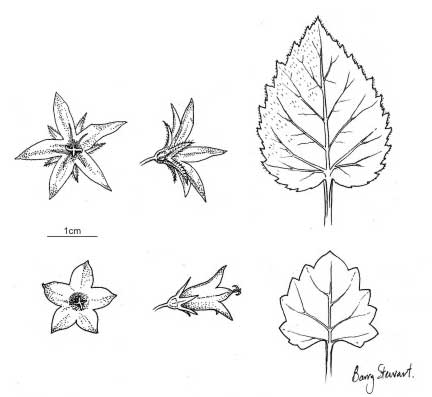
For identification, good descriptions are given in Campanulas (Lewis & Lynch, 1989) and there are excellent line drawings by John Latham in BSBI News 33 (April 1983: 11) but I am indebted to Barry Stewart for providing the comparative illustrations of flowers and leaves drawn from local material and reproduced below. Essentially, C. portenschlagiana is a more compact, almost cushion-forming plant with small hairless leaves and is darker-flowered (giving rise to one Llanelli name of 'Wall Lobelia'), it also flowers slightly earlier, though both species peak in June. Its flowers are bell-shaped and held in a more erect, rather loose panicle or spike. C. poscharskyana, on the other hand, is a more straggling plant with larger, hairy leaves and the flowers are typically a lighter, vaguely mauve, blue, more open and deeply cut, giving a star-like appearance.
There may be a third taxon on the loose in Carmarthenshire - a very dark-flowered variety which I have noticed on a wall near Gorslas. Readers should also be aware of the hybrid known as 'C. Birch Hybrid', which has been referred 'as a major form of C. portenschlagiana', but with pale mauve flowers.
This brief, cursory 'ad hoc’ Campanula study has been fruitful for other urban plants too, and 'back street botanising' apart from its risks, such as dogs or their debris (a source of nutrient for weeds), has yielded some noteworthy finds, an account of which will appear in a later issue of the Llanelli Naturalists Newsletter or Bulletin.
Thanks are due to Dr George Hutchinson for providing copies of papers relating to these species.
Reference
Lewis, P. & Lynch, M (1989). Campanulas. Christopher Helm (London) & Timber Press (Oregon). Published in association with the Hardy Plant Society.
