Llanelli Naturalists Newsletter - Sumnmer 1991
George Hutchinson
Glasswort is one of the most curious looking British plants seemingly with neither leaves nor flowers and growing on the bare coastal mud, salt-marshes and river estuaries of the county. Some plants look like small rubber models of the giant columnar Saguaro cacti of the Arizona desert. It must not be confused with the Rock Samphire (Crithmum maritimum) the umbellifer of rocky shores, or the Golden-samphire (Inula crithmoides) with its yellow daisy-like flowers.
Derivation of Names, and Uses.
Salicornia. Sal- = salt, because it is found in salt- marshes.
-cornea = horn, from the shape of the branches. Glasswort - as the ashes contain sodium carbonate which was used for glass making in the 16th century. The herbalists of the day referred to it as glaswede. It was also used to make soap.
The translations of the botanical names of the three species recorded recently in the county are:
- S. ramosissima - greatly branched, referring to its secondary and tertiary branches.
- S. dolichostachya - long spiked, referring to the long terminal spike at the top of the main stem.
- S. pusilla - very small, minute, insignificant, referring to its small secondary and tertiary branches.
Provided it is collected from unpolluted areas and is washed thoroughly, it can be eaten in various ways. Raw when young, lightly boiled when more mature or cooking it whole by holding the plants by the roots and dipping them into melted margarine flavoured with chopped mint. The plant can be pickled in spiced vinegar. It can be eaten by holding the roots and sliding the stem between the teeth to draw off the flesh (modified leaves) from the tough central spines.
Collecting and preservation.
Most Salicornia plants can be identified in the field but it is occasionally necessary to collect specimens for more careful study by a specialist. The succulent nature of the plant means that on drying it shrivels badly making the flower shape and size difficult to interpret. Nevertheless, it is important to press and dry material as it will retain its general skeletal structure. Coupled with this another
plant should be collected so that its upper half can be pickled allowing the flowers to be studied at a later date, but also take notes in the field. This part is pickled by placing it in a small glass sample jar containing a mixture of equal parts alcohol, glycerol (glycerin), water and can be stored indefinitely. The remaining part of the plant can be pressed and dried. Plants can also be sent fresh through the post in a plastic bag for identification.
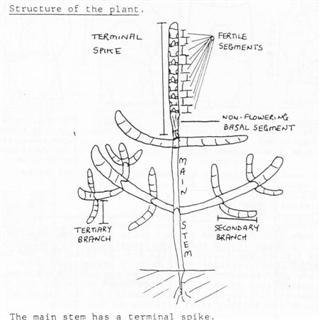
The main stem has a terminal spike.
Primary branches come off the main stem.
Secondary branches come off the primary branches. Tertiary branches come off the secondary branches. The fertile segments contain the flowers.
Each segment and hence the flowers are arranged
alternatively at right angles to each other up the spike.
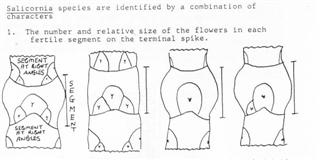
The flowers are arranged usually in threes or are solitary in each segment and are called three-flowered (3-fld) and one-flowered (1-fld) cymes respectively. This feature is repeated on the opposite side of each fertile segment.
Identification.
Salicornia species are identified by a combination of characters
1. The number and relative size of the flowers in each fertile segment on the terminal spike.
These were the only three species found in the Autumn 1990 survey. S. ramosissima and S. dolichostachya have had other related species identified for the British Isles but the taxonomy of these is controversial and much work needs to be done. Specimens were collected in the survey which differed from the above combination of characters, but these were very few and have been submitted for possible determination to the Botanical Society of the British Isles referee, Mr D.H. Dalby.
Ecology and Distribution.
The salt-marsh has been conveniently divided into three zones:
The lower salt-marsh which often contains areas of bare mud frequently being colonised by Spartina anglica and covered by most tides.
The middle salt-marsh which has more vegetatively diverse habitats and is covered by only the higher tides.
The upper salt-marsh covered by only the Spring tides together with the strand line and areas of relic salt-marsh.
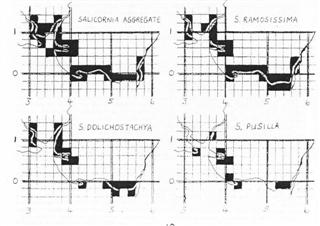
S. ramosissima was by far the commonest glasswort, found mostly in the middle salt-marsh with some in the lower salt-marsh but scarce in the upper salt-marsh.
S. dolichostachya favoured the lower salt-marsh being a coloniser of the bare mud of tidal channels and creeks, with stragglers in the middle salt-marsh.
S. pusilla was a surprise being found in 7 new tetrads at 10 new sites, exclusively just below the strand line in the upper salt¬marsh. Prior to this the species was recorded from Kidwelly and nr Llanelli as S. disarticulata by Hamer (1911) which was considered doubtful in 1967 and listed as lost or extinct (Mau). The first confirmed record was in 1982 from Ginst Point (Q.O.N. Kay). One of the best sites for the species in the current survey was south-east of Kidwelly Quay, midway between the Gwendraeth Fawr and Fach estuaries. Here it grew with S. ramosissima and the dead stems of Plantago maritima.
Occasionally plants were seen in this population with 1- and 2¬fld cymes possibly indicating hybridity. Cross pollination by wind is feasible. The old records of S. pusilla (Hamer, 1911) seem vindicated. Indeed in the upper salt-marshes of north Gower the species is considered locally frequent (Wade et al.).
Conclusions
Salicornia has been recorded from all suitable tetrads around the coast of Carmarthenshire and to species level from all but five which have more difficult access; from nr. Llangennech in the Loughor estuary, where it is scarce, round to Pembrey Burrows and including Llanelli Docks and Burry Port harbour. Similarly, from Kidwelly round to Laugharne and Ginst Point. Cefn Sidan beach and the coast to the west of the county seem unsuitable habitats with long sandy beaches followed by sea cliffs.
Acknowledgements.
I an grateful to Richard Pryce for providing details of earlier records and for his assistance in the field; to Ian Morgan for sending plants for determination from the remoter corners of S.E. Carmarthenshire and finally Mr D.H. Dalby (BSBI Referee Salicornia) for his initial determinations and tuition.
References.
Hamer, D. (1912). List of Carmarthenshire Plants. Yr Encilion 1 (2), 27 (Journal of the Carmarthenshire Antiquarian Society and Field Club).
May, R.F. (1967). A List of the Flowering Plants and Ferns of Carmarthenshire. Haverfordwest.
Wade, A.E., Kay, Q.O.N. & Ellis, R.G. Flora of Glamorgan. (in press).
Safety.
Plants are best studied from late August to mid October. As this coincides with the high autumnal tides, tide times are essential to check before venturing out. They can usually be found in the local newspaper, or annual tide-tables can be obtained from good fish-tackle shops. Check whether times are in GMT or BST.
