 Llanelli Naturalists Newsletter - Winter 1991/1992
Richard Pryce
A population of Yellow Bartsia (Parentucellia viscosa), growing in disturbed ground near water treatment lagoons was discovered on 11th September at Garnant opencast site (SN683130). Over fifty plants were counted ranging from 5cm to 35cm tall, some still resplendent with their attractive, yellow, snapdragon-like flowers, others having desiccated after setting seed following the preceding hot, dry weather.
The species thrives in damp ground in warmer, continental areas and may often be seen as an abundant arable weed colouring the fields in lands bordering the Mediterranean. In Britain, however, it is confined principally to coastal areas in the south of England, Wales and Lancashire where it is mainly found in disturbed sand-dune systems. In Carmarthenshire the species was previously known only From the area between Llanelli and Cydweli, and in particular, Tywyn Burrows, where despite being notoriously sporadic in appearance, a few plants are seen in most years. The only recent prolific display was in 1985 when the disturbance caused by the felling o4 a block of Corsican Pines in Pembrey Forest (at SN408009) exposed the dormant seed already in the soil and provided the conditions necessary for their germination. Thousands of plants grew and flowered, allowing the replenishment of the seed bank so that the species will be able to burst into life when, in future years, conditions again become favourable.
The Garnant plants were in damp, clayey soil, seemingly growing best in the wetter hollows. They were associated with a curious mixture of remnant damp grassland species like Bristle Club-rush (Scirpus setaceus), Common Yellow Sedge (Carex demissa) and Lesser Spearwort (Ranunculus flammula) and also species typical of disturbed situations, for instance Common Broom (Cytisus scoparius), Coltsfoot (Tussilago farfara), Spear Thistle (Cirsium vulgare) and Red Bartsia (Odontites verna). Their origin is presumably the soil seed-bank, seed having remained dormant for many years. It is not thought likely that the seed was inadvertantly introduced from some anthropomorphic source, although the species has been known as a contaminant of commercial seed mixes, and no seeding has taken place in this part of the opencast site.
The discovery of Yellow Bartsia at Garnant is significant as it is one of only a very few inland records which are not known introductions.
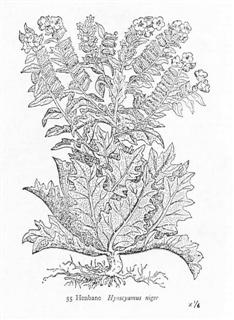
Another species of sporadic appearance is the highly poisonous Henbane (Hyoscyamus niger). Jane Kelsall recorded three or four plants during the summer, growing in the clear-felled, scrubby area of Pembrey Forest between the new pool and the airfield (SN393028). The last vice-county records for this species were in the mid 1970s when hundreds of plants were found growing in a large stand c15m x 6m in May 1976 on the edge of Pembrey airfield (SN394033). My diary, written at the time, also refers to the presence of 'odd single plants in the adjacent failed forestry plantation (SN395027)' which were only a couple of hundred metres from Jane's 1991 plants. Several plants were also noted at the same locality the following year. At that time the airfield was still part of the Eastwood's poultry farm complex and there was speculation as to whether the source was contaminated chicken feed or whether dormant soil-bank seed germinated following agricultural works. There is no doubt that the 1991 plants originated from the soil seed-bank, again probably due to the production of favourable conditions for germination resulting from disturbance.
Both Yellow Bartsia and Henbane are annuals (Henbane can also be biennial) and individuals die at the end of each season. Both the Garnant and Pembrey sites therefore need monitoring in 1992 and if growing conditions permit it can be hoped that new plants will appear and put on fresh attractive displays.