Llanelli Naturalists Newsletter - Winter 1991/1992
Ian Morgan
Drift-seeds or disseminules are frequently found - if irregularly recorded - from the coasts of the British Isles with at least thirty-nine species known (Nelson, 1989) and with the first record of such seeds being made as long ago as 15/0 by M. De L'Ober. These seeds are often of tropical (West Indies and Central America) or temperate (eastern USA) origin, carried over the intervening ocean by the North Atlantic Drift or so-called "Gulf Stream". The occurrences of these drift-seeds has been carefully and comprehensively summarized by Nelson (loc.cit. & 1978) to whose fascinating papers readers are directed.
Drift-seeds are quite small objects that float amongst the surface currents, which are strongly influenced by prevailing winds; the currents of the North Atlantic having an essentially clockwise pattern. Recent work by naturalists in Cornwall has shown that drift-seeds are more frequent than hitherto supposed and that they include seeds that have not been recognised in the past eg Calystegia spp or Lathyrus japonicus in large numbers on Cornish beaches.
These disseminules stranded on beaches can be divided into two main categories - "peregrine", the true drifters; or "refuse" eg material discarded from ships. Also seeds of local origin (eg beach rubbish - peach, plum, cherry etc) or of locally-native plants eg hazel Corylus avellena or beech Fagus sylvatica or pine cones Pinus sp. occur.
Perhaps surprisingly, there are a number of old records for Carmarthenshire - including sole British records - and some very casual recent recording by Barry Stewart and Nigel Stringer has also produced strand-line disseminules.
Cefn Sidan beach (SN30,40,SS49), being an essentially depositional feature ideally placed to received the predominant south-westerly local sea currents, is doubtless the best local site to search for these drift-seeds - whose frequency can vary, depending on recent local conditions etc. Nicholson (1985) was not exaggerating - when he referred to the frequency of flotsam etc on Cefn Sidan beach - in calling it "a veritable Aladdin's cave bestowed by nature". The listing of shipwrecks (and the many human corpses) in the Pembrey Parish Church Register bears testimony to this. More recent decades have additionally seen a dead dolphin, an octopus, walrus, and many birds - including little auk, gannets, fulmar, cormorants, gulls (with ringed examples of these latter three) washed up.
Drift-seeds listed by Nelson as occurring in Carmarthenshire are:
Carya illinoensis (pecan). Only three pre-1930 British records. This species is said to be regular in beach debris on the eastern North American seaboard.
Caryocar nuciferum (butter-nut, souari nut). The only British record is from Carmarthen Bay in 1894; the specimen is preserved at Kew.
Entada gigas (sea heart, Molucca bean). One of the most distinctive (and therefore collected) species. They are said to be often viable when collected and they have an extensive folk-lore associated with them.
Manifera indica (mango). Three British records, including Carmarthen Bay (1894). This seed is believed to arrive in Britain only as a result of Man's activities (ie ship refuse).
Mucuna sloanei (sea bean, horse-eye bean, etc). syn. M. urens. Said to he frequent and one of the more conspicuous disseminules.
One of the above species - Entada gigas (the "sea heart") has been also recorded twice in recent years at Cefn Sidan. Once was collected in 1983 by a student who passed it on to Dr. R.N. Stringer who, in turn, had it identified at the National Museum of Wales, Cardiff; and another - of the same species - was found by Barry Stewart on 14 April 1991. Barry also found a coconut Cocos nucifera (new to the county) although, of course. it is believed that this species belongs to the "refuse" category (see earlier) rather than true "peregrine". Perhaps surprisingly. germinated coconuts have bin found on Irish and Shetland beaches!
Another recent new county record (for Cardigan, VC46, June 1989) worth reporting is the specimen of Mucuna sloanei recorded by Heather Slade from Ynys-las beach in north Ceredigion (VC46,22/69).
"Llanelli Naturalists" members may wish to look out for drift-seeds on Cefn Sidan (or elsewhere); remember that some species are quite small (pea-sized or less). The author would welcome the opportunity to see specimens. E. Charles Nelson (National Botanic Gardens, Glasnevin, Dublin 9, Ireland) and the Botany Dept., Nat. Mus. Wales, Cardiff, CF1 3NP, would also be interested in finds.
Acknowledgements: Thanks to Heather Slade, Barry Stewart and Nigel Stringer for making available their records of drift-seeds. Nearly all of the above information on drift-seeds is from various papers by Nelson, which are essential reading for the beachcombing naturalist.
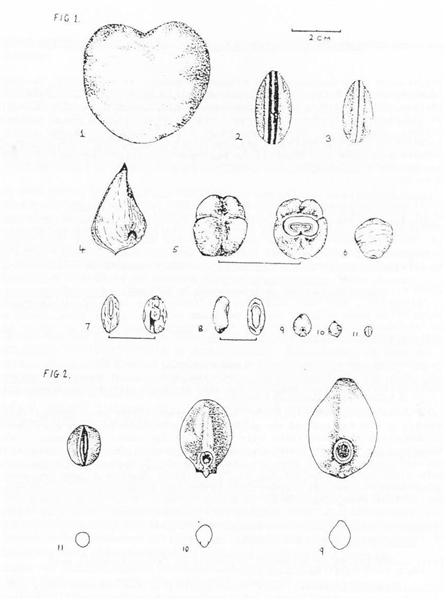
- Entada gigas,
- Mucuna sloanei,
- Dioclea reflexa,
- Astrocaryum sp.,
- Merremia discoidesperma,
- Caesalpina bonduc,
- Canavalia roses,
- Erythrina sp.,
- Ipomoea alba,
- Calystegia cf. soldanella,
- Lathyrus japonicus.
References
Nelson, E.C. (1978) Tropical drift fruits and seeds on coasts in the British Isles and western Europe, 1. Irish beaches. Watsonia 12:103-112
Nelson, E.C. (1989) Exotic drift fruits and seeds from the coasts of Britain and adjacent islands. J.Roy.Inst.Cornwall 10:147-177
Nicholson, J.A. (1985) Pembrey and Burry Port - their Harbours, Shipwrecks and Looters. Llanelli Borough Council.
Wallace, J. (1700) An account of the Isles of Orkney (London)
