Llanelli Naturalists Newsletter - May 2002 - No 68
Ian Morgan
Leader Ian Morgan
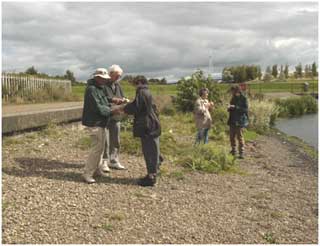 On a pleasant afternoon, about 10 members assembled in the car park and proceeded to walk around this artificial water body in an anti-clockwise direction, starting at its SE ‘corner’. The meeting had originally been programmed to survey the weed flora of Llanelli’s streets and back-lanes, but earlier herbicide treatment by the council had led to a change of plan. George Hutchinson, Thomas Morgan and the leader did, however, briefly previously examine a small area not far from the fire station in Corporation Avenue – near the small footbridge over the Afon Lliedi at SN510007 where, (at the western end of Toft Place), the robust bramble Rubus armeniacus ‘Himalayan Giant’ (which George informs me, is now spreading in urban areas), Horse-radish Armoracia rusticana and the ‘Butterfly Stonecrop’ Sedum spectabile were seen.
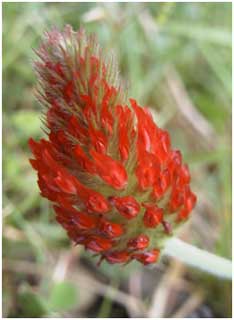
The shingly eastern margin of the lake at Sandy Water Park proved to be the richest for bird seed aliens, as this is the area where the public feed the swans and other wildfowl. Plants of interest here include frequent Cockspur Grass Echinochloa crus-galli, Flax Linum usitatissimum and Crimson Clover Trifolium incarnatum (the latter only a second Vice-County Record). Green-Bristle Grass Setaria viridis,Yellow, Bristle-grass S. pumila and a tiny plant of Common Millet Panicum mileaceum were other casual grasses of interest. Canary grass Phalaris canariensis, Bristly Oxtongue Picris echioides and Keeled-fruited Cornsalad Valerianella carinata were also noted. Also a depauperate plant of Hemp Cannabis sativa was found.
The party then proceeded around the lake, noting various native weeds, water plants and plantings (both aquatic and terrestrial). Around the margins, clumps of introduced Galingale Cyperus longus (not native in Carmarthenshire) were very prominent as well as other British native plants though some of these were also originally introduced by Park staff at this locality. These include Branched Bur-reed Sparganium erectum, Yellow Flag Iris pseudacorus, Sea Club-rush Scirpus maritimus and Grey Club-rush Schoenoplectus tabernaemontani. Increasing beds of reeds Phragmites communis are invading parts of the margin, providing cover for nesting birds. Submerged water plants include Horned Pondweed Zannichellia palustris, Canadian Pondweed Elodea canadensis and Rigid Hornwort Ceratophyllum demersum. Near the SE corner (but along the south margin of the lake), a large clump of Sweet Flag Acorus calamus was seen (and smelled). Nearby was the reputedly rather frost-tender Pickerelweed Pontedera cordata (a native of southern North America), with attractive blue flowers. Also alien at Sandy Water Park, were the rafts of a White Water-lily cultivar Nymphaea alba in the NW corner of the lake.
 Herbaceous water-side plants include Water Mint Mentha aquatica, Marsh Woundwort Stachys palustris, False Fox-sedge Carex otrubae, Remote Sedge Carex remota, Hemlock Water-dropwort Oenanthe crocata, Celery-leaved Buttercup Ranunculis scleratus and Gipsywort Lycopus europaeus. Young saplings of Alder Alnus glutinosa were seen and these, coupled with plantings of various willows (as well as self-sown willow), will probably result in a more tree-fringed lake in the future.
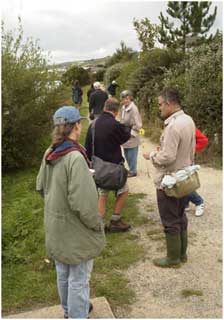
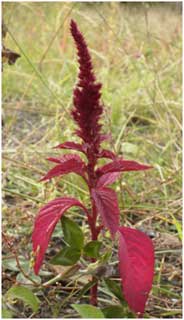
Later, the party crossed over the road via the new Pont d’Agen cycle-way bridge and examined an area of new (but weedy) plantings and ground left bare after bridge-construction. A surprisingly good list of plants was achieved, most notably species such as ‘Love-lies-bleeding’ Amaranthus caudatus, Shaggy Soldier Galinsoga quadriradiata (= ciliata), Sharp-leaved Fluellen Kickxia elatine, as well as the more frequent ruderals including Perennial Wall-rocket Diplotaxis tenuifolia, Hoary Mustard Hirschfeldia incana, Narrow-leaved Everlasting Pea Lathyrus sylvestris, Black-bindweed Fallopia convolvulus, Mignonette Reseda lutea, Black Nightshade Solanum nigrum and Field Woundwort Stachys arvensis.
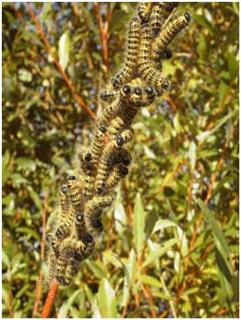
Barry Stewart focussed on the lepidoptera and identified a larval mass of the Buff-tip Phalera bucephala on a planted White Willow cultivar Salix alba var. vitellina on the southern margin of the lake. Other species he pointed out included the leaf-mines of Stigmella aurelia on Bramble Rubus fructicosus, S. salicis (mines on Grey Willow Salix cinerea & others), Caloptilia stigmatella (mines on Grey Willow & others), Phyllonorycter salicicolella (mines on Grey Willow), P. rajella (mines on Common Alder Alnus glutinosa), P. viminiella (mines on White Willow Salix cf. alba var. vitellina) and Emmelina monodactyla (larva in flower of Hedge Bindweed Calystegia sepium).
 |
 |
 |
I thank Richard Pryce, George Hutchinson and Barry Stewart for both determinations and species lists. An account of Sandy Water Park (including details of the bird interest) is also to be found in the Llanelli. Nats Bull. 5:17 (2001).