Llanelli Naturalists Newsletter - September 2007 - No 73
George Hutchinson
Leader: Rob Collins
The Society was invited to this unexplored area of Carmarthenshire by Rob Collins from the Company’s Conservation Group. While waiting in the outside car-park (SS6554987) a 1m tall shrub of Tall Tutsan Hypericum x inodorum with its scented leaves, a tall example of Maire’s Cotoneaster Cotoneaster mairei with its slightly yellowish-white tomentose underside to the leaves, and Buck’s-horn Plantain Plantago coronopus with tiny, toothed leaves were noted outside the boundary fence.
After instructing the group on safety procedures for the visit, Rob Collins gave a brief history of the industrial site from its Bynea Steelworks days, through to Texaco with its large-lettered illuminated sign visible after dark as one passed on the train and now the Huntsman Chemical Company, which was founded by the Mormon Jon Huntsman in 1982 and at Bynea specialising in performance products manufacturing.
The party of fourteen entered the area on a mild summer’s day. Despite dark clouds and heavy showers visible in the distant hills we were blessed with dry, warm, sunny weather for the whole visit making plants easier to spot with their flowers fully open. The first area visited near the entrance was of neutral grassland and in its second year of mowing. It was clear that we were entering a site where the rabbit reigned supreme, Trailing Tormentil Potentilla anglica, Lesser Stitchwort Stellaria graminea and Ox-eye Daisy Leucanthemum vulgare were in flower but it was just too late to see a solitary Bee Orchid Ophrys apifera at its prime. The eye was attracted to small patches of grey, spindly-curved inflorescences which proved to be Early Forget-me-not Myosotis ramosissima, a few pin-head sized blue flowers remaining. Cinnabar moths Tyria jacobaeae were much in evidence indicating that Ragwort would soon be found.
Moving to a more disturbed area to the south-west of the silos, basal rosettes of Great Mullein Verbascum thapsus and Field Madder Sherardia arvensis with its tiny pink flowers were found. Before moving on to the main avenue through the plant Jeff Davies, the bird specialist on site, showed us the curious location of a Pied Wagtail’s nest, built inside a stack of wooden palettes. House Martins were abundant here and were entering nests inside the large sheds.
 The southern side of the main avenue supported rank vegetation including small trees of Silver Birch Betula pendula and the encroaching bramble Rubus armeniacus ‘Himalayan Giant’, the giant leaves contrasting with the small delicate leaves of the nearby Rubus ulmifolius, but both white tomentose on the underside. The common hybrid Eyebright, Euphrasia confusa x nemorosa, clung on in the tall vegetation. A small drainage ditch on the north side of the avenue was sufficient to encourage a sward of Jointed Rush Juncus articulatus.
Rob Collins pointed out that the next block of short grass was being managed with conservation in mind. Initially, it came as a surprise to be told that Palmate Newts were breeding in a culvert on the edge of the area and members of the party peered into the gloomy interior to get a view. Common Ragwort Senecio jacobaea was the tall plant in this area and it was thought that whereas a small patch should be kept for the Cinnabar larvae, much should be eradicated. With this in mind there was a short diversion to pull-up the plants: many hands making light work!
Here, it was only around the shaded side of the golden-leaved conifers that the vegetation diversified. Fairy Flax Linum catharticum was the best find here among grassed over chippings, with a few plants of the eyebright Euphrasia nemorosa. Other plants included Thyme-leaved Sandwort Arenaria serpyllifolia ssp. leptoclados and a small area of more, seeding Early Forget-me-not. Dark-green leaved sedges survived the rabbits, although the young tips were eaten. One was clearly Oval Sedge Carex ovalis but the other was a puzzler, later identified by Arthur Chater as an immature subspecies of Prickly Sedge C. muricata ssp. lamprocarpa. An attractive brown and cream day-flying moth was much photographed and later identified by Barry Stewart as one of the micro-moths, Pyrausta cf purpuralis.
At the end of the avenue, after passing the giant sculptured hands, the shrubby vegetation in the corner had Rough Hawkbit Leontodon hispidus and a seedling of Wall Cotoneaster C. horizontalis. The party then turned sharply north-eastwards along the south-eastern edge of the buildings. Looking ahead one could not but admire the distant hills of that less explored part of Glamorgan rising above Pontarddulais and Pontlliw - Mynydd Pysgodlyn, Cefn Drum and Graig Fawr, the last at 942 feet falling steeply on its western flank to the River Loughor.
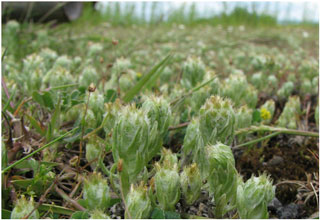
Shortly afterwards it was time to stand and stare downwards instead at the discovery of the day, a large sward of grey-white woolly-stemmed Common Cudweed Filago vulgaris, the largest population known in Carmarthenshire. It covered some 30m across the grey chippings, a few plants already showing their delicate, yellow florets. The English name deludes the frequency of this scarce and declining species. Spiking the population and also enjoying the barely vegetated stony area here were a few light green tufts of Slender Rush Juncus tenuis.
There was time to walk out to the River Loughor, the air initially being scented with the oils from a small thicket of Garden Privet Ligustrum ovalifolium engulfing an old the ruin, with Wild Mignonette Reseda lutea and a pink-flowered garden rose present. Many explored the upper salt-marsh while a few crossed to the edge of the bare mudflats where typically Purple Glasswort Salicornia ramosissima and flowering Common Saltmarsh-grass Puccinellia maritima were in evidence (SS5614.9886). Plants found in the upper salt-marsh included Common Sea-lavender Limonium vulgare, its dense, young, fresh-green leaves being particularly impressive.
After walking back, when one was reminded of the wealth of plants seen, the party thanked Rob Collins and Jeff Davies for this rare glimpse into this secret corner of Carmarthenshire and looked forward to future visits.
