Llanelli Naturalists Newsletter - September 2007 - No 73
George Hutchinson
Leader: Richard Pryce
Members met at the forestry pull-in (SN545042), just south of Graig Fach, and bedecked with recently planted Rowan Sorbus aucuparia. We were greeted by a fluttering Orange-tip butterfly Anthocharis cardamines, the female lacking the orange markings. The spring sound of the migrating Chiffchaff had returned. The party set off to explore the signs of spring at this recently acquired Community Woodland. It was sunny and mild, in fact the month as a whole turned out to be one of the warmest and driest Aprils since records began. Those among us with phenological inclinations had noticed a surge in flowering and leafing over South Wales during the past week and this was soon confirmed when walking down the main trackway through the wood. Most plants seemed to be about two weeks early this year.
First seen was Great Wood-rush Luzula sylvatica, already in flower, and Bilberry Vaccinium myrtillus well into leaf. Here the upper slopes were planted with conifers with Sitka Spruce Picea sitchensis, Norway Spruce P. abies and Douglas Fir Pseudotsuga menziesii, the last with its fallen cones examined for the projecting, forward-pointing, three-toothed bracts.
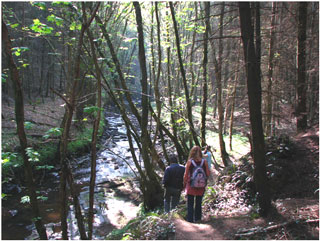 The acidity of the soil was reflected on the banks with large sterile fronds of Hard-fern Blechnum spicant and the delicate Hairy Wood-rush Luzula pilosa. Similarly the track verge to the left, which then steeply drops away through the wood had tufts of freshly flowering Pill Sedge Carex pilulifera, Green-ribbed Sedge C. binervis and Pendulous Sedge C. pendula. Further down, the wooded slopes above had tall shuttlecocks of an over-wintering subspecies of Scaly Male-fern Dryopteris affinis ssp. affinis with its retained bun-like indusia still well attached.
It was time for the group to drop steeply down off the main track to cross the wooden footbridge over the Afon Morlais. Moisture-loving plants were soon evident with the yellow-green of Opposite-leaved Golden-saxifrage Chrysosplenium oppositifolium, Brooklime Veronica beccabunga, Cuckooflower Cardamine pratensis, a solitary tussock of Tufted Hair-grass Deschampsia cespitosa, with its dark green, erect razor-tooth edged blades, and Smooth-stalked Sedge C. laevigata with its prominent obtuse ligule. The tiny wooded flood plain had Wood Avens Geum urbanum in flower, Wood-sorrel Oxalis acetosella and Wood Anemone Anemone nemorosa with its flowers just opening.
Along the wooded riverside footpath Raspberry Rubus idaeus and Pignut Conopodium majus were discovered, together with flowering Common Dog-violet Viola riviniana with another Orange-tip in attendance. Philip Jones identified the Blusher fungus Amanita rubescens with its prominent membranous ring on the stem, the flesh turning pinkish with age or when bruised. Just above the undercut riverbank croziers of Soft Shield-fern Polystichum setiferum were uncurling alongside Remote Sedge Carex remota. A small Holly bush Ilex aquilinum had Polypody Polypodium vulgare s.s. nearby.
A wet flush down to the Morlais was reached where the emerging leaves of Wild Angelica Angelica sylvestris were seen among much flowering Wood Avens Geum urbanum. Trees here were Alder Alnus glutinosa and Hawthorn Crataegus monogyna with much Pedunculate Oak Quercus robur in the surrounding area. An old fallen Beech tree Fagus sylvatica made a fine focal point and binoculars were used to identify Snowberry Symphoricarpos albus growing across the river. Here the low level of the river water could be appreciated by admiring the zoning of the drying mosses up the opposite steep bank, topped with a white zone of Sphagnum.
 On an old trunk a curious white hemisphere about the size of a ping-pong ball caught the eye, identified by Philip Jones as a member of the Myxomycetes, with a jelly-like inside. Its plasmodium can migrate along a surface giving the appearance that the object has been slowly moving. It is not a fungus. Birch Polypore Piptoporus betulinus clung to an old birch tree. Near here a Speckled Wood Pararge aegeria was seen flitting among the ground-cover plants, this individual with rather more orange in the creamy wing spots. Near a female Holly tree Ilex aquilinum, still rich with red berries, were the emerging leaves of what looked from a distance to be Black Currant or Sycamore but closer inspection showed them to be those of Guelder-rose Viburnum opulus.
Creeping Soft-grass Holcus mollis, the hairy-noded grass of woodland floors, was finally found and the fresh green blades of False Brome Brachypodium sylvaticum were emerging but there was no sign yet of the culms produced in summer. A small area of Hazel Corylus avellana was reached within sight of the boundary fence and it was time to about-turn. Nothing is quite the same walking in the opposite direction. A highlight was a Dipper flying downstream and eventually landing on a pebble in the very shallow water. Leaves of Sweet Chestnut Castanea sativa were found in the leaf litter but the tree was not so obvious.
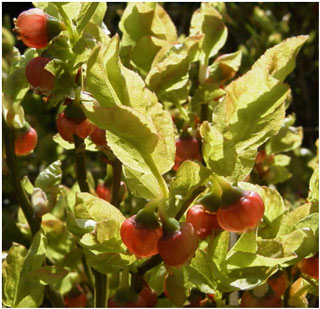
The steep climb back to the entrance needed a stop for breath where we admired the pinkish-red flowers of Bilberry Vaccinium myrtillus, photogenic with their young, green leaves as background. Finally, at the car-park that early, camouflaged plant of urban lawns, Field Wood-rush Luzula campestris, was already in fruit beneath the signpost. The party departed, slightly disappointed that the two rare ferns present elsewhere in the woodland (Tunbridge Filmy-fern and Hay-scented Buckler-fern) had not been seen within the area visited, but even so, reflecting on the rich diversity of this Community Woodland.
For reports of previous Llanelli Naturalists visits to different areas of Troserch Woods, see I.K. Morgan (2003). Llanelli Nats. Newsl., No. 69, pp.16-17. and p.20 in this Newsletter. For further information about Troserch Woods see Ian Morgan’s 2007 Ecological Appraisal of Troserch Woods and also the website www.troserchwoods.co.uk, which includes information about the Troserch Woodlands Society.