Llanelli Naturalists Newsletter - November 2005 - No 72
Philip Jones & Simeon Jones
The Extraordinary Fuel-ash Ponds: A Haven for Wildlife
Leaders: Philip Jones and Simeon Jones
 On a fine sunny afternoon members and visitors met at Pwll Playing Field car park. Before starting out, the industrial history of the area was briefly outlined, much of this information was gained from Ian Morgan’s notes scattered through past Llanelli Naturalists’ Newsletters and from various books about local history including A Long Mile, Jon Gower’s 2004 history of Pwll.
The area where we met would have been Pwll Quay and the high water mark before the main railway line was built and opened in 1852. The Ashpits Lagoon was formed from pulverised fuel ash (pfa) which was pumped, mixed with sea water, from the coal fired Carmarthen Bay Power Station at Burry Port which generated electricity between 1953 and 1984. A series of lagoons had been made to receive the pfa and this area, being furthest from the power station, was the last lagoon formed. It is remarkable that plants we were to see must have all colonised the area over a period of only about 15 years. Crown Colliery, which was worked from 1915 to 1932, was situated somewhere within this lagoon and, in at least one place, the deposit from a stream running through the site is rusty red (similar to iron deposits from other colliery streams) as if it might come from the old mine.
The party went down a steep embankment, passing one of the large drainage pipes, the height of which had been lowered to drain this lagoon of water. The uneven terrain is due to floating islands of pfa becoming fixed by tree roots after the water level was lowered.
In clearings between birch and willow, some of the specialities of the site were found immediately. Royal Fern Osmunda regalis (Rhedynen Gyfrdwy), some clumps being quite large, is found all over the area with young plants colonising the wetter areas. Common Wintergreen Pyrola minor (Glesyn-y-Gaeaf Bach) and Common Sundew Drosera rotundifolia (Gwlithlys) were also found here as well as elsewhere during the walk. Common Spotted Orchid Dactylorhiza fuchsia (Tegeirian Brych) and Southern Marsh Orchid Dactylorhiza praetermissa (Tegeirian-y-Gors Deheuol) were also frequent. Wetland plants included low mats of pink flowered Bog Pimpernel Anagallis tenella (Gwlyddyn-Mair y Gors), Water Figwort Scrophularia aquatica (Gwrnerth y Dŵr), Purple-loosestrife Lythrum salicaria (Llysiau’r-Milwr Coch) and Marsh Thistle Cirsium palustre (Ysgallen y Gors), including at least one white flowered plant. On reaching the wetter open area of lagoon we were shown a few stems of Saw Sedge Cladium mariscus (Corsfrwynen Lem) with hazardous sharp serrated edges to their leaves, discovered here only last year and a species new to Carmarthenshire.
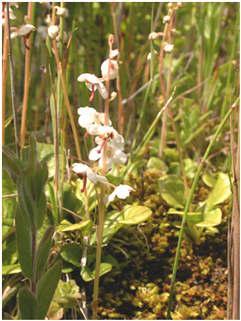
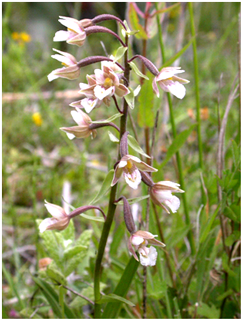 Marsh Helleborine Epipactis palustris (Caldrist y Gors) which has also only been noted here in the past two years is present over a wide area having increased considerably from 2004. One small pfa island had Round-leaved Wintergreen Pyrola rotundifolia (Glesyn-y-Gaeaf Deilgrwn) in full flower making a fine picture for photographers. Those who had disregarded the advice to wear Wellingtons (in July!) missed this splendid sight as the island was surrounded by water and reed.
Leaving the wet area of lagoon, to the calls of a Cetti’s Warbler, the party followed a path parallel to the northern ashpit embankment. This area towards Burry Port is drier and is now clothed in mature birch and willow woodland.
We passed a new fishing pond and the eastern extension of the old ‘Ashpits Pond’, moving into an area that has remained undisturbed during the creation of the Millennium Coastal Park and plantings which now form the Burry Port Community Woodland. This small natural wooded area has been colonised mainly by Grey Willow Salix cinerea (Helygen Lwyd) with occasional birch and at least one Corsican Pine Pinus nigra subsp. laricio (Pinwydden Corsica). We were able to admire many scapes (leafless flower stalks) of Yellow Bird’s-nest Monotropa hypopitys subsp. hypophegea (Cytwf) forming a ‘fairy ring’ with the pine at its centre. Last year, when Monotropa was first found here, about 350 scapes were counted. A similar number were found this year. This seemed to fit in with what Philip understood about Monotropa; that the plant is associated with a fungus which is itself associated with pine (hypo pitys meaning ‘under pine’). Then sharp-eyed George Hutchinson noted a further small group of scapes under Aspen Populus tremula (Aethnen) about 25m away! This and other factors did not fit in with what Philip had read about Monotropa so after further enquiries the fascinating story of this plant can be given and will be explained in a separate forthcoming article. Alder Buckthorn Frangula alnus (Breuwydden) was also noted, whilst Yorkshire Fog Holcus lanatus (Maswellt Penwyn) carpeted the woodland floor.
We were now at the end of our official field meeting. Some of us returned to our cars via Ffordd y Wagen (the defunct railway line, now an informal footpath), kindly cleared the previous week by Simeon, whilst others explored the embankment along the recently built southern distributor road to Burry Port Harbour where numerous ephemeral plants and weeds were growing.