Llanelli Naturalists Newsletter - November 2005 - No 72
Andrew Stevens
Leaders: Edith Jones & Andrew Stevens
 A group of about 8 started downhill from the farm on a beautiful sunny day, crossed a tightly grazed dry field and entered a mixed ash/ oak woodland where new arrivals doubled the numbers. The wood became progressively wetter with much Remote Sedge Carex remota and large stands of Wood Horsetail Equisetum sylvaticum. The wood thinned and opened out into a bog which had been grazed but retained a good selection of complete plants.
Round-leaved Sundew Drosera rotundifolia was in flower, as was Bog Asphodel Narthecium ossifragum. Other plants seen were Bog Pondweed Potamogeton polygonifolius, Bog Violet Viola palustris, Cross-leaved Heath Erica tetralix, Common Cottongrass Eriophorum angustifolium, Many-stalked Spike-rush Eleocharis multicaulis, Marsh St John’s wort Hypericum elodes and Bog-bean Menyathes trifoliata.
As conditions became slightly drier, Creeping Willow Salix repens, Whorled Caraway Carum verticillatum, Heather Calluna vulgaris and a sub-erect bramble Rubus cf. scissus were prominent with Bell Heather Erica cinerea and Tormentil Potentilla erecta on the drier tumps. In some wet cattle trodden patches, Round-leaved Crowfoot Ranunculus omiophyllus was seen.
The plan had been to proceed onto drier heath at this point but, as the direction in which we walked had been reversed from the trial run a few days earlier to ensure that we had time to see the bog properly at the beginning, the leader missed the turn and we ended up having to cross another bog and steep bank before finally reaching the dry heath. It was not too perilous but most ended up with wet peat over the tops of walking boots. Growing on the dry acid soil was Heath Bedstraw Galium saxatile, Sheep’s Sorrel Rumex acetosella, Pill Sedge Carex pilulifera, Heath Milkwort Polygala serpyllifolia, Heath Speedwell Veronica officinalis and Bell Heather.
We climbed up into woodland where we had obviously missed a glorious sight of massed bluebells Hyacinthoides non-scripta by several weeks and all that remained were yellowing leaves and flowering stalks. There was much Hazel Corylus avellana and an odd crab-apple Malus sylvestris, while Hard Fern Blechnum spicant, which tends to indicate acid soils, grew alongside Sanicle Sanicula europaea suggesting a degree of base enrichment. We emerged into a nice dry hay field which we skirted to reach a wet peaty meadow.
This field is so wet that it cannot be cut every year especially at its upper end where there was a large clump of Greater Tussock Sedge Carex paniculata. (This can grow into a dense tussocks up to 1m across, standing on shaggy pedestals to reach 1.5m high, as they do elsewhere on the farm, and which Edith fondly calls her Triffids). Much of the ground was covered with Purple Moor–grass Molinia caerulea, although lower down, Sharp-flowered Rush Juncus acutiflorus predominated where Lesser Spearwort Ranunculus flammula also grew frequently. It was noticeable that along the field edge where ditch spoil had been spread this rush was replaced by Soft Rush Juncus effusus, either because the ditch rendered soil slightly better drained or the chemical/ physical composition had been changed.
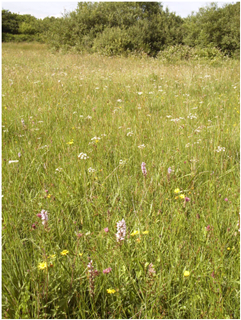
Crossing a stream we were on the `home straight` and in the field where walks had started in the past. Brooklime Veronica beccabunga, Water Mint Mentha aquatica and Square-stemmed St.John’s-wort Hypericum tetrapterum quickly gave way to Silverweed Potentilla anserina and Carnation Sedge Carex panicea with Whorled Caraway and Devil’s-bit Scabious Succisa pratensis not yet in flower. Taller components were occasional clumps of Cocksfoot Dactylis glomerata and Common Knapweed Centaurea nigra. Common Spotted-orchids Dactylorhiza fuchsii and taller hybrids (with Southern Marsh-orchid) D. fuchsii x D. praetermissa were in abundance and further colour was provided by Yellow Rattle Rhinanthus minor, Eyebright Euphrasia sp. and Tormentil.
We enjoyed good weather and everybody appreciated the hospitality of hosts Edith and Neil and their sensitive management of the farm. Some had returned to make this their second or third visit.