Llanelli Naturalists Newsletter - November 2005 - No 72
Leader: Simeon Jones
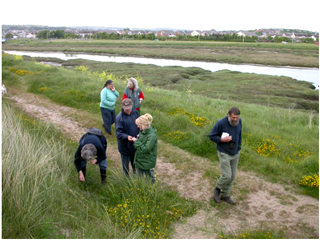 The visit by Llanelli Naturalists to North Dock Dunes proceeded with an air of festivity as it coincided with the formal declaration of the dunes as a Local Nature Reserve by the Council earlier in the year. Thanks to the hard work of many the area will continue to be positively managed for conservation with access for all whilst the inhabitants will also be quite happy to be left alone whatever the dunes are called and will be around for many years to come.
The group included Kath Pryce, Andrew Stevens, Liz Stevens, Diana Hopkins, Philip Jones, David Poulter, Lowri Gwenllian, Kirsten Dick, Richard Pryce and Fiona Lance. We met on a sunny spring evening at 1900 in the car park and proceeded along the ridge into the dunes. Sand dune habitats have a high diversity of plants and animals which are specially adapted to withstand the harsh conditions. The dune grassland community of Marram Ammophila arenaria, Restharrow Ononis repens and Red Fescue Festuca rubra occurs over much of the dunes and is characteristic of the calcareous conditions due to the presence of shell fragments. On the bare sand there was plenty of the distinctive Sand Sedge Carex arenaria (Hesgen Arfor) which spreads by suckers hence helping to bind the sand. One of the first plants that we came across in the dunes was the ubiquitous “Burnt-rubber Plant” or Perennial Wall Rocket Diplotaxis tenuifolia( Roced-y-muriau Meinddail) the crushed leaves of which smell of burnt rubber. For those wishing to revise their knowledge of the Compositae (Daisy family) there was some impressive looking Smooth Sow-thistle Sonchus oleraceus (Llaethysagallen Lefn), Cat’s-ear Hypochaeris radicata (Melynydd) which has bracts on the stems resembling cat’s ears and Autumn Hawkbit Leontodon autumnalis (Peradyl yr Hydref). The nationally scarce Dune Fescue Vulpia fasiculata (Peisgwellt y Twyni), a grass which only grows on mobile sand, was noted, the inflorescence of which looks like a miniature one-sided Wall Barley Hordeum murinum (Haidd y Mur).
We carried on up to the end of the dune spit following the path along the saltmarsh passing the locally frequent Sea Campion Silene maritima (Gludlys Arfor) and a stand of Wild Marjoram Origanum vulgare (Penrhudd). The end of the dune spit consists of bare patches of sand and is the best area to see a splash of colour with attractive flowering plants throughout spring and summer. We were pleased to find a couple of Yellow-horned Poppies Glaucium flavum (Pabi Corniog Melyn) which must have found their way here from other sites where they grow along the coast. Japanese Rose Rosa rugosa (Rhosyn Japan) was also present having found it’s way here from amenity plantings along the nearby coastal road. If anyone is keen to help this would be a good candidate for pulling up during the winter.
After a passing peregrine appeared flying up Lliedi Haven we made our way back along the beach passing the marram dominated mobile dune community along the foreshore with salt tolerant plants such as Sand Couch Elytrigia juncea (Marchwellt Tywyn) and Prickly Saltwort Salsola kali ssp. kali (Helys Ysbigog).
List of plants seen additional to those noted in text:
- Ribbed Melilot Melilotus altissimus (Meillionen y Ceirw)
- Wild Mignonette Reseda lutea (Melengu Wyllt Ddisawr)
- Common Stork’s-bill Erodium cicutarium (Pig y Crëyr)
- Smooth Sowthistle Sonchus oleraceus (Llaethysagallen Lefn)
- Common Vetch Vicia sativa ssp. segetalis (Ffacbysen)
- Hairy Tare Vicia hirsuta (Corbysen Flewog
- Tansy Tanacetum vulgare (Tanclys)
- Yellow Oat-grass Trisetum flavescens (Ceirchwellt Melyn)
- White Campion Silene alba (Gludlys Gwyn)
- Grey Willow Salix cinerea (Helygen Lwyd)
- Sea Sandwort Honckenya peploides (Tywodlys Arfor)
- Sea Bindweed Calystegia soldanella (Taglys Arfor)
