Llanelli Naturalists Newsletter - Sumnmer 1991
Ian Morgan
{rokbox align=|right|}images/stories/newsletters/1991_07/11.jpg{/rokbox}Ladybirds are familiar members of a family of beetles known as the Coccinellidae, and like all other beetles, their fore-wings are modified to form hardened wing Cases (or 'elytra'), and they have biting - rather than sucking - mouthparts. Ladybirds range in size from 1 to 10mm long and they are round or oval in shape, the elytra being often brightly-coloured and patterned with spots, stripes or other markings. Of the forty-two or so British species some twenty-three have been recorded in Carmarthenshire. They are familiar creatures to the non-naturalist and they perform great service by feeding on aphids, which are damaging to many plants. Additionally, ladybirds make a nice, compact family of insects for the novice entomologist to study, particularly as there exists (Majerus and Kearns, 1989) a superbly illustrated, well-written text on this group.
The Species List
Family Coccinellidae Sub-family Epilachninae
Subcoccinella 24-punctata - 24-SPOT LADYBIRD - A smallish, orangy-red (with many black spots) rounded species, usually encountered in grassy situations or other low herbage; probably widespread in the county.
Sub-family Coccinellinae
Anisosticta 19-punctata - WATER LADYBIRD - A handsome species, larger than the former, and occuring in wetlands, often associated with reeds Phragmites or more usually in Carmarthenshire, reed-mace Typha latifolia; in winter it can be found hiber¬nating behind the older leaf-sheaths of reed-mace. Normally found in small numbers, sometimes larger quantities can be recorded - such as the couple of dozen 'swept' from sea club-rush Scirpus maritimus at the edge of the brackish pond at Glynea, Bynea 21/554989 in late summer 1990. This species is rather rare in Wales and the only Carmarthenshire records come from coastal marshes SE of Llanelli (Machynys to Bynea) and also from the northern Talley Lake 22/633338.
Aphidecta obliterata - LARCH LADYBIRD - Often associated with conifer plantations, where it can be found hibernating under bark or beaten from foliage, the larch ladybird is un-ladybird like, being devoid of spots or markings, and an uniform straw-yellow colour. There are a wide scattering of records in the county.
Micraspis 16-punctata - 16 SPOT LADYBIRD - A small., yellow species with black spots, with Carmarthenshire records confined to the coast, it typically being found (often in numbers) amongst herbage or debris etc at the landward edge of saltmarsh grassland, as at Pembrey Saltings 21/41-99- or Penrhyngwyn, Machynys 21/51-97-.
Adalia 2-punctata - 2 SPOT LADYBIRD - A common and widespread ladybird, the 2-spot is found in a wide range of herbaceous, bushy or woodland habitats.
Adalia 10-punctata - 10 SPOT LADYBIRD, and Coccinella 7-punctata - 7 SPOT LADYBIRD - are, like the 2-spot, common and widespread; the 7-spot being almost ubiquitous.
Coccinella 5-punctata - 5 SPOT LADYBIRD is national rarity, which is a regular member of the river shingle community in south¬west Wales. Until its rediscovery on the Afon Tywi at Llanwrda 22/715307 on 16 April 1987, it was thought to be extinct in Britain (very soon after the discovery of a colony at Llanwrda, it was also found in Ceredigion). Indeed, it was only known from two old records in England and two in Scot¬land (the last being in the Spey Valley in 1953), though it subsequently came to light that David Davies of Rhandirmwyn had recorded this species on the Afon Brân near Cynghordy 22/809407 on 1 May 1974.
Currently, it is known to occur, in the county, principally on the sparsely-vegetated shingle banks of the Tywi, where it can be seen feeding on aphids on thistles, knapweed or broom or found walking across the bare shingle. It is also known from a shingle area on the Cothi 22/546357 near Edwinsford and there have been a couple of interesting records from minor streams south of Rhydcymerau 22/585378 and in Cwm Cych 22/273368.
Coccinella 11-punctata - 11 SPOT LADYBIRD - The 11-spot is most commonly-encountered in dry habitats such as coastal grassland, wasteground, old quarries and river shingle; it's preference for drier habitats means that it is commoner in coastal areas of the county.
Coccinella hieroglyphica - HIEROGLYPHIC LADYBIRD - The only record of this species - which is associated with heathers - is from the Rhandirmwyn area in the NE of the county. Heather has much declined in the county due to the ravages of overgrazing by sheep (it is now considerably reduced for example, on the Black Mountain 22/71 etc), and it is possible that this species has similarly declined.
Harmonia 4-punctata - CREAM-STREAKED LADYBIRD - This beautiful species is associated with pines and has been spreading north and westwards across Britain in recent years since it's discovery in Suffolk in the early 1930's. The first Carms. record was by John Steer at Bynea 21/553984 on 5 Sept 1989, and soon afterwards it was found in Pembrey Forest 22/416007. These are the only county records to date.
Halyzia 16-guttata - ORANGE LADYBIRD Another attractive species, this time particularly associated with sycamore in damp woodland, where the larvae and adults both feed on the whitish mould which grows on the underside of the leaves, in such damp situations; it can also (more rarely) be found under the leaves of other deciduous trees such as lime. The best way to find this species is by looking upwards at the underside of sycamore leaves, particularly in April-May and in late summer.
Myrrha 18-quttata - 18 SPOT LADYBIRD -.Another species associated with pines, which because of its preference for situations high in these trees, is rarely recorded. It is known from Pembrey Forest, and others were beaten from an old, isolated clump of Scot's Pines near Blaencennen 22/700193. It is chestnut with creamy spots.
Psyllobora 22-punctata - 22 SPOT LADYBIRD - There is a scattering of records for this yellow and black species which feeds on mildews on various herbaceous plants.
Calvia 14-guttata - CREAM SPOT LADYBIRD - Similarly-patterned to the '18-spot', the cream spot is particulary associated with hawthorn and blackthorn hedges, from which it can be beaten; it is widely distributed in the county.
Propylea 14-punctata - 14 SPOT LADYBIRD - A widespread and variably-marked black and yellow species, found throughout the county in a wide range of habitat types.
Myzia oblongoquttata - STRIPED LADYBIRD - Chestnut with creamy markings, this conifer specialist has only been found in Carmarthenshire on Corsican Pines in Pembrey Forest 22/30.
Anatis ocellata - EYED LADYBIRD - Yet another conifer specialist, the large, handsomely-marked, aptly-named 'eyed ladybird' has only been noted in Pembrey Forest.
Sub-family Chilocorinae
Chilocorus renipustulatus - KIDNEY-SPOT LADYBIRD - Small, black and with red markings, the kidney spot is particularly associated with willows in damp scrub or woodland; and has only been found at a few (mostly - but not exclusively - coastal) localities; the towpath at Ffrwd Fen Nature Reserve 22/421027, Pembrey is a good site to see this species.
Chilocorus bipustulatus - HEATHER LADYBIRD - A record of this species which - as it's name suggests frequents heather, from Tywyn Burrows 22/363056 (7.5.1989), needs confirmation.*
Exochomus 4-pustulatus - PINE LADYBIRD - known from a scattering of woodland sites, usually associated with conifers.
Several of the larger British ladybirds have not yet been recorded in Carmarthenshire. The attractive, but nationally scarce, Adonis' ladybird Adonia variegata occurs in Glamorgan, and was once frequent on duneland herbage as near as the Swansea area, where even the now very rare 13-spot ladybird
Hippodamia 13-punctata has, in the past, been noted (Tomlin, 1913).
Of the smaller coccinellids (which do not look like ladybirds to the layman), three species have been confirmed for the county - Rhizobius litura and Coccidula rufa, both of which typically occur in damp habitats, and Coccidula scutellata which has only been recorded once - by David Davies at the old lead mines, Rhandirmwyn 22/797445 on 14 June 1974.
Places to see ladybirds
{rokbox align=|right|}images/stories/newsletters/1991_07/22.jpg{/rokbox}Armed with a good identification guide (Majerus and Kearns, 1989), a net and a beating stick, some containers and patience, many of the afore-mentioned ladybirds can be seen in the Llanelli area. The commoner species can turn up almost anywhere but others require searching for. Pembrey Forest will hold the several species of conifer specialists (see the Species List), and the grassland areas nearby will too support the 24-spot and the 11-spot; the 16-spot *though Tomlin (1913) notes (on Glamorgan dunes) this species on burnet rose Rosa pimpinellifolia, a species which is frequent on Tywyn Burrows can be found on the Pembrey Saltings and the kidney-spot at Ffrwd Fen. Stradey Woods (humid areas with sycamores are best) will reveal the orange ladybird after searching and the cream-spot can be beaten from surrounding hedgerows. A visit to the reed-mace areas of the Machynys Ponds 21/510980 or the Glynea marsh 21/554989 (opposite Thyssyn's, Bynea) will be needed to see the water ladybird (late summer is best), and for the rare 5-spot, careful searches of the larger shingle areas (in April or late summer) of the R. Tywi will be needed.
Welsh names for ladybirds - Readers may be interested to know that the local Welsh name for 'ladybird' in the Llanelli area is 'Buwch bach gwta' ('little tail-less cow'); this is of general use in Dyfed, where 'Buwch bach Duw' ('God's little cow') or (in N. Ceredigion) 'Buwch bach Adda' ('Adam's little cow') are also known. Have readers any other names?
References:-
Majerus, M. J. M.J. (1987) Ladybirds in Dyfed, 1985-1986. Dyfed Invertebrate Group Newsl. 5:3-7
Majerus, & Fowles, A.P. (1989) The rediscovery of the five-spot ladybird Coccinella 5-punctata in Britain. Ent. mon. Mag. 125:177-181
Majerus, M.J. & Kearns, P. (1989) Ladybirds, Naturalists Handbooks - 10. Richmond Publishing Co.Ltd., Slough. (*Recommended reading - ISBN-0 85546 267 1, £6.95, pbk).
Tomlin, J.R.Le B. (1913) The Coleoptera of Glamorgan. Trans. Cardiff Nats. Soc., XLVI:41-42
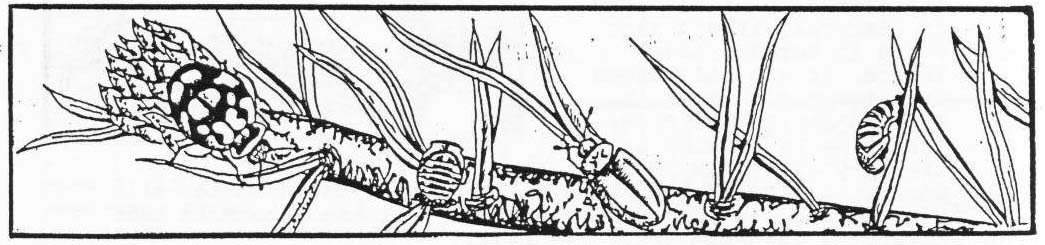
Acknowledgements: The illustrations were taken from the newsletter of the Cambridge Ladybird Survey, to whom gratitude is due.
{rokbox align=|left| album=|ladybirdmaps|}images/stories/newsletters/1991_07/ladybird/*{/rokbox}