Llanelli Naturalists Newsletter - May 2002 - No 68
Ian Morgan
Amongst local birdwatchers, there has been some recent debate about the status of Green Woodpecker in the county, as it apparently becomes increasingly scarce in north-west Carmarthenshire. It favours a mixture of mature timber (copses and scattered trees) interspersed with rough (often dryish) pasture/grassland with meadow ant mound nests – ant pupae are a favoured food. Old coal mining landscapes are liked by this species and Green Woodpeckers were heard calling at Nant Arw, (nr. Cwm Fferws, Saron) and at Cynheidre (on the old colliery site) in mid-April.
A pair of Goosanders, seen in April at Pont Ceidrych near Cwm Isfael in the Gwendraeth Fach valley, with the female investigating holes amongst large boulders, were very likely a breeding pair and represented a significant range expansion for this fish-eating duck.
The Machynys Peninsula, located adjacent to WWT Penclacwydd and the Burry Inlet, and with its copious supply of new water bodies, continues to attract birds. The ‘main golf course pond’ (I’m sure that a better name will evolve for this!), had 8 White Wagtails on passage on 15/4, whilst Greylag Geese, Gadwall, Tufted Duck and Pochard all subsequently bred at this site or Machynys Pond just to the west. Indeed, at Machynys Pond on 29/5 there were 4 pairs of Greylags, with 10, 6, 2 and 8 young respectively (total 24 young). Only 1 pair actually bred on this pond; the rest moved in (the young were by this stage, capable of flight). At least 4 pairs of Lapwing bred in the Machynys Peninsula around the various ponds or shallow floodings. For example, the extensive flooded depression south of Machynys Pond had 2 breeding pairs of Lapwing and also a pair of Ringed Plover and an extremely agitated pair of Redshanks, which subjected me to frenzied mobbing – obviously young birds nearby.
Other Machynys Peninsula breeding records include, at the main golf course pond: a pair of Shelduck with 9 ducklings, 4 pairs of Tufted Duck, 4 pairs of Pochard and a pair of Mute Swans (with 6 cygnets). The other pond just to the north had a pair of Common Sandpipers, 2 pairs of Shelduck and a pair of Ringed Plover (all 26/5) whilst Penrhyngwyn Pond (on 20/6) had a pair of Pochard with 4+ young. A pair of Gadwall at the main golf course pond were accompanied by 10 ducklings on 23 July. All in all, this pond complex is developing into an important aggregation of wetland habitat, which should become better for wildfowl as marginal vegetation establishes itself, though waders will decline as the bare ground diminishes. A pair of Oystercatchers at the Penrhyngwyn shingle spit on 29 May were very reluctant to fly and kept returning to the same general area – suggesting that they were possibly breeding. At least 3 pairs of Ringed Plovers nested on the man-made Machynys beaches (which have also provided some nice mini sand dune habitat). These beaches and the associated groynes (good wader roost sites) have been a positive enhancement to the north shore of the Burry Inlet. Several pairs of territorial Meadow Pipits were also to be seen at Machynys during the breeding season.
Jon Baker made an important discovery whilst moth-trapping in Pembrey Forest, hearing ‘churring’ Nightjars on 28 May and almost running over one at a later date. Local birders had suspected that this crepuscular species occurred in the Forest – after all, the habitat looks ideal and even better than the inland and upland forests of north and north-east Carmarthenshire that this species is known to have re-colonized in the last decade or so. Forest Enterprise staff report that ‘of 6 territories in Glasfynydd Forest (extending into north-east Carmarthenshire) at least 1 pair is in the Carmarthenshire section’, and Mike Shrubb also located another Nightjar territory in the Carmarthenshire section of Crychan Forest.
Two Cetti’s Warblers singing near Panteg (SN419047) on the Kidwelly flats (21/5, D N Lewis) may represent a new ‘sub-site’ for the Lower Gwendraeth population of this resident warbler. Julian Friese and Tony Forster surveyed the birds of Dinefwr Park and Castle Woods, Llandeilo and they showed that this site is, seemingly, by far the most important locality for breeding Stock Doves in Carmarthenshire, with some 21 singing males/pairs counted in 2001. Obviously, the hole-rich ancient oaks are favourable for this scarce dove.
In the northern part of Machynys, Neville’s Dock (horribly re-named as ‘Delta Lake’!) had 3 singing Reed Warblers in small patches of tall reeds at the sides of the dock (right at its SE end) and, similarly, expanding patches of reed at Sandy Water Park has allowed this species to newly colonise this site, which also had a solitary Great Crested Grebe present on 5/7. Earlier (on 13/6), a pair of the latter species had 3 young at the Upper Lliedi Reservoir. Kingfishers were regularly seen at the top end of the lower reservoir – do they breed here?
Wandering Kites provided excitement, with one near Kidwelly on 3/6, at Penymynydd, Trimsaran, 24/6 (both R N Stringer) and over Bynea on 19/6 (Jeff Davies). There were breeding Grey Wagtails on the Afon Dulais in Stradey Woods in early July; a male Ring Ouzel at the Foel Fawr quarries on Mynydd Du (SN733187) on 3/7; 8 Crossbills at Cwm y Rhaiadr plantation near Cilycwm (again 3/7) and breeding Redpolls in birch scrub at Mynydd Mawr, Tumble on 24/7. I V Evans made two good gull records from the outlet of the Lliedi (south of North Dock), where gulls often congregate for roosting etc. On 24 July he recorded a Mediterranean Gull and, 3 days later, a Yellow-legged Gull (the distinctive Herring Gull of the Mediterranean) was also present; records of both these species have increased over recent years.
An adult and 2 juvenile Peregrines flying noisily over the Ashpits Pond on 27/7 were probably locally-bred birds, whilst 12 Little Egrets decorated Glynea Pond, Bynea on the evening of 31/7. Julian Friese reports two summer sightings of Hobbies in the mid-Tywi Valley which suggests possible breeding. There was a glut of Kingfisher records in the early autumn, with birds at Neville’s Dock, Llanelli; Burry Port (inner harbour); nr. Pwll cricket ground and on the Afon Taf nr. Llanddowror. Another was near Pont Bacas, Bynea in early December. Dispersing Kingfishers – a party of 3 – were at Cydweli on 1 September and another 3 a few days earlier at the confluence of the Gwili and Tywi (SN432205).
The best autumn record was that of a juvenile White-winged Black Tern, found by Gary Harper at Sandy Water Park on 16/10 – details are given in the last Newsletter. An influx of wind-blown Grey Phalaropes was a feature from 1 October when Gary Harper found 2 birds at Llanelli Beach, with a maximum of 7 present on 4 October and subsequent dates. Julian Friese also had one on the Tywi at Dryslwyn on 9 October. These birds, which breed in the High Arctic, winter on the Atlantic off Africa but strong gales can intercept them en route, and because they rarely encounter humans, wind-blown birds can be extremely tame and allow very close approaches.
Droppings of Red Grouse ‘above Clogau Mawr’ demonstrate that this species is hanging on despite the paucity of heather on Mynydd Du, (G S Motley and S D S Bosanquet, ‘early October’). Black-tailed Godwits (18 birds) and a Green Sandpiper at Kidwelly Quay on 18 October were a nice find; whilst Woodcock were flushed north of Glynhir, Ponthenri and in Stradey Woods in December. A Green Sandpiper was present on the saltings near Llangennech Station on Boxing Day (R D Pryce & K A Cottingham) and was again seen in the same locality two days later.
Interesting late winter records were 5 Goosanders on the upper part of the Loughor Estuary (14/12, Rob Howells) and a ‘ringtail’ Hen Harrier near Wharley Point, Llansteffan on 17/12 (D N Lewis). Wintering Blackcaps were noted at Glenalla Road, Llanelli, 23/12 (showing that they penetrate quite urban areas), and another at Abergwili on 31/12; both birds were males. A very aggressive male was a regular visitor to the feeders in the garden of 57 Station Road, Llangennech between 10/12 and mid January (RDP & KAC).
WWT, Penclacwydd
As is now usual in these ‘Bird Notes’, WWT Penclacwydd dominates the review and some of the highlights (kindly provided by Nigel Williams and Wendell Thomas) are given below in chronological order:
April 2001 A Cetti’s Warbler took up residence on the Eastern Scrapes and a record 450 Sand Martins passed over the ‘Millennium Wetland’ on 24/4, whilst 3 Barn Owls remained throughout the month. Many summer visitors had their first records during April.
May 2001 As evidence of the continuing scarcity of the Cuckoo, the individual present on 11-19th was the first since 1997; until the early 1980’s Cuckoos were regularly heard on the ‘Llanelli Levels’ between Bynea and Machynys. In contrast, positive news was provided by the 3 Cetti’s Warblers holding territory on the Millennium Wetland, where the maturing habitat is obviously to their liking. Five Lesser Whitethroats also held territories. A Bittern was seen briefly (5th) and a Red Kite flew over (25th); up to 3 Garganey were sighted (6th onwards), whilst a spring-time drake Smew on 26th was most unusual.
June 2002 An adult Spoonbill was present on the Marsh Scrapes (10th to 18th) along with a drake Garganey (14th to 18th). Last month’s record numbers of Sedge and Reed Warblers increased further to 48 and 32 respectively, and a second summer and 3 adult Mediterranean Gulls mixed company with up to 634 Black-headed Gulls throughout.
July 2001 A Red Kite was seen on several dates. Less obliging were a drake Garganey (9th), Mediterranean Gull (10th), Common Tern (22nd), Sandwich Tern (22nd), Arctic Tern (23rd) and a very early Hen Harrier (22nd). Up to 35 Little Egrets were sighted daily and included 2 juvenile birds which appeared late in the month. Peak counts included 41 Cormorants, 11 Grey Herons, 7 Mute Swans, 24 Greylag Geese, 12 Shovelers, 8 Canada Geese, 920 Oystercatchers, 1270 Curlews, 406 Redshanks, 31 Whimbrel, 20 Greenshanks, 14 Black-tailed Godwits, 35 Dunlin, Common Sandpipers, Ruff, Turnstone, and Curlew Sandpiper (from 30th).
August 2001 A White Stork seen briefly flying overhead (28th) was the first record for the Centre and a Great White Egret frequented the Marsh Scrapes (15th). Little Egret numbers increased steadily to a new Welsh record (75 throughout the month). A female/immature Garganey was too elusive for some (5th to 10th) as was a Little Stint (9th). Other highlights included a Green Sandpiper (from 10th), Little Ringed Plover and 8 Curlew Sandpipers.
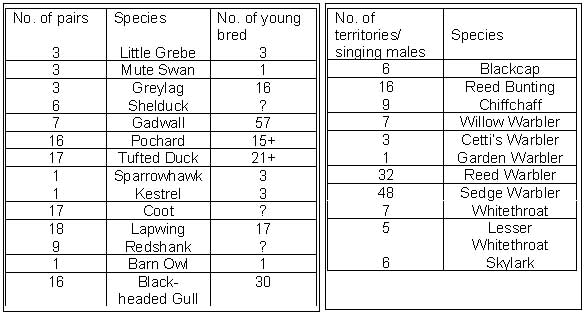
September 2001 A Welsh record of 217 Little Egrets came in to roost in the European Pen throughout. A female Ruddy Duck was in the Millennium Wetland (29th and 30th). Four Black Terns were on the estuary (30th) along with a Common Scoter. A Redpoll flew over (11th) and the last Wheatear was along the sea wall (15th). Two Jays were frequently seen around the maturing woodland at the ‘discovery area’ and Millennium Wetland.
October 2001 A female Mandarin arrived (12th) and remained throughout the winter. Up to 51 Little Egrets were present throughout. A Black Tern and a Grey Phalarope were on the estuary (5th), whilst a Little Stint was seen briefly (2nd and 5th), as was a Woodcock (22nd). A Short-eared Owl appeared (16th); other raptor highlights included 2 Peregrine, Merlin, 2 Barn Owls, 3 Sparrowhawk, 2 Buzzard and 4 Kestrel.
November 2001 Up to 148 Little Egrets (5th) came in to roost through the month. A family of Whooper Swans arrived (1st). A Slavonian Grebe was on the estuary (19th); a Hen Harrier showed briefly (20th), 3 Short-eared Owls were seen frequently as well as 2 Barn Owls and a Tawny Owls. Some 150 Woodpigeons flew over (16th).
December 2001 A ‘redhead’ (i.e. female) Smew took up residence (from 7th) and a White-fronted Goose was seen on several dates usually amongst the Greylag flock (from 17th). A Centre record 10 Goldeneye were on the estuary along with a female Scaup (from 18th). Brambling appeared with an influx of Chaffinches (11th) and a ringtail Hen Harrier arrived with the cold snap. At least 14 Water Rails were heard around the reserve mostly in the Millennium Wetland. Up to 62 Little Egrets occasionally came in to roost.
January 2002 Highlights included a Great Northern Diver offshore and a Centre record of 16 Water Rails, whilst peak counts included 346 Brent Geese, 446 Wigeon, 41 Gadwall, 759 Pintail, 143 Shoveler and 5 Spotted Redshanks. Three Short-eared Owls were present.
February 2002 Four Scaup were present and the Smew remained. An adult Glaucous Gull was noted from the 1st – 28th February and a 1st winter Mediterranean Gull was seen on the 17th. Three Short-eared Owls, 2 Ruff and a Hen Harrier were other interesting records, as were up to 350 Brent Geese on the Estuary. A Red Kite was present from 26th (it stayed until March).
March 2002 Only 1 Scaup (a male) remained, but a Spoonbill was present for much of March. The first of the migrants was a Garganey on 12th, whilst Chiff Chaff and Sand Martin arrived on the 17th and House Martin, Willow Warbler and Swallow announced the advent of Spring on 25th March.
