 Llanelli Naturalists Newsletter - Winter 1992/1993
Dillwyn Roberts
It was not until 1802, that Col. George Montagu, working in Devon, finally clarified the characters for recognition which had confused the respective identification of the hen harrier Circus cyaneus and Circus pygarqus, to which he give his name. However some confusion continued to occur (and still does), as a pair of hen harriers reported to have summered in 1865, near Newcastle Emlyn in Carmarthenshire, were almost certainly Montagu's. Other nineteenth century Montagu's records were one or two seen near Cydweli/Kidwelly), and a first year male "shot by the Elkington's keeper near Pembrey in June 1880, and stuffed by Jeffreys", the Carmarthen taxidermist, who appears to have been busily engaged during this period. The following extract from the Rev. Murray Mathew's "Birds of Pembrokeshire and its Islands" (1894) typifies the contemporaneous short strife meted out to rare and scarce birds:-
"Montagu's harrier - A summer visitor; rare. The late Mr Fortune found a nest of this Harrier close to his residence at Leweston, July 2, 1854, containing an egg and three young birds in down. He succeeded in obtaining the two old birds and mounted them with the young, and the case is now to be seen in the Museum at Tenby, and is a beautiful example of his skill in taxidermy. The egg was presented to the collection of the Rev. C.M. Phelps."
Montague harriers may never have been numerous in Britain and decreased through deliberate persecution in the nineteenth century, as well as suffering from loss of habitat as heathland and marshes were taken into cultivation. Among the three or four pairs which managed to retain a precarious toe-hold in England and Wales was a pair which nested on the Cardiganshire side of Llyn-y-gwaith in 1904, on Carmarthenshire's northern boundary.
Numbers increased in England and Wales to about 15-25 pairs in the 1930's and to about 40-50, possibly 70-80 in the mid 1950's since when there was a continual decline up the the late 1970's. Although it had been reported that ths species had bred in the county and pairs had been seen in more than one area, Ingram and Salmon (1954) concluded that this could not be verified. They quote only three occurrences, a female near the Witchett Pool, 10 June 1938; a pair near Llanfynydd in August 1947 and a male near Capel Ifan, 20 April 1951.
An adult female, thought to be this species was seen near Penbre (Pembrey); 7 May, 1960. Although no nest was found, in 1966, a pair on Pembrey Burrows was watched on several occasions and were seen to carry food. In the following year, a pair was seen near Penbre, 13 May; a male flying over Pembrey Forest near Tywyn Point, 2 June, and a male crossing the River Taf towards Laugharne, 17 August. In 1968, a nesting was suspected on Wharley Point, a male seen 19 April, a pair on 28 May, the female carrying food or nesting material and driving away a herring gull, the male soaring in the same yicinity on 28 and 29 June, but no sign of the female.
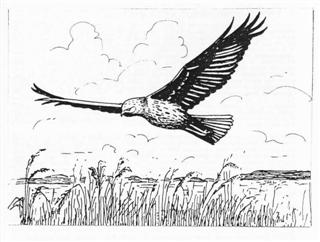
In 1969, there were no coastal records but a pair summered and may have nested on Mynydd Llanfighangel Rhos-y-Corn with several sightings near Gwernogle, Llanllwni and Mynydd Llanybydder. On 1st September, an adult male was seen at Bishop's Pond, Abergwili. This slim harrier, narrow-winged with outer wing very long-tipped, the adult male having narrow dark wing-bars, was last seen in the county, at a mire near Llangynog in early June, 1971 and probably near Pont-Tweli, 7 June, 1972. In most years, one or two passage birds are seen in Wales and one even over-wintered on Skomer Island in 1988/89. During the last decade, the general breeding trend in southern England has been encouragingly upwards, with seven pairs confirmed breeding in 1989 with possibly another eight pairs.
Footnote: Readers might be interested to know that, in 1802, George Montagu found another harrier - the marsh Circus aeruginosus "the most common of the falcon tribe about the sandy flats on the coast of Carmarthenshire" - a reflection perhaps of the comparative abundance of reed-beds and extensive rough, open ground for hunting that once-existed in the lower Gwendraeth valley area.